Meta's second quarter settled the question of whether AI improves advertising. Ad impressions rose 14% and average price per ad rose 12%, a mix that points to better matching rather than heavier ad load. The improvement stopped short of the bottom line. Family of Apps revenue grew 28% while that segment's operating income fell 6%. Shares finished after-hours trading down nearly 10%.
Where the profit went
Wall Street looked for $7.19 a share on $60.22 billion of revenue, according to FactSet. Revenue came in at $60.80 billion. Earnings came in at $6.18.
The gap has a clear explanation. Meta booked $2.40 billion of legal charges and $1.18 billion of severance tied to the May headcount cut. Susan Li said operating income would have risen 9% without them, and the release supports her math. Adding both charges back lifts operating income to $22.4 billion against $20.4 billion a year ago. On that basis earnings land near $7.35, above consensus.
The reported miss was therefore a poor account of what moved the stock.
The recurring cost lines carry more weight. Research and development rose 67% to $21.7 billion. That line now takes 36% of revenue, against 27% a year ago. Depreciation and amortization rose 46% to $6.4 billion. Share-based compensation rose 58% to $7.7 billion. None of those reverse next quarter.
The tax line added pressure few models carried. Meta's effective rate rose to 16% from 11%. The provision grew 32% while pretax income fell 9%. Guidance puts the rate at 15% to 17% for the rest of the year, up from a prior 13% to 16%.
Interest costs have started to show as well. Other income and expense swung to negative $19 million in the quarter from positive $93 million. Across six months the swing is wider, from positive $919 million to negative $1.14 billion.
The ad system earned its keep
The strongest part of the case is that the advertising evidence is specific.
Meta put a generative model into ad retrieval this quarter. Li said that work, combined with the GEM ranking model and sequence learning, lifted ad clicks 8.3% and conversions 15.7% on Facebook. Early pilots using models to read user preferences raised app event conversions on Instagram by 1%.
Advantage+ now runs above $75 billion in annual revenue run rate. Nine million small businesses use at least one AI creative tool. Family of Apps other revenue crossed $1 billion for the first time and grew 73%, driven by WhatsApp paid messaging and subscriptions.
Those figures support the claim that AI is lifting the value of an auction Meta already owns. Nothing else in the portfolio yet carries a disclosed price. Business agents reached more than one million weekly business users with no revenue attached. The Muse Spark API launched with no revenue attached. Personal agents have not shipped. Compute sales exist as inbound offers, without signed contracts.
Brian Nowak of Morgan Stanley asked which of those lines would scale first and show quantifiable return on capital. Zuckerberg said he was optimistic about growth in all of them. No figure followed.
What the BlackRock deal actually transfers
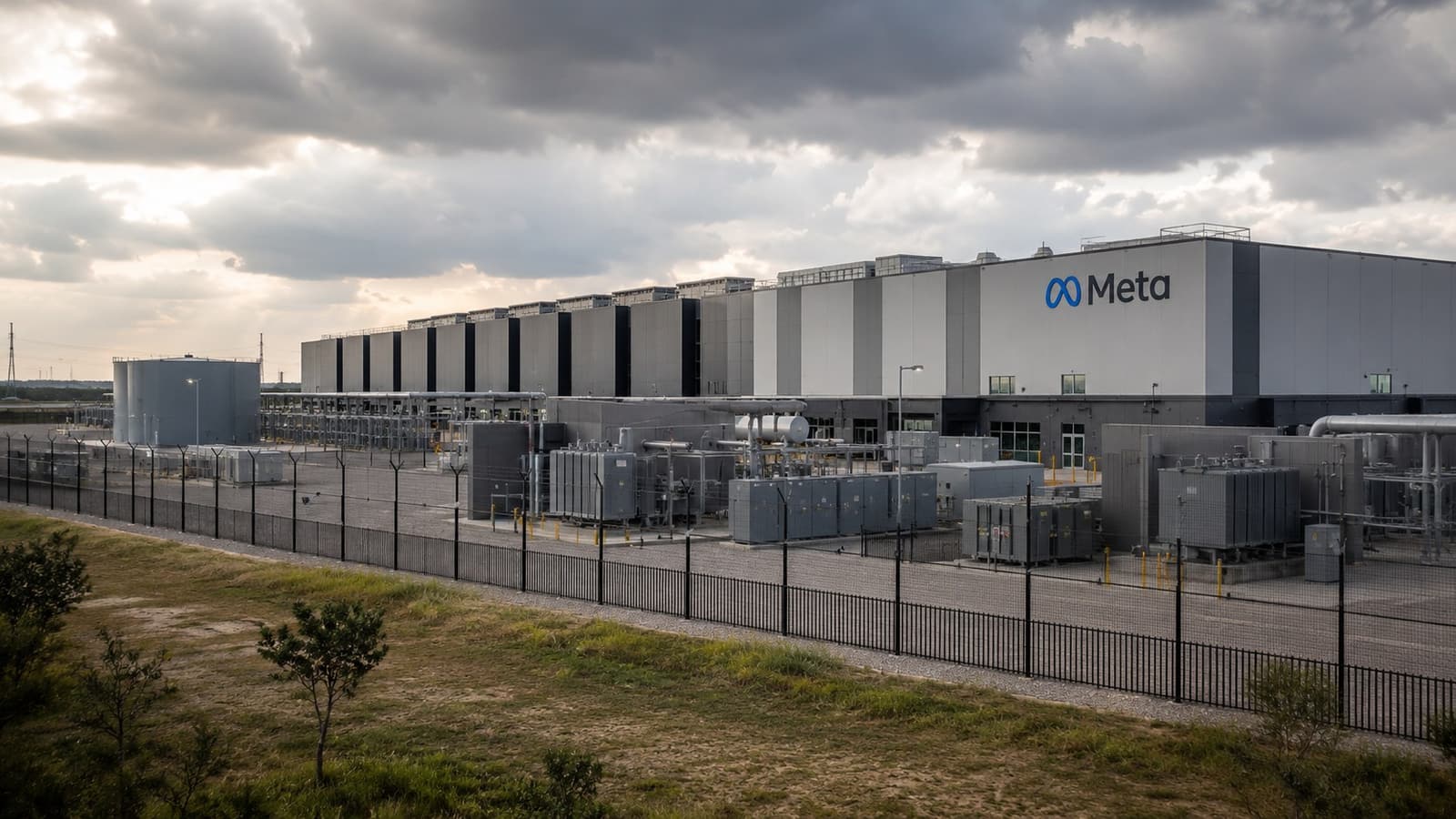
The El Paso venture is the clearest window into how Meta is funding this build.
BlackRock funds take 80% of a campus carrying roughly $14 billion of development cost. Meta keeps 20%, contributes land and construction assets worth about $2.3 billion, and receives a one-time distribution near $1 billion. BlackRock puts in about $4.9 billion of cash, part of it funded by $12.5 billion of project debt. The campus delivers one gigawatt starting in 2028.
Ownership moved. Exposure largely stayed in place.
Meta leases the entire campus and will be its sole initial occupant. The lease runs four years with four extension options, reaching a potential 20-year term. Meta also provides residual value guarantees with an aggregate threshold near $13 billion that declines over time. If certain conditions are met within the first 16 years, Meta covers the shortfall between fair value and that threshold.
On a $14 billion campus, Meta holds a fifth of the equity and backstops close to the whole asset value. Lenders and BlackRock's investors are underwriting Meta's credit and its tenancy. The structure improves reported capital efficiency. It does not shift obsolescence risk.
What the guidance withheld
Third-quarter revenue guidance of $61 billion to $64 billion carries a midpoint below the $63.14 billion consensus. Currency accounts for about a point of headwind. The midpoint implies a step down from 28% growth.
Capital spending guidance moved again. The 2026 range narrowed to $130 billion to $145 billion from $125 billion to $145 billion. The floor has risen twice this year while the ceiling has held. A rising floor signals that more of the program is now locked in.
For 2027, Li gave no figure. Nowak asked directly. Her answer was that planning remains dynamic, and that Meta is focused on maximizing 2026 and 2027 capacity while keeping flexibility for 2028.
The stock reaction followed that sequence. Shares fell about 4% in the minutes after the release. The decline reached roughly 9.6% by the end of after-hours trading, closing near $529 against a $585.61 regular-session close. Options had priced a 7.8% move. The realized move ran past it, and the damage arrived during the call, after the numbers had already been read.
The burden of proof
The balance sheet now carries the argument.
Long-term debt reached $83.7 billion from $58.7 billion at year end, funded by a $24.9 billion issuance. Cash and securities stand at $90.3 billion. Net cash has fallen to about $6.6 billion from roughly $22.8 billion in six months. Buybacks stopped completely, against more than $10 billion in the same quarter last year. Dividends held at $1.35 billion.
Capital spending of $31.1 billion consumed about 98% of operating cash flow. Free cash flow fell 91% to $784 million. The six-month picture is less severe, at $13.2 billion against $18.9 billion, which places the inflection squarely in this quarter.
Zuckerberg closed the call by describing the spending as a personal bet, saying those who invest in this will be rewarded over time. The framing is honest about what is being asked of shareholders.
Meta has shown that its models raise the value of an auction it already controls. The company has yet to show that agents, APIs and compute sales can carry a cost base that grew 55% and a lease book that keeps growing. Until one of those lines carries a disclosed price, advertising funds the entire program by itself.