

In January 2021, a Reddit forum forced Melvin Capital into a $6 billion hole and made Robinhood freeze the buy button. Five years later, that same platform gets to sit inside the index every 401(k) in America is forced to buy. If you think that is a redemption arc, you are reading the wrong story. It is a treaty.
But before we get to that, let's take a quick look on the markets and what matters today…
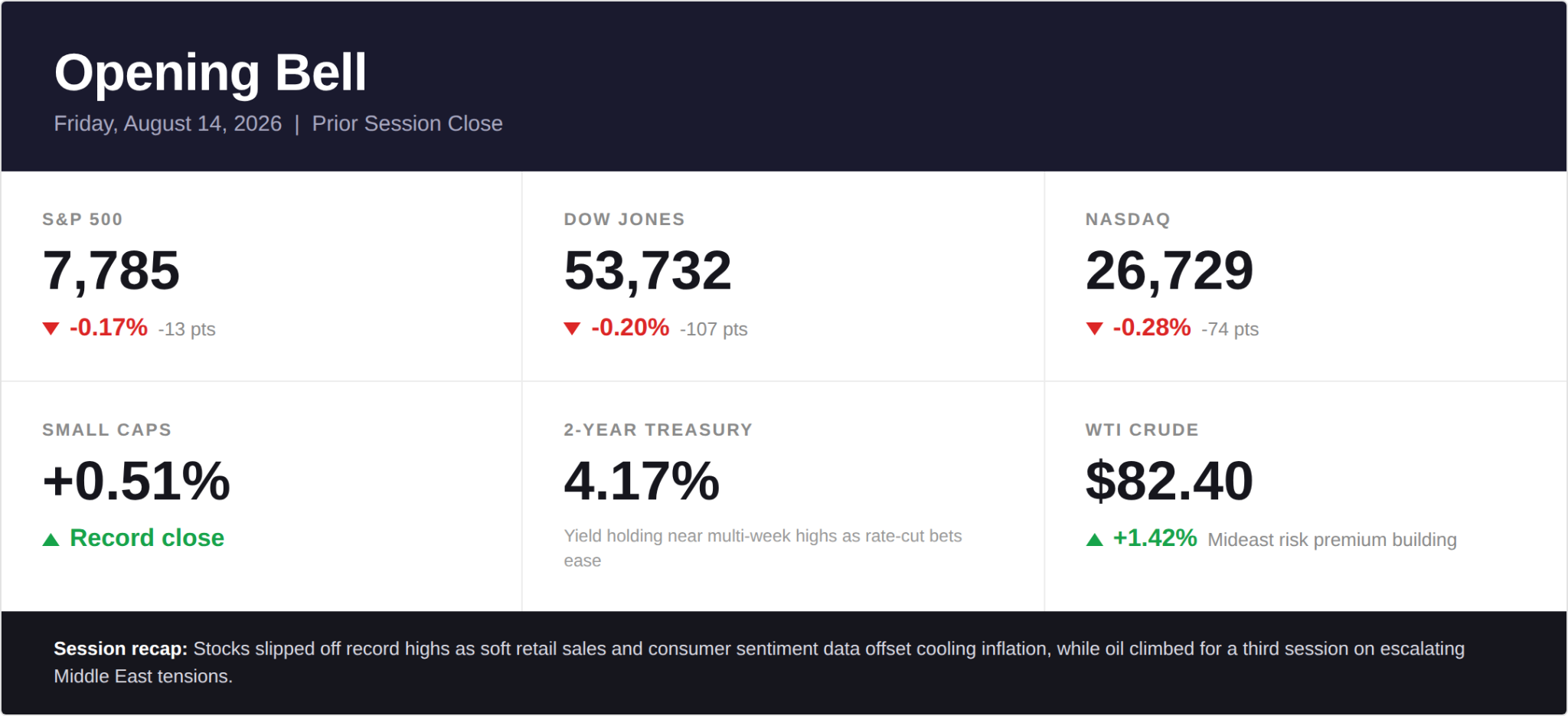
3 Movers in 3 Minutes
- Retail sales cracked. July retail sales fell 0.6% against expectations of a 0.2% rise, the worst downside surprise in years. Michigan consumer sentiment slipped the same morning. The Fed's "hold, and see" posture depends on a consumer that keeps spending. Friday said maybe not.
- SanDisk's investor day rewrote the memory story. SanDisk (SNDK) climbed 7% Friday on top of a 13% jump Thursday, after guiding to 80% non-GAAP gross margins by 2028 and multi-year fixed-price contracts with eight hyperscalers worth roughly $9 billion. The stock is up 580% year to date. What used to be a cyclical commodity is being repriced as a subscription.
- Oil is edging toward the ceasefire cliff. Brent traded near $89 into Sunday night as Israel struck southern Lebanon and Washington signalled new sanctions on Iran, with the current ceasefire formally expiring today. WTI closed Friday at $82. The market is not pricing conflict. It is pricing the option on conflict.
3 Signals for Today
NAHB Housing Market Index at 10:00 AM ET. Homebuilder sentiment against a 10-year Treasury at 4.6%. The disconnect between Fed rate-path pricing and the mortgage market has become impossible to ignore.
Home Depot (HD) reports tomorrow. The first read on the consumer that just missed on retail sales by nearly a full percentage point. What HD guides for the second half tells you whether Friday's number was a wobble or a signal.
Jackson Hole is 11 days away. Fed Chair Kevin Warsh delivers his first symposium keynote August 28. Nvidia (NVDA) reports the evening of August 26. The market's biggest earnings event and its biggest Fed event land 36 hours apart. Position accordingly.
Mode Mobile won't be under-the-radar much longer.
The price on pre-IPO shares goes up soon — and over 60,000 investors have already put in more than $100 million, including Shark Tank's Kevin Harrington.
Mode is still private — but the Nasdaq ticker $MODE is already secured. And this price change could signal a public listing is getting closer.
The traction is already there:
- 490M+ users
- $115M+ lifetime revenue
- $1B+ earned and saved by users
- 170+ countries served
- Deloitte's #1 fastest-growing software company in North America — 32,481% growth
Uber turned cars into taxis. Airbnb turned homes into hotels. Mode is turning everyday phone use into something that pays you back.
This isn't early-stage hype. It's about timing.
And with that out of the way, let's get to today's big story…
The Sip
The Establishment Just Made Its Peace With the Mob
Every great empire has a moment where it stops trying to defeat the barbarians and starts paying them a salary instead.
Rome did it. The British Empire did it. Wall Street just did it too.
Tomorrow morning, before markets open, Reddit (RDDT) will join the S&P 500, replacing AvalonBay Communities. The stock jumped over 10% Thursday on the announcement, and every index fund on the planet is now required to buy a slice of a company whose flagship community, r/wallstreetbets, once cornered short sellers so hard that Melvin Capital took a $6 billion loss in a single month and Robinhood had to freeze the buy button to protect its clearing house.
That happened in January 2021. Five years and seven months later, the platform that hosted that revolt is officially part of the establishment it revolted against.
The war that never happened
You have to remember what the consensus was in 2021 to appreciate how strange this moment is.
Congress held hearings. The SEC opened investigations. Half the financial press wrote long essays about the death of price discovery. Trading platforms froze retail buying. There was a serious argument, made by serious people, that Reddit was a threat to the functioning of American capital markets.
The premise was that a coordinated forum full of retail traders was fundamentally illegitimate, a bubble to be quarantined and eventually starved.
That did not happen. What happened instead is that Reddit went public in March 2024 at $34 a share, and by July 2026 was reporting $805 million in quarterly revenue, up 61% year-over-year, with a net margin of 31% and free cash flow of $261 million in a single quarter. Eight straight quarters of over 60% revenue growth. Adjusted EBITDA margins pushing 43%. A trailing twelve-month operating cash flow that just crossed $1 billion.
The forum that was going to be quarantined is now more profitable per employee than most banks.
Who actually needed whom
Here is the reframe.
The story the establishment told itself about GameStop was that a chaotic mob had briefly overwhelmed the professionals. The story the professionals never quite absorbed is that the mob was sitting on something the professionals desperately needed.
Reddit's second-largest revenue lever is not advertising. It is data licensing. And Reddit's two biggest data-licensing partners are OpenAI and Google (GOOG), both of whom need Reddit's twenty years of human-written conversation to train the models that increasingly power the workflows of every Wall Street desk that once wanted the forum banned.
The consulting firm memo you got last week about AI adoption? Trained partly on r/investing arguments. The equity research assistant your firm just rolled out? Trained partly on the same r/wallstreetbets Wall Street once tried to muzzle.
Reddit did not join the establishment. The establishment finally figured out it had been paying Reddit rent all along, and decided to formalise the arrangement.
The GameStop squeeze taught Wall Street a lesson everyone got wrong. The lesson was not that retail traders could sometimes coordinate. The lesson was that a bunch of anonymous strangers on a website had generated the single most valuable corpus of financial conversation ever assembled, and no one on Wall Street owned any of it. That is a much harder problem than a short squeeze. You can hedge a squeeze. You cannot hedge the fact that the last twenty years of every unfiltered opinion about every stock, ETF and macro theme lives on a website you do not control and have to pay a licence fee to read at scale.
World's Largest Investors Are Moving Their Money (Not Into AI)

While the media distracts you with stories about the next big AI IPO... The world's largest investors are moving their money into one asset – at the fastest pace in a generation. This asset has crushed the S&P 500's return over the past 12 months… More than TRIPLED the S&P 500's return in 2025… and has outperformed the S&P 500 over the past 25 years by more than 1,100 percentage points. According to one Wall Street veteran, with over 40 years of professional investing experience… the biggest gains could be still ahead. That's why he's urging you to make one money move now.
This ad is sent on behalf of Stansberry Research, 1125 N Charles St, Baltimore, MD 21201. If you would like to optout from receiving offers from Stansberry Research please click here.
What tomorrow actually signals
The mechanics of index inclusion look boring. AvalonBay merges with Equity Residential. A slot opens. Reddit fills it. Passive funds tracking the S&P 500 reweight. Life continues.
But look at what got swapped.
AvalonBay was an apartment REIT, $22 billion of physical inventory in the ground, one of the oldest kinds of institutional asset the market knows how to price. Reddit is a website where strangers argue. Housing inventory out. Conversation inventory in.
That is not a footnote. That is the shape of the market's next twenty years, delivered as a routine index announcement on a summer Thursday.
The Russell 2000 hit its fourth straight all-time high the same afternoon. Small caps are ripping. Retail is dominant. And starting tomorrow, the platform where most of that retail conversation happens is a compulsory holding for every pension fund and target-date fund in the country.
Stephens' data says newly-added S&P 500 names tend to underperform the index by about 2% in the three months after inclusion. That is a fine trading observation. It is also entirely beside the point.
The point is not what happens to RDDT the stock in the next 90 days. The point is that the definition of what belongs in the index of American capitalism just quietly widened to include the platform that five years ago was described, in the same rooms that make these decisions, as a threat to market integrity.
Wall Street did not defeat the mob. It made the mob a compulsory allocation.
He predicted the 2008 financial crisis…
He predicted Trump’s election in 2016….
He even predicted the rise of COVID-19 writing:
“The chance we don’t have something on the scale of a national pandemic in the next few years is near zero”
That was three months before the first reported case.
If he’s right again, God Bless America…
Because this crisis will be tectonic in scale…and it's going to begin with the bubble popping in AI.
The MarketSipsTakeaway
Every conversation about "retail investors" for the last five years has treated them as a temporary phenomenon: a pandemic-era anomaly that would fade with normal life. Tomorrow's index reshuffle is the market officially conceding the opposite. The retail investor is not a phase. The platform where retail investors argue is not a fad. It is now infrastructure, priced as such, and owned by every diversified portfolio in America whether the owner knows it or not.
The next time someone tells you a market move is being "driven by retail," remember that the venue where that retail talks is now inside the very benchmark those flows are supposedly disrupting. There is no outside anymore.
Today's reply prompt: What other "fringe" venue do you think ends up in the S&P 500 within the decade?
Until then, sip slowly!
The Market Sip Desk
Tickers: UI MS SNDK GAAP WTI NAHB ET HD NVDA MODE RDDT GOOG MD REIT COVID