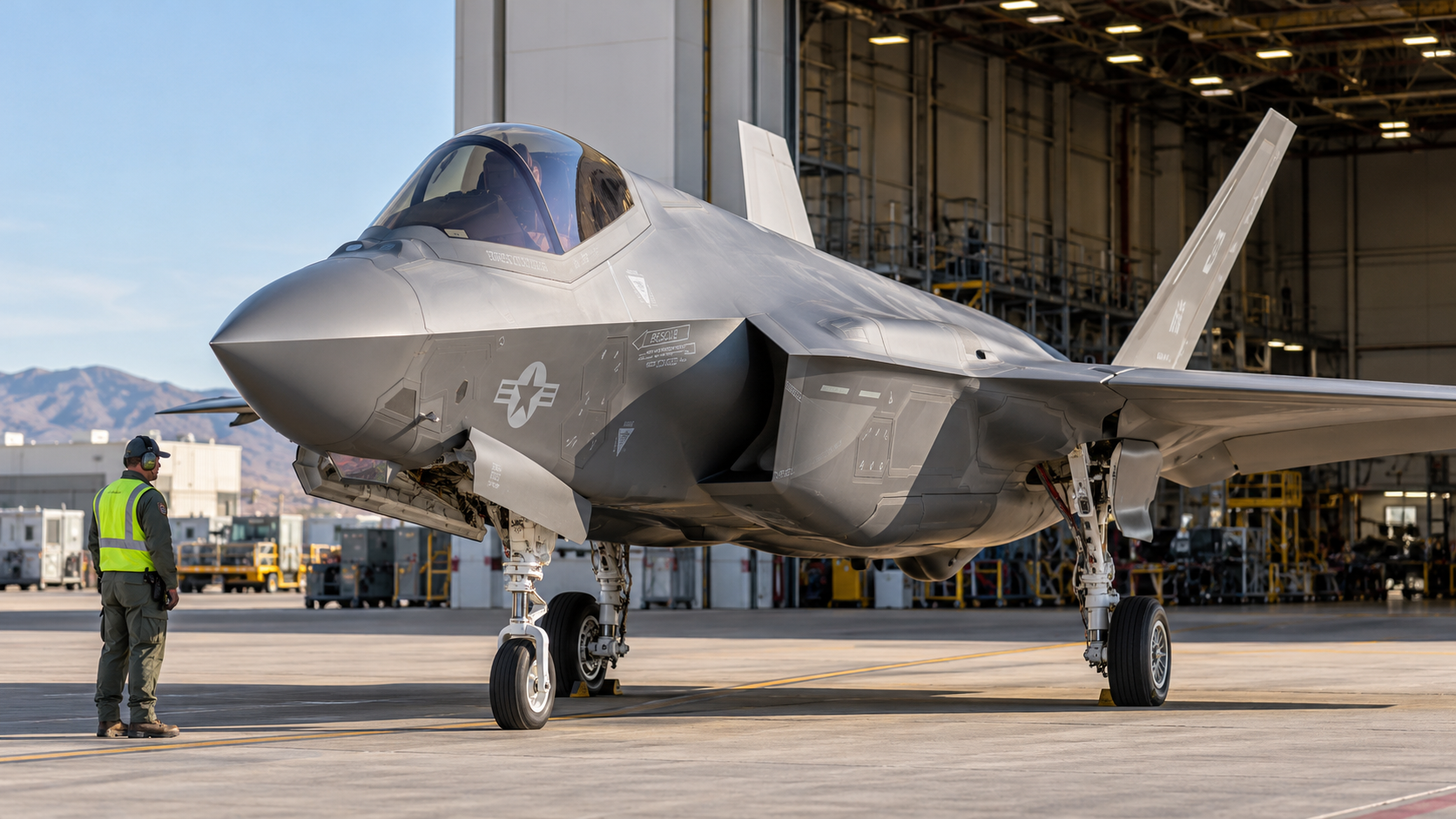
Lockheed Martin beat estimates, lifted its 2026 outlook and unveiled a framework for 850 more F-35s. The framework is not a contract, and the jet's next production lots are still under negotiation.
Lockheed Martin gave investors a beat, a raise and a fighter-jet framework on Thursday. The shares rose, but they gave back about half of their early gain.
Third-quarter sales rose 11% to $20.71 billion, above the $20.46 billion analysts expected. Net earnings were $1.8 billion, or $7.97 a share, up from $6.95 a year earlier and ahead of the $7.52 consensus. Backlog reached a record $292 billion, including $52.5 billion from a multiyear award for the PAC-3 MSE interceptor.
The company raised its 2026 outlook. It now expects sales of about $80 billion to $82 billion, up from $79.75 billion to $81.75 billion; earnings per share of $30.35 to $30.75, up from $29.95 to $30.65; and free cash flow of $7.8 billion to $8.0 billion, up from $7.0 billion to $7.2 billion. It also raised its dividend for a 24th straight year.
Shares were at $582.79 at 1:46 p.m. Eastern, up 5.7%, after touching $607.88, a gain of about 10%, earlier in the session. Northrop Grumman rose 2.3%, General Dynamics 0.7% and RTX 0.1%.
Cash already in hand
The full-year cash forecast rose by $800 million at the midpoint, the biggest change in the outlook in percentage terms. Free cash flow in the quarter itself fell to about $3.0 billion from $3.3 billion a year earlier, but the year to date tells the more important story. Lockheed has generated about $5.6 billion of free cash flow through September, after a negative first quarter and about $2.9 billion in the second.
That means the new range of $7.8 billion to $8.0 billion implies only $2.2 billion to $2.4 billion in the fourth quarter, less than in either of the past two quarters. The raise reflects cash already collected rather than a bet on a strong finish.
The F-35 framework
Lockheed and the Department of War also announced a framework for multiyear F-35 production and sustainment. It covers 850 aircraft for the U.S. over 10 years, with spares, modification kits and sustainment, plus international orders across Lots 21 to 30, at a rate of 156 aircraft a year.
The framework addresses one of the stock's longest-running worries: uncertainty over future F-35 production. But it is not binding. Final terms, prices and schedules have not been set, and execution depends on Congress granting multiyear authority and appropriations. Lockheed said separately that it remains in negotiations with the U.S. government on contracts for Lots 20 and higher, and that the outcome could affect future results and cash flow.
The debate
The bullish reading is that a record backlog, a higher cash forecast and a path to a decade of F-35 production give Lockheed more visibility than it has had in years. Missile demand, reflected in the PAC-3 award, adds a second growth leg.
The skeptical reading is that the framework is a statement of intent, and the stock's fade from a 10% gain to under 6% suggests some investors want signed contracts first.
What to watch
A definitized contract for F-35 Lot 20 and later, and whether Congress grants multiyear procurement authority. Fourth-quarter cash should land in the implied $2.2 billion to $2.4 billion range; a shortfall there would undercut the raise.