Revenue rose 48% on 60% volume growth, acquired IPR&D took $3.03 out of both earnings measures, and the shares closed up 4.86% after trading 9% higher.
Eli Lilly grew revenue 48% to $23.0 billion, lifted its full-year revenue and margin guidance, and trimmed the top of its earnings per share range by $0.50. The shares opened higher, reached $1,216.94 at the session high, and closed at $1,169.86, up 4.86%. About four points of a nine-point gain came off during the day. Two questions stayed open. The first is what Lilly's earnings power amounts to once deal charges are counted inside the reported number. The second is how long volume can outrun the net price decline the company now says is coming.
The quarter was won on volume
Revenue grew 48% on a 60% increase in volume and a 13% decline in realized prices. Mounjaro reached $9,943 million, up 91%. Zepbound reached $4,928 million, up 46%. The two together came to $14,871 million, which is 64.7% of company revenue on this publication's calculation. Chief Financial Officer Lucas Montarce said the pair contributed $6.3 billion of the growth.
The geographic split has shifted. U.S. revenue rose 33% to $14.4 billion on 37% volume growth. Revenue outside the U.S. rose 80% to $8.6 billion on volume growth of 113%. Mounjaro revenue outside the U.S. now exceeds Mounjaro revenue inside it. Montarce said Europe grew 55% in constant currency, China 93% and the rest of the world 136%. Europe also included a $250 million Jardiance milestone payment tied to the Boehringer Ingelheim collaboration.
Gross margin reached 86.3% on a non-GAAP basis, up 1.3 points, on better cost of production and product mix. Non-GAAP performance margin, which Lilly defines as gross margin less research and marketing costs, came to 54.8%, up 9 points. Research spending grew 14% against 48% revenue growth, and marketing and administrative costs grew 25%.
Lilly's deal costs land in two different places
Four acquisitions closed during the quarter. Two of them, Orna Therapeutics and Ajax Therapeutics, produced $2,776 million of acquired IPR&D charges, against $154 million a year earlier. That equals $3.03 a share, and Lilly states twice in its release that the charge is inside both reported and non-GAAP EPS. It appears in the per-share bridge as a memo line below the non-GAAP total, not as an adjustment.
The other two closings, Centessa Pharmaceuticals and Kelonia Therapeutics, produced $703 million of special charges tied mainly to accelerated vesting of employee equity awards and integration costs. Those charges are excluded from non-GAAP EPS. Two deal-cost buckets from the same quarter receive opposite treatment.
The effect on the growth rate is large. Reported EPS rose 26% to $7.94 and non-GAAP EPS rose 33% to $8.38. Removing the IPR&D charge from both years puts non-GAAP EPS near $11.41 against roughly $6.45, growth of about 77% on this publication's calculation. The 33% figure understates the operating result by a wide margin.
Two further items sit in the same area. The reported $7.94 includes $445 million of gains on equity investments, worth $0.39 a share, which the non-GAAP measure excludes. The effective tax rate jumped to 23.3% from 16.5%, which Lilly attributes primarily to the non-deductible nature of the acquired IPR&D. Reported operating margin therefore fell to 39.1% from 44.1%, because operating income is struck after both deal charges. The movement comes from transaction accounting. The underlying business did not weaken.
One consequence is practical. Published consensus for the quarter sat near $6.10, and the estimates almost certainly do not contain a charge from deals that closed inside the quarter. A percentage beat calculated against that number measures the mismatch rather than the performance.
The deal charges reached the guidance too
Lilly raised the bottom of its revenue range by $3 billion and the top by $2 billion, to $85 billion to $87 billion. Performance margin guidance rose 2 points at both ends, to a range of 49% to 50.5%. Montarce said the earnings guidance rose $2.78 a share at the midpoint before the $3.03 impact of the second-quarter charges.
After that offset, the non-GAAP EPS range became $35.50 to $36.50. The prior range was $35.50 to $37.00. The midpoint fell $0.25 and the top end fell $0.50. Both statements about this guidance are true at once, and reporting the raise without the reduction describes a different company.
The range is also incomplete by design. Footnote three states that guidance does not include acquired IPR&D incurred after June 30. Lilly then discloses that it completed three acquisitions after quarter end to build an infectious disease portfolio, and agreed to acquire AtaiBeckley, which works on treatment-resistant depression. Further charges are therefore already committed and sit outside the range. Chief Scientific Officer Dan Skovronsky told analysts that Lilly has grown more active in business development over several years. Both the pace and the average deal size have gone up. The acquired IPR&D charge of $2,776 million was close to the $3.1 billion Lilly returned in the quarter through dividends and share repurchases.
The second half is guided to slow sharply
First-half revenue was $42,773 million, up 51.2%. The updated full-year range leaves $42,227 million to $44,227 million for the second half, growth of 14.5% to 19.9% against a prior-year base drawn from provider data. Performance margin ran at 52.6% across the first half and 54.8% in the second quarter, against roughly 47% implied for the second half at the guidance midpoint.
Jefferies analyst Akash Tewari put the point directly, asking whether the guide implies deceleration and whether the team was being conservative. Montarce gave four reasons. Prior-period adjustments to rebate and discount estimates, including one in this quarter, are not expected to repeat. The second half of 2025 contained the bulk of Mounjaro's new country launches, which will not recur. Dollar growth remains significant even as percentage growth falls. European third-quarter holidays and fourth-quarter diabetes seasonality are both in the guide.
Lilly International president Patrik Jonsson made a related point about the years ahead. With market leadership already established outside the U.S., he said market expansion rather than new launches will drive growth from here. Full-year tax guidance was left unchanged at 18% to 19%. That sits well below the 23.3% booked in the quarter, and it implies a lower rate over the rest of the year.
The price question Lilly answered directly
U.S. realized price fell 3% as reported. Lilly then discloses that the figure benefited from a change to rebate and discount estimates, and that excluding those adjustments U.S. price fell about 9%. The second number is the underlying one.
Evercore analyst Umer Raffat pressed further. He noted that Zepbound's net price per prescription runs well above the comparable Novo Nordisk product, and asked whether medical exceptions explain the gap. Montarce said CVS access begins in the fourth quarter. He called the medical exception route a short-term feature. The price should go down as a result, he said. He added that the decline is embedded in guidance and that volume growth should more than offset it. Outside the U.S., realized prices fell 36%, driven mainly by adding Mounjaro to China's national reimbursement list.
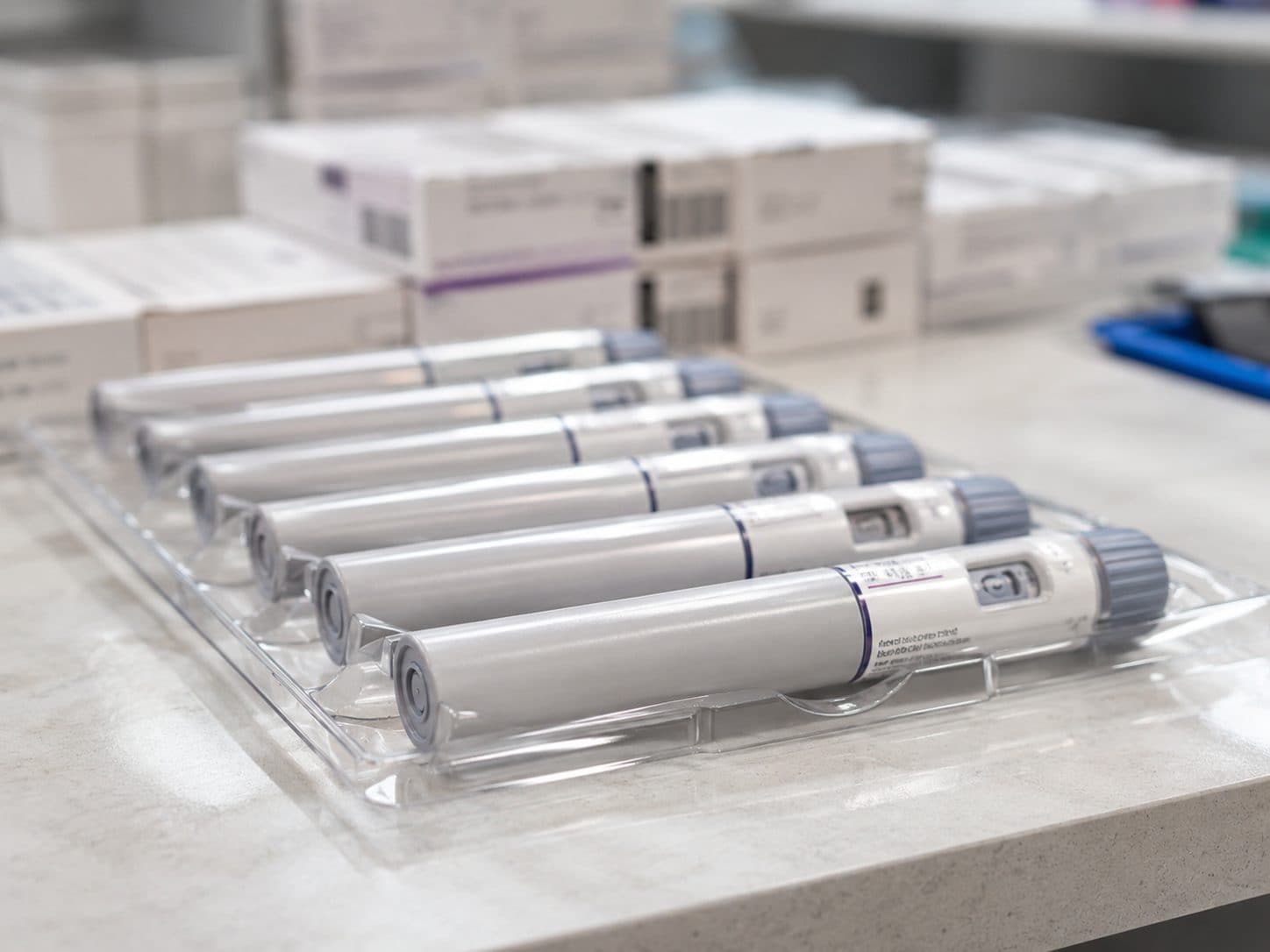
The newest launch is where the two threads meet. Foundayo, the oral GLP-1 approved in April, recorded $98 million in its first full quarter, or 0.43% of revenue. Leerink analyst David Risinger put U.S. sales at $67 million and United Arab Emirates sales at $31 million, figures management did not dispute. Goldman Sachs analyst Asad Haider described the U.S. launch curve as slower than anticipated. Lilly USA president Ilya Yuffa said prescribers rose from about 8,000 to 36,000. Volume in the last week of July nearly doubled from a month earlier. Close to one in four new starts are now on the product, he said.
The burden of proof has moved. Lilly no longer has to demonstrate that demand exists, and it has raised the revenue and margin it expects from that demand. Three things remain unproven. The volume engine has to hold as net price falls. The second half has to land inside a range with a much shallower slope. The deal program running outside the guidance has to convert into approved medicines. Management also confirmed that the filing route for retatrutide, its next weight-loss medicine, remains in active litigation with the FDA. A submission is planned for the first quarter of 2027. The clinical package is complete, and approval still waits on a pathway the courts have not settled.