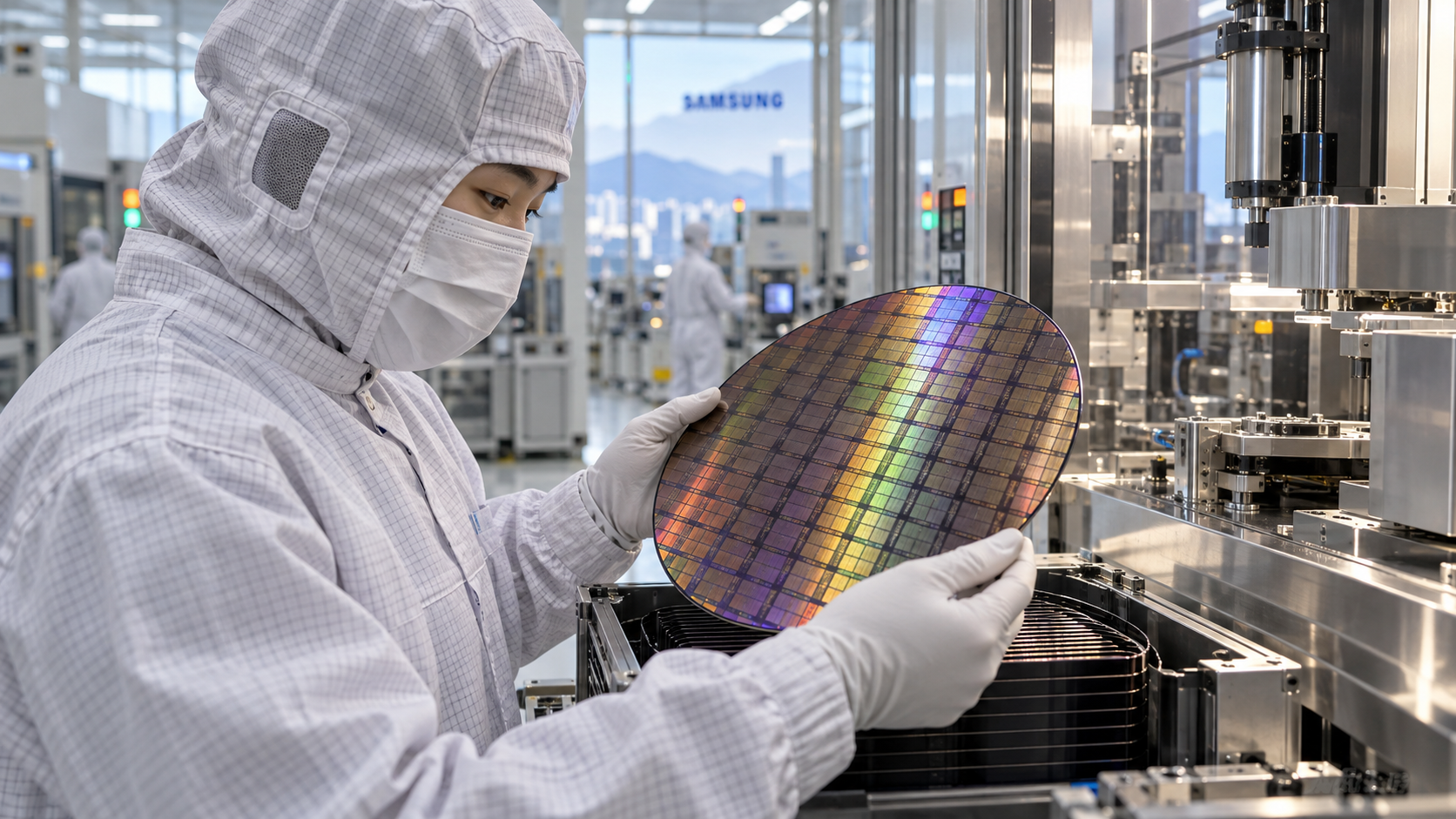
Samsung Electronics and SK hynix each lost more than 4% as foreign investors sold in the first session after a holiday. The won still strengthened to 1,332.88 per dollar, a sign that the money leaving chip stocks was not leaving Korea.
South Korea's stock market and its currency sent opposite signals on Monday, and the gap between them is the most useful clue to what drove the selloff.
The Kospi fell 241.69 points, or 3.65%, to 6,384.24, closing below 6,400 for the first time since Aug. 11. It opened down 0.72% at 6,578.17 and lost ground for most of the session. The tech-heavy Kosdaq dropped 4.83% to 849.19. Samsung Electronics closed down 4.38% and SK hynix 4.52%. Foreign investors were net sellers, concentrated in the two memory makers.
Meanwhile, the won rose to 1,332.88 per dollar, its strongest in two years and up 7.4% for the year. Local companies sold dollars heavily, and cheaper oil helped too.
What the split says
A market selloff driven by a broad loss of confidence in Korea usually hits the currency too, as foreign investors convert proceeds into dollars. Monday's pattern points to something narrower: a rotation out of two very large, very crowded positions in memory chips, with domestic dollar sales more than offsetting any outflow.
With both of the market's memory leaders down more than 4%, the index had little chance. Analysts in Seoul also cited the end of share buyback programs at both companies, which removes a steady buyer from the market.
Three explanations on offer
The first is a reassessment of memory makers' competitive position. China's CXMT said it had made progress on a memory-cell design that allows more cells on each chip, and Micron Technology shares were down about 2% before the U.S. open. SK Group's chairman has urged faster factory construction as Micron and CXMT close in.
The second is funding anxiety around artificial intelligence. Speaking in Singapore on Monday, Broadcom Chief Executive Hock Tan said capital "might be the biggest constraint" on the AI buildout, a striking comment from a supplier whose sales depend on that spending continuing.
The third is timing. Korean markets were closed on Friday for Hangeul Day, so Monday was the first chance to react to two sessions of global trading, including a selloff in AI-related shares on Thursday. High oil prices and rising borrowing costs, which local commentators also cited, have been in place for weeks.
The Asian backdrop
Elsewhere in Asia, the picture was mixed. Mainland China's CSI 300 fell 0.68% and Australia's S&P/ASX 200 rose 0.76%. Japanese exchanges did not open because of a national holiday. In the U.S., S&P 500 futures were modestly higher, and Nasdaq 100 futures were roughly flat.
Two readings
One reading is that this was positioning, not a change in fundamentals. The currency is strong, the selling was concentrated in two names after a long rally, and a holiday compressed two days of global news into one session.
The other reading is that it is an early warning on memory pricing power. A credible Chinese competitor gaining ground and an industry leader questioning whether AI spending can be funded are exactly the kind of news that would hit the stocks most exposed to the cycle first.
What to watch
U.S. memory and semiconductor shares at Monday's open are the first test. ASML reports on Wednesday and Taiwan Semiconductor Manufacturing on Thursday, and both will be asked about demand for advanced chips into 2027. Foreign flow data in Seoul on Tuesday will show whether the selling continued.