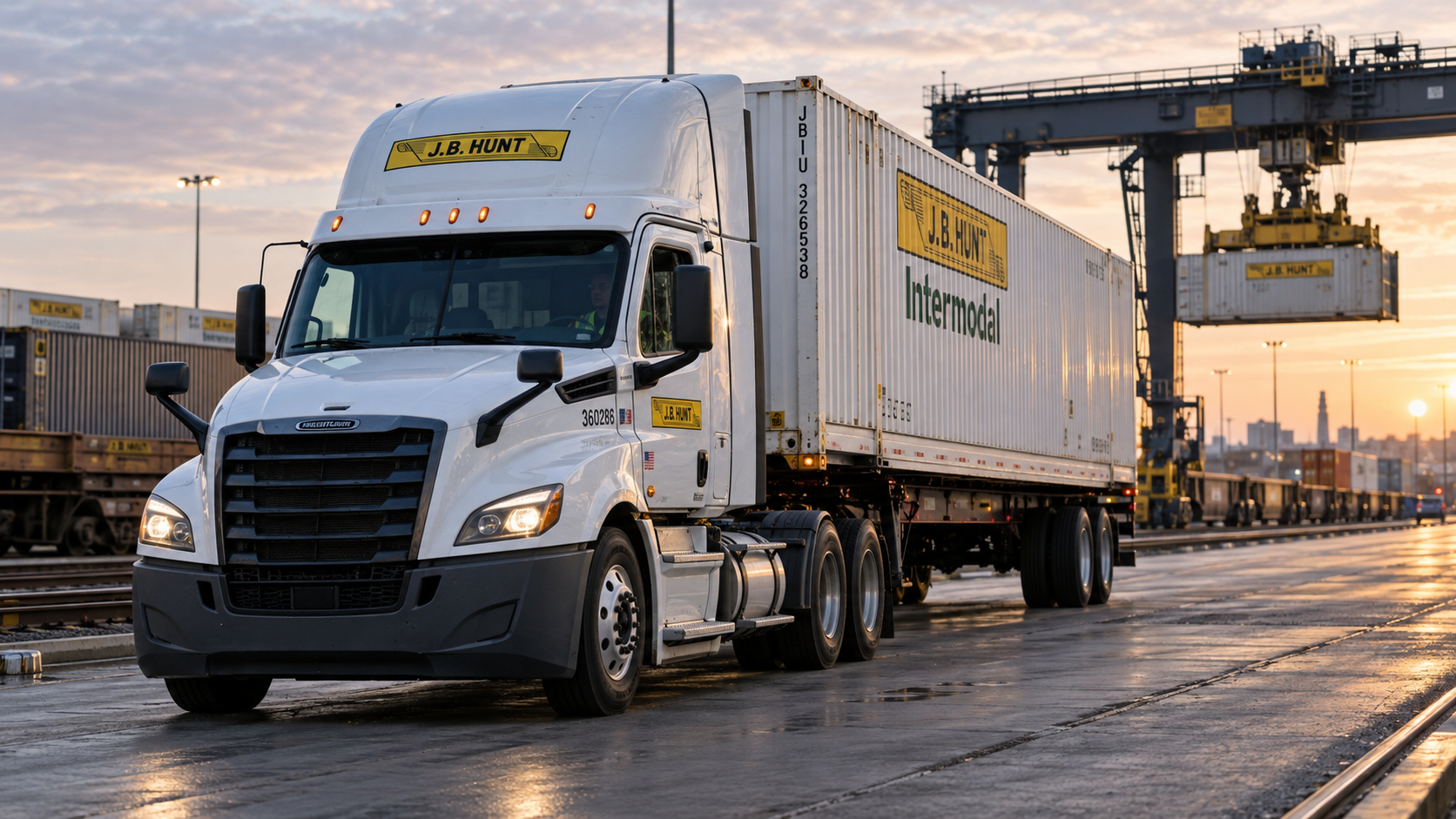
The trucking and intermodal company's third-quarter earnings of $1.82 a share were in line with most forecasts while revenue beat. Excluding fuel surcharges, revenue rose 13%; the operating ratio worsened and Dedicated profit fell 22%.
J.B. Hunt Transport Services sold a lot more freight service in the third quarter. Very little of it reached the bottom line.
The company reported revenue of $3.68 billion, up 20% from a year earlier and above the $3.59 billion analysts expected. Earnings were $1.82 a share, in line with the $1.81 consensus, though some estimates ran as high as $1.95, and up from $1.76 a year ago. Net earnings were $172.4 million.
Operating income, however, rose just 2% to $247.1 million. Put in dollars, revenue grew by about $624 million from a year earlier while operating income grew by about $4.4 million, by this publication's arithmetic. About $285 million of the revenue increase came from fuel surcharges, which rose to $670.8 million from $385.6 million; excluding them, revenue rose 13%. Surcharges largely pass fuel costs through to customers, so they swell revenue without adding much profit, which explains part of the gap. The operating ratio, operating expenses as a share of revenue, worsened to 93.3% from 92.1%. For a trucking company, a higher ratio means each dollar of revenue is costing more to deliver.
Shares slipped 1.4% to about $232 in after-hours trading from a close of $235.31.
Where the money went
The segments split sharply.
Intermodal, the company's largest business, which moves containers by rail, performed well. Revenue rose 20% to $1.83 billion, loads increased 8.5% to 585,582, and operating income rose 18% to $147.5 million.
Dedicated, which supplies trucks and drivers to individual customers under contract, was the weak spot. Revenue rose 11% to $960 million, but operating income fell 22% to $81.7 million.
Integrated Capacity Solutions, the brokerage arm, grew revenue 57% to $434 million and swung to a $9.6 million operating profit from a $0.8 million loss. Final Mile Services revenue slipped 3% and its operating income fell 76% to $1.6 million. Truckload revenue rose 37%, while its operating income fell 6% to $7 million.
The pattern: revenue growth in every unit except Final Mile, and higher operating income only in Intermodal and in brokerage.
Spending less
One line points to how management is responding. Net capital expenditures for the first nine months were about $291 million, down from $491 million a year earlier. Spending less on equipment preserves cash when margins are under pressure, and it matters for the truck and trailer makers that sell to J.B. Hunt.
Chief Executive Shelley Simpson's comment in the release thanked employees for "operating safely and executing with excellence every day" and offered no financial outlook.
Market implications
One reading is that J.B. Hunt is gaining volume in a weak freight market and will earn more as conditions improve. Intermodal loads and profits are rising, brokerage revenue is growing fast, and lower capital spending protects cash flow until pricing recovers.
A second reading is that the growth is coming at the expense of margins. A 20% revenue increase, or 13% without fuel surcharges, that yields 2% operating-income growth, a deteriorating operating ratio and a 22% drop in Dedicated profit suggest the company is buying volume with price or absorbing higher costs.
What to watch
The call commentary on Dedicated pricing and fourth-quarter intermodal volumes, and whether the operating ratio improves. Other truckers reporting over the next two weeks will show whether the margin squeeze is industrywide.