

Every screen on Wall Street will be locked to the FOMC minutes today at 2:00 PM ET. Traders will parse three dissenting votes for a hike, count the mentions of "sticky," and rerun their September odds. What almost no one will mention is that the meeting that actually repriced the long end of the yield curve this week happened seven thousand miles away, in a building most of them can't name. And it just moved for the first time in thirty years.
But before we get to that, let's take a quick look at the markets and what's setting up today…
3 Movers in 3 Minutes
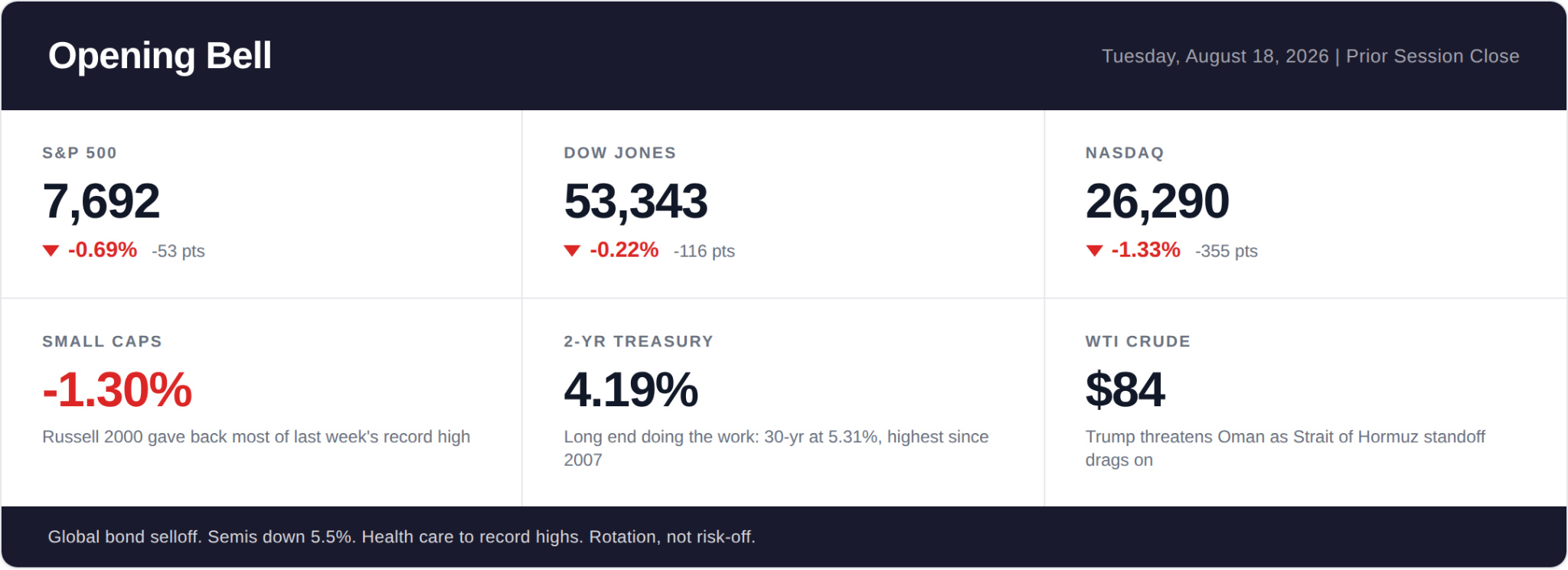
- The AI trade cracked. The Philadelphia semiconductor index fell 5.5%, its worst session in months, with SanDisk (SNDK) down 9%, Seagate Technology (STX) off more than 9%, Marvell Technology (MRVL) down 8%, and Western Digital (WDC) down 7%. Nvidia (NVDA), Micron Technology (MU), and Broadcom (AVGO) were the heaviest weights on the tape as investors reassessed the frenzy around AI valuations against a rising cost of capital.
- Health care hit a record while tech burned. Johnson & Johnson (JNJ) climbed 3.3% to its first record close since July 7, dragging the $44 billion Health Care Select Sector SPDR ETF to an all-time high.
- Oil grinded higher on a Trump ultimatum. WTI settled near $84 and Brent traded near $91 after President Trump threatened to "bomb" Oman if it interferes with U.S. plans for the Strait of Hormuz. The oil complex now sits at three-week highs with no de-escalation path in sight, and every bond desk on the Street is pricing that in.
3 Signals for Today
FOMC minutes at 2:00 PM ET from the July 28–29 meeting, where three members dissented in favor of a hike against a 3.50–3.75% hold. Fed funds futures still price 84% odds of a September cut. Any language on term premium or long-end issuance will move the tape.
Retail's second wave hits before the bell. Target (TGT), Lowe's (LOW), TJX Companies (TJX), and analog-chip bellwether Analog Devices (ADI) all report Q2 results. After Home Depot's hold-guidance rally, the read on DIY versus pro spend and tariff pass-through is on Lowe's and Target to deliver.
20-year Treasury auction at 1:00 PM ET. The bellwether for how much term premium the market is now demanding. A weak tail here, one day after the 30-year hit its highest level since 2007, would confirm that the long-end selloff has legs beyond the intraday panic.
There's a Strategy Behind the Iran War.
I know because I've seen the evidence firsthand.
On March 2nd — three days after the first missiles hit — I sat across from two U.S. Congressmen in back-to-back private meetings.
Those meetings pointed me toward something I spent weeks verifying.
The real purpose behind the strikes. The real objective. And the single company at the dead center of all of it.
This isn't random. It's a calculated Two-Front Economic War.
And there's one company positioned right at the heart of it.
See the strategy behind the Iran war — and the company at the center of it
The sooner you understand what's really happening — the better positioned you'll be before August 12th.
— Dylan Jovine, Founder, Behind the Markets
And with that, let's get to today's big story: the central bank that just did more to move your 30-year mortgage than the FOMC will do this week.
The Sip
A move that took thirty years to make
Yesterday, the 30-year U.S. Treasury yield closed at 5.31%. The last time long American debt yielded this much, Ben Bernanke had just been sworn in as Fed Chair, Countrywide was still writing mortgages, and Lehman was a going concern. Every financial screen in Manhattan tried to explain it the same way. Sticky inflation. Oil at $84. A flood of AI-related corporate issuance. Trump threatening Oman. Take your pick.
They all missed the memo. It came from Tokyo.
On Tuesday morning, Japan's benchmark 10-year government bond yield climbed to 2.945%, its highest level since September 1996. The 2-year JGB hit 1.7%, a 31-year peak. The 5-year set a record. Germany's 30-year hit its highest since 2011. France's since 2008. Every developed-world sovereign curve moved the same direction on the same day, and none of them were waiting for Jerome Powell.
The pipes of global finance were built on a single assumption: that Tokyo would always be the cheapest place on earth to borrow.
The workings nobody talks about
For thirty years, Japan was not just a country. It was a subsidy scheme. The Bank of Japan held its policy rate at zero, then negative, then back to a whisper above zero, for the better part of three decades. That created something called the “yen carry trade.” The workings were beautifully simple. You borrowed yen at effectively no cost, converted them into dollars, and bought anything that yielded more. Emerging market debt. U.S. Treasuries. Silicon Valley venture rounds. Latin American real estate. The trade financed pockets of global risk-taking that nobody wanted to trace back to a Tokyo bank ledger.
Estimates of outstanding yen carry positions run from Morgan Stanley's $500 billion to well over a trillion, depending on who is counting. Nobody knows the real number, which is precisely the problem. When the anchor of a system is invisible, so is the damage when it drifts.
And Japan is not just a source of leverage. It is the second-largest foreign holder of U.S. Treasuries, sitting on roughly $1.1 trillion of American government debt. Every basis point that JGB yields rise makes those Treasuries relatively less attractive to a Tokyo insurance company deciding whether to keep its money at home. The Fed can hold. The Fed can cut. It changes nothing if the buyer on the other side of the trade is quietly walking away.
The rehearsal was August 5, 2024
We have seen this setup before, and recently. On August 5, 2024, the BOJ hiked its policy rate by 25 basis points off a floor of zero. The yen surged roughly 6% in a matter of days. Margin calls fired across the carry trade. The Nikkei collapsed 12.4% in a single session, its worst day in nearly forty years, and dragged the S&P 500 down with it. The VIX briefly spiked above 65. Investors who had never thought about Japanese monetary policy in their lives suddenly had to.
Why are companies flying spy planes over Elon's closely-guarded AI lab?
Elon did the seemingly impossible – far faster than anyone expected...
And it's sent the tech industry into PANIC MODE.
ChatGPT, Claude, Google Gemini, and DeepSeek could soon become obsolete.
And three little-known firms could soar 10X or higher as a result.
That was a hike from zero to 0.25%. The BOJ is now at 1%. Reuters and other outlets have reported that BOJ officials are turning increasingly hawkish, and the board may pursue tightening at a faster clip than markets have priced. A hike in September would take the policy rate higher and at a pace not seen since 1989. DBS now expects one quarter-point move every three to four months.
None of this is happening at Jackson Hole. None of it will be in the FOMC minutes today. And all of it is why the U.S. long end is behaving like it does not care what the Federal Reserve does next.
What the minutes will not say
The FOMC minutes today will get five thousand words of analysis before dinner. They will confirm what everyone already suspects, that three regional presidents wanted to hike in July, that the Committee is split on how much the labor market has actually softened, that inflation remains uncomfortable. Fed funds futures may reprice at the margin. The two-year yield may twitch. The financial press will run its usual choreography.
Meanwhile, the marginal buyer of a 30-year Treasury is sitting in an office in Otemachi looking at a JGB yield that has doubled in fourteen months and doing quiet math about whether it still makes sense to fund America's deficit at a discount. That decision is happening every day, in every yen the BOJ does not spend defending 158 against the dollar, in every Japanese pension fund that quietly rotates a percentage point of its book from foreign bonds back into domestic ones.
You will not see a headline. You will see a slow, methodical repricing of the entire long end of every developed-market curve, dressed up as an inflation story, an issuance story, a geopolitics story, an AI story. It is none of those. It is a plumbing story.
The tell for the next six weeks
Watch the yen. Not the S&P. Not the FOMC. The yen. If the BOJ hikes on September 19 and the yen strengthens sharply, the carry unwind that gave you the August 2024 flash crash will run again, with more leverage stacked on top of it. If the BOJ holds and gives dovish guidance, the long end here gets a temporary reprieve and equity indices probably grind higher into year-end.
Either way, the meeting that matters this fall is not in Washington. And when the story finally breaks into the mainstream press, it will already be too late to be a story.
Middle East Conflict Lights Fuse on US Debt Bomb
America was already drowning in $38 trillion of debt, but the recent conflict in the Middle East just accelerated the timeline.
As oil spikes, a 100-year-old stock market signal that accurately predicted the 2008 and 2020 crashes is flashing a massive "Sell" on dozens of popular U.S. equities.
If you hold the wrong stocks when this debt crisis hits, it could wipe out years of gains.
Click here to see the 10 popular stocks to dump immediately
11780 US Highway 1, Palm Beach Gardens, FL 33408-3080 Would you like to edit your e-mail notification preferences or unsubscribe from our mailing list? Copyright © 2026 Weiss Ratings. All rights reserved.
The MarketSipsTakeaway
For thirty years, cheap Japanese money was the invisible tailwind under every risk asset on earth. That tailwind is now a headwind, and it is being priced into the long end of every sovereign curve on the planet whether the Fed cooperates or not. The FOMC minutes today are a distraction. The BOJ meeting on September 19 is the trade. Watch USD/JPY like it is the only chart that matters. This month, it probably is.
Today's reply prompt: When Tokyo hikes in September, does the long end here spike or does the S&P finally notice?
Until then, sip slowly!
The Market Sip Desk
Tickers: UI MS FOMC PM ET SNDK STX MRVL WDC NVDA MU AVGO JNJ SPDR WTI TGT TJX ADI DIY JGB BOJ VIX PANIC MODE DBS FL USD JPY