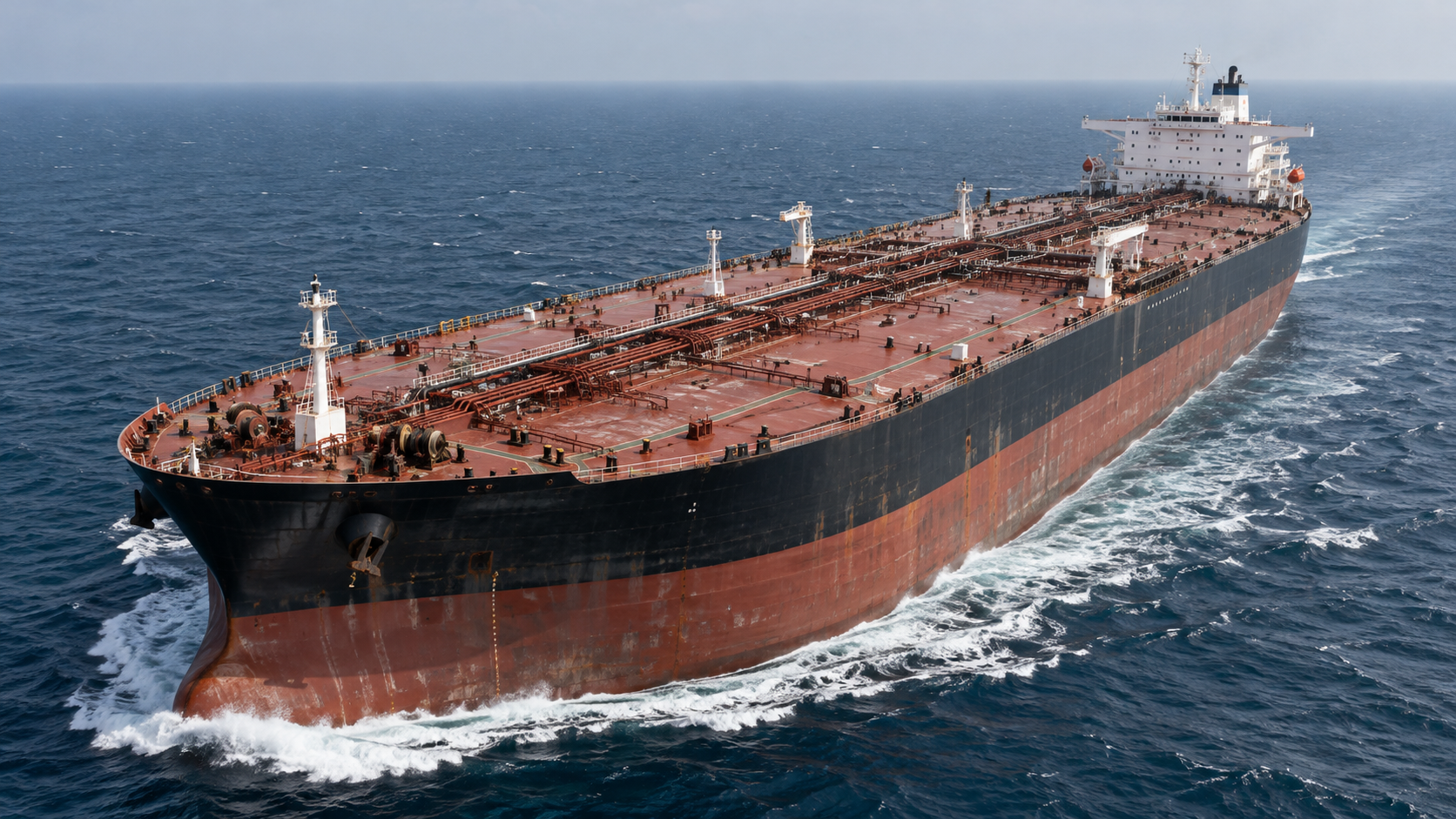
The U.S. tanker owner agreed to acquire Oslo-listed Bruton in a deal valued at about $370 million. Because the exchange ratio is fixed, Thursday's 4.7% drop in International Seaways shares cut what Bruton's holders will receive, not how many shares they get.
International Seaways is adding to its fleet of the largest crude tankers, mostly with ships that have not yet left the yard, and it is paying with shares rather than cash.
The New York-listed shipping company said early Friday it agreed to acquire Bruton, an Oslo-listed owner of very large crude carriers, in a transaction valuing Bruton at about $370 million. Bruton has one vessel in operation and three under construction, with deliveries scheduled between the fourth quarter of 2026 and the fourth quarter of 2027, according to Bruton's announcement. International Seaways will issue about 3.12 million of its own shares, which account for roughly 96% of the consideration.
The deal is structured in two steps. Holders of 50.5% of Bruton, including Drew Holdings and Koch, have agreed to exchange their shares in a first step expected to settle around Oct. 20. The remaining shareholders are expected to vote around Oct. 30, with the committed holders' support already in hand. International Seaways also released preliminary third-quarter results alongside the announcement.
A fixed ratio, a moving price
Bruton holders will receive 0.0519 International Seaways shares for each Bruton share, a ratio set at signing. A cash alternative of $6.3044 per Bruton share was fixed by reference to an agreed pre-signing value of about $121.47 per International Seaways share, according to the terms.
International Seaways closed Thursday at $113.11, down 4.74%, before the announcement. That is about 7% below the value used to set the cash alternative, by this publication's arithmetic. Because the ratio does not change, the drop did not alter the number of shares International Seaways will issue. It reduced the dollar value of what Bruton's holders will receive, and until closing their payout will rise and fall with International Seaways' stock. The new shares amount to roughly 6.3% of the company's existing share count, by this publication's estimate.
Paying in stock also preserves the roughly $965 million of liquidity, cash plus an undrawn credit line, that International Seaways reported alongside the deal, more than twice the transaction value.
Why supertankers, why now
Flows through the Strait of Hormuz fell to about 11.6 million barrels a day in the week to Oct. 13, roughly a third below the baseline used by ship-tracking firm Kpler. Disruption on that scale can scramble tanker routes. If buyers replace Gulf barrels with cargoes from farther away, voyages lengthen and more ships are tied up for each barrel delivered, which tends to support rates for the largest vessels.
Most of what International Seaways is buying arrives over the next 14 months. Three of the four ships are newbuilds, so the bet is on rates holding into late 2027, not just on today's market.
Market implications
One reading is that the deal is well timed. Disrupted Gulf flows and longer voyages support demand for large tankers, consolidation adds ships without new orders at the yards, the company keeps its cash, and paying in stock ties the sellers to International Seaways' own performance.
A second reading is that the company is buying at an elevated point in the cycle. Tanker rates that rise on a geopolitical shock can fall as quickly if Hormuz traffic recovers, and three newbuilds due through late 2027 add capacity whether or not rates hold.
What to watch
The first-step settlement around Oct. 20, the Bruton vote around Oct. 30, and International Seaways' full third-quarter results on Nov. 5, where management can explain the rate assumptions behind the price. Weekly VLCC rates and Hormuz transit counts will decide whether the timing looks shrewd or early.