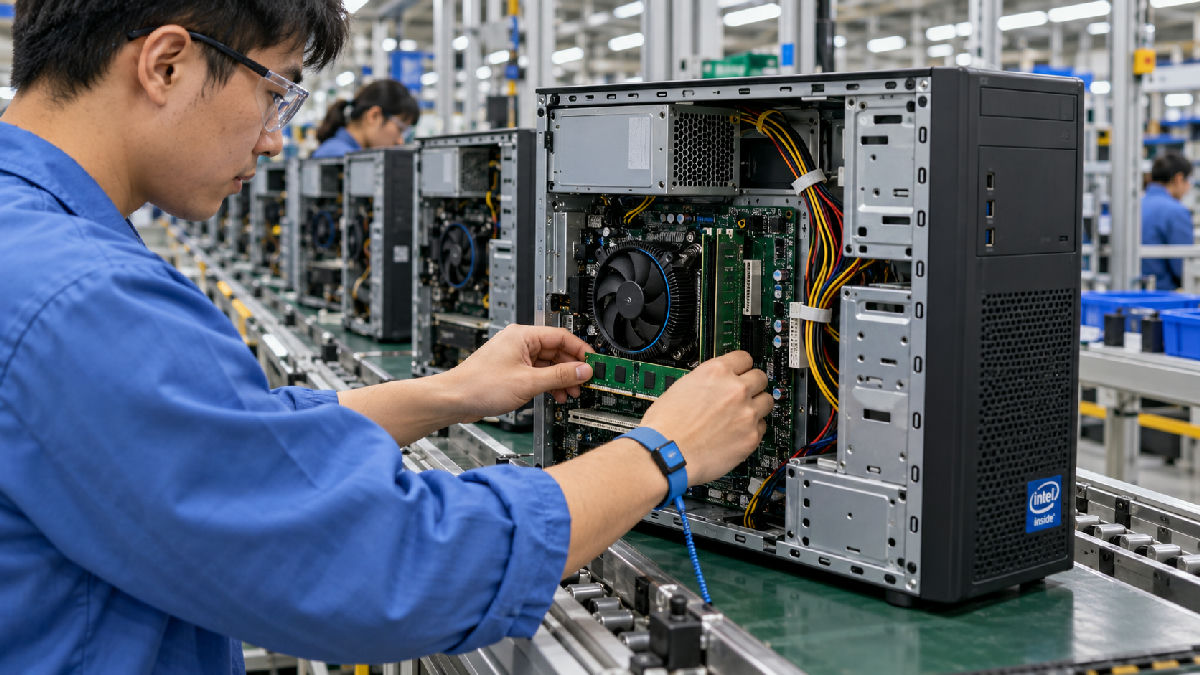
Intel's chief executive said customers began signaling a PC slowdown tied to memory prices and availability. Dell, Qualcomm, AMD and Arm each fell more than 11%, and memory companies fell too.
Regular trading did not soften Intel's forecast. It made the reaction worse.
Intel shares were down about 30.3% at $64.21 in early afternoon Friday, against Thursday's close of $92.07. The stock opened at $68.35, near where it had traded overnight, and kept falling through the morning on about 300 million shares. Before the open it had been indicated about 26% lower.
The trigger was Intel's fourth-quarter outlook: revenue of $15 billion to $16 billion, against the $17.07 billion analysts expected, adjusted earnings of 25 cents a share against 43 cents, and an adjusted gross margin of about 38%. The company cited a slower PC market and an explosion at its plant in Kiryat Gat, Israel.
The memory problem
Chief Executive Lip-Bu Tan put the PC weakness in specific terms. "Our customers began signaling a PC slowdown based on the memory prices and availability," he said.
That explanation spread the selling well beyond Intel. Dell fell about 12.3%, Qualcomm about 11.9%, Arm about 11.5%, AMD about 11.4% and HP about 9.3%. Each sells into the PC market or depends on it.
Memory companies did not benefit from the higher prices Intel described. Sandisk fell about 14.6%, Seagate about 9.8%, Western Digital about 8.5% and Micron about 6.3%. Sandisk's own results this week described strong data center demand, the opposite of the PC picture Intel painted, yet its stock fell more than twice as far as Micron's.
What the session settled
Before the open, the debate was whether Intel's guidance was a temporary setback, driven by a plant outage and a cyclical PC dip, or a reset for a company whose largest business is still PC chips. The regular session did not settle that question, but the selling in PC makers and memory companies was consistent with investors treating the warning as a sector problem rather than an Intel problem.
The data center business is the counterweight. Intel's data center and AI revenue rose about 78% in the third quarter to roughly $7.3 billion, and foundry revenue about 58%. The stock's fall erased those gains from the conversation for a day.
Setback or reset?
The setback view holds that the shortfall is mostly PCs and a one-time plant problem, and the businesses Intel's turnaround depends on are growing fast.
The reset view holds that management expects PC weakness through at least the first half of next year, the plant effect extends into the first quarter, and memory costs are a problem Intel cannot fix on its own.
What to watch
Intel's closing level, the restart of the Kiryat Gat plant, PC demand data through the holiday season and whether PC makers echo Intel's memory warning in their own outlooks.