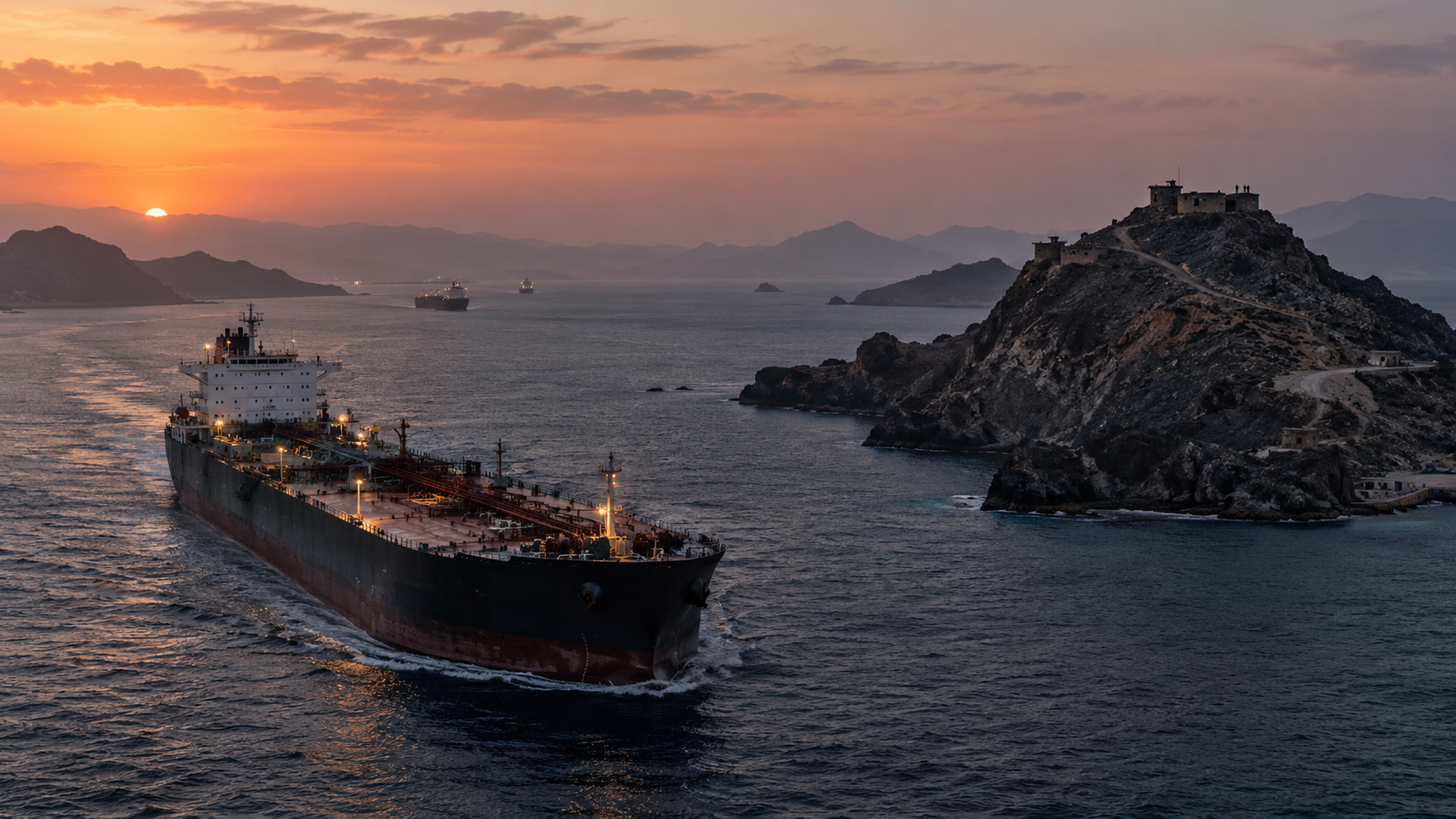
Fighting killed more than 500 people in the week to September 14 against roughly 200 the week before, and the territorial gains sit astride one of the two chokepoints carrying the world's seaborne energy trade.
Houthi forces captured the Greater and Lesser Hanish islands, a pair of positions in the southern Red Sea roughly 160 kilometres north of the Bab el-Mandeb strait, in an advance reported on September 14.
The humanitarian toll escalated sharply over the same period. More than 500 people were killed in Yemen in the week to September 14, against roughly 200 the preceding week, with approximately 94,000 people displaced. Thirteen civilians were reported injured in strikes on Khamis Mushait, a city in southwestern Saudi Arabia. Casualty figures in an active conflict are provisional and are compiled by different agencies on different bases, and counts published by relief organisations have diverged from those in wire accounts throughout this escalation.
Why these islands matter commercially
The Hanish group has no meaningful economic value in itself. Its significance is positional.
Bab el-Mandeb is the strait between Yemen and Djibouti through which traffic between the Suez Canal and the Indian Ocean must pass. It is roughly 30 kilometres wide at its narrowest point. Positions 160 kilometres to the north sit directly on the approach lane, within range of the anti-ship missiles and drones that have already been used against commercial vessels in this theatre.
Control of that approach does not need to be exercised to be commercially effective. It changes the underwriting assumption for every vessel routed through the Red Sea, and underwriting assumptions are what determine whether a shipping line sails the route or takes the alternative around the Cape of Good Hope, which adds roughly ten days and a comparable increment of fuel cost to an Asia to Europe voyage.
The diplomatic track has collapsed
The parallel effort to reduce tension in the region has failed. Talks hosted by Oman between Iran, Gulf states and Iraq, intended to produce a temporary arrangement on the Strait of Hormuz, were indefinitely postponed, with several accounts describing the summit as having fallen through rather than merely been rescheduled.
One report circulated suggesting the meeting had proceeded on September 14 as scheduled. It is contradicted by the weight of reporting from more reliable outlets published the same day, all describing postponement, and should not be relied upon.
Hormuz and Bab el-Mandeb are separate waterways with separate actors, and the two should not be treated as one theatre. They are connected only in the sense that a cargo leaving the Gulf for Europe passes through both, which means a shipowner now faces compounding risk at each end of the same voyage.
What it is already costing
Marine war-risk premiums for the most exposed transits have moved into the double-digit millions of dollars per voyage. Major container and tanker operators have suspended transits through Hormuz. Vessel traffic through that strait has thinned to a fraction of its historical baseline.
None of that is yet reflected in a single clean freight index, because the response so far has been avoidance rather than repricing. The cost is showing up as longer voyages and idle capacity rather than as higher quoted rates on the affected lane.
The near-term markers
Whether the Hanish positions are used or merely held is the first question, and the evidence would be an attack on commercial shipping in the southern Red Sea. The second is whether any party revives the Oman process, which currently has no scheduled date. Neither has a timetable.
# CRYPTO