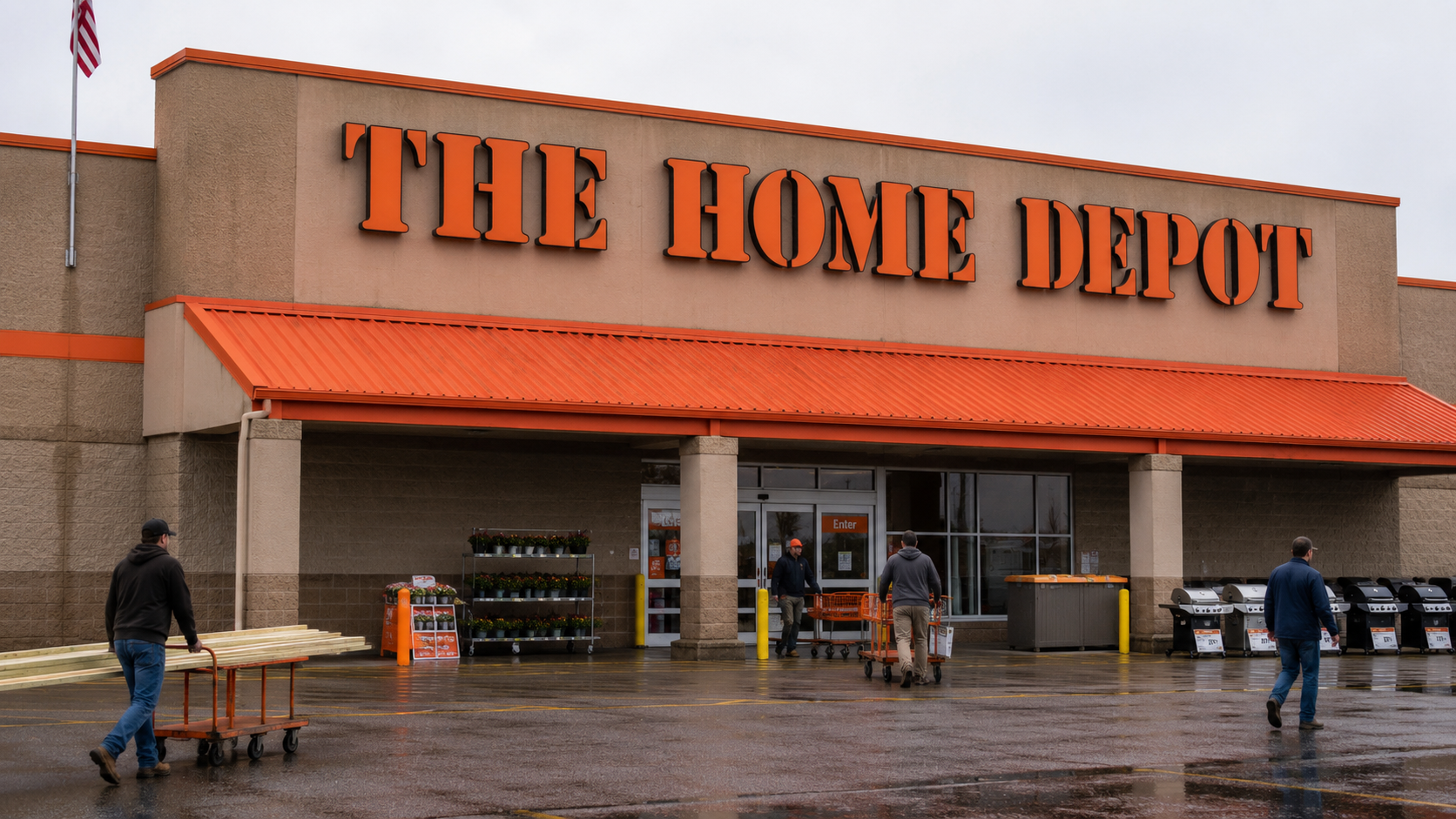
Home Depot's second quarter produced its best comparable sales in several quarters, an earnings beat, and a lower operating margin. The item connecting all three is a $685 million tariff refund that ran through cost of goods sold. The refund was worth about 52 cents a share after tax. The beat against the roughly $4.73 a share analysts expected came to 19 cents.
Shares rose more than 2% before the open, reached $344.54 during the session, then held a gain of less than 1% near $339.50 late in the day. Long-term Treasury yields climbed that morning and housing starts came in soft, a backdrop that works against a home improvement retailer. The stock sits roughly 20% below its 52-week high of $426.75 and below both its 50-day and 200-day averages.
A refund did most of the margin work
Gross margin reached 33.7%, up about 25 basis points from a year earlier. The refund alone accounted for roughly 145 basis points of that. Home Depot received $730 million in IEEPA tariff refunds during the quarter, of which $685 million reduced cost of goods sold. The remaining $45 million sits in inventory and reaches the income statement as that inventory turns.
Chief Financial Officer Richard McPhail laid out the offsets. Unplanned fuel, energy and input costs took about 60 basis points. Mix from the GMS and Mingledorff's acquisitions took roughly another 60. Without the refund, the gross margin trend was down rather than up.
Operating margin makes that plainer. It fell to 14.3% from 14.5% on a GAAP basis, and to 14.7% from 14.8% on the adjusted basis that excludes $178 million of pretax intangible amortization. Gross margin rose 25 basis points while operating margin fell 20. Operating expenses grew faster than sales in a quarter that carried a large one-time cost credit.
Michael Lasser of UBS asked whether Home Depot had missed its own underlying profitability plan once the refund is stripped out. McPhail said results would have exceeded expectations regardless. The call produced no figures behind that answer.
The comp accelerated on price, not visits
Total comparable sales rose 1.7%, with U.S. comps up 1.3%. The cadence improved through the quarter, from 1.2% in May to 1.5% in June and 2.3% in July. Thirteen of sixteen merchandising departments posted positive comps. Digital sales grew 11%, a fifth consecutive quarter of double-digit online growth.
The composition is less comfortable. Comparable average ticket rose 2.8%. Comparable transactions fell 1%. Customers are spending more per visit and visiting less often. Big-ticket transactions above $1,000 did rise 2.4%, and executives credited Pro demand and better in-stock levels.
Lasser also asked whether the sequential acceleration came from share gains or a genuine market recovery. Management chose share gains, pointing to delivery investments, on-shelf availability and its Magic Apron tools. Merchandising chief Billy Bastek said customers "continue to engage in smaller, repair and maintenance projects," while "larger discretionary projects remain under pressure." That describes a retailer taking ground inside a stalled market, not a market that has turned.
Growth is arriving at a lower return
Total sales rose 5.7% to $47.9 billion. Only 1.7 points of that came from comparable sales. The rest came from acquisitions, new stores and new SRS branches. Home Depot now runs 2,364 stores and more than 1,340 SRS branch locations.
Bought-in growth carries a price. Trailing twelve-month return on invested capital fell to 24.8% from 27.2%. Inventory turns slipped to 4.5 times from 4.6, with merchandise inventories up about $2 billion to $26.8 billion. Diluted share count was flat year over year, so repurchases contributed nothing to per-share growth.
The first half sharpens the point. Six-month sales rose 5.3% to $89.6 billion. Six-month net earnings rose 0.9%, and GAAP diluted earnings per share moved from $8.03 to $8.09. Cash generation ran the other way, with free cash flow up 21% to about $4.5 billion against roughly $880 million of capital spending and $2.3 billion of dividends.
Unchanged guidance is doing real work
Management reaffirmed every full-year metric: sales growth of 2.5% to 4.5%, comparable sales of flat to 2%, gross margin near 33.1%, GAAP operating margin of 12.4% to 12.6%, and earnings per share growth of flat to 4%.
Set those against the quarter just reported. Gross margin of 33.7% versus a 33.1% full-year target. Operating margin of 14.3% versus a target range topping out at 12.6%. Seasonality explains part of the gap and the refund explains more of it. What is left is a second half management declined to underwrite more confidently.
Seth Sigman of Barclays and Kate McShane of Goldman Sachs both asked why the range was not narrowed after a quarter that ran above its midpoint. McPhail cited volatility, unplanned cost pressure, and housing conditions he called frozen. Housing turnover, he said, "has never been lower as a percentage of the housing stock," with "no sign of an inflection point at this moment."
The quarter also arrived under interim leadership. Chief Executive Ted Decker began a temporary medical leave disclosed on August 12. McPhail is serving as interim principal executive officer, Ann-Marie Campbell is running day-to-day operations, and lead director Gregory Brenneman is chairing the board. The company expects Decker back in a few months. One analyst offered well-wishes on the call. No one asked about continuity.
The third quarter arrives without the refund
Third-quarter gross margin is the first clean look at the underlying trend McPhail described. The transaction line matters as much. Ticket-led comps can run for several quarters, but sustained growth eventually needs more visits, not larger baskets from fewer of them.
Two other items carry into fiscal 2027. Whether the 60 basis points of fuel and input cost pressure resets the cost base determines how much of this quarter's expense growth is permanent. And the $400 million cross-sell target across SRS and GMS has so far been described qualitatively rather than quantified, which leaves return on invested capital as the clearest available measure of whether acquisition-led revenue is earning its keep.
Home Depot spent Tuesday arguing that it is gaining share in a market that has not moved. The refund made that argument cheaper to make.