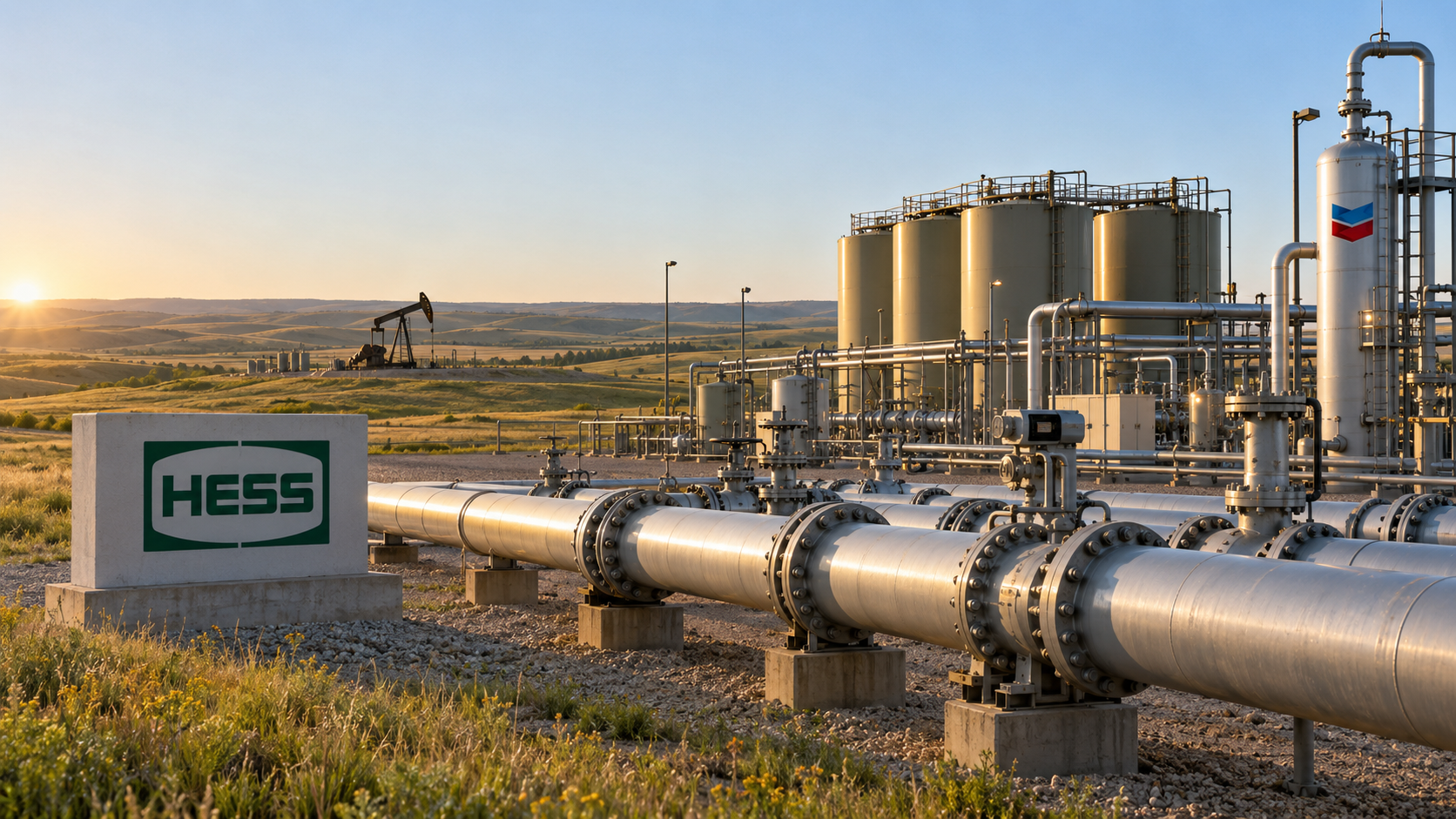
The pipeline partnership retires close to two-fifths of its units, but lower Bakken fees leave 2027 free cash flow per unit roughly where it is today. Chevron accepts a multibillion-dollar writedown in exchange for cheaper gathering.
Strip away the share cancellations and the new 2045 contracts, and the deal Chevron and Hess Midstream announced late Tuesday leaves one number almost untouched: the free cash flow each remaining Hess Midstream unit is expected to generate.
By FinancialMarkets.com's estimate, using guidance midpoints and an approximate unit count, adjusted free cash flow works out to about $4.47 per unit this year and about $4.48 in 2027. That flat line is the clearest way to understand a transaction that looks generous on some measures and costly on others.
What changes hands
Chevron is turning over everything it owns in the partnership: 77,827,485 Class B operating units, 449,000 Class A shares and the entire general partner interest. It is also contributing its DJ Basin crude gathering and storage business in Colorado. Hess Midstream will cancel the units, shrinking its unit count by close to 40%, and send Chevron $200 million in cash.
Chevron's payoff comes through its cost line. The partnership will charge lower Bakken fees between 2027 and 2033, and the agreements now run through 2045 instead of 2033. Cost-of-service arrangements become fixed fees that rise with inflation. Chevron says its Bakken midstream cost per unit should roughly halve, lifting its return on capital employed by 0.5 percentage point. It will take about $3.7 billion of partnership debt off its books and record an after-tax special charge it puts at $3 billion to $4 billion.
That charge is close to the market value of what Chevron is surrendering. At Tuesday's $38.69 close, its units were worth about $3.03 billion, before any value is assigned to the general partner stake or the Colorado assets. For a company valued at roughly $413 billion, the writedown is under 1% of market capitalization, and it is an accounting loss rather than cash out the door.
Bigger per unit, smaller overall
The partnership's preliminary 2027 outlook calls for adjusted EBITDA of $850 million to $950 million, against $1.225 billion to $1.25 billion for 2026. At the midpoints, that is a decline of about 27%. Divided over the smaller unit base, though, EBITDA per unit climbs about 17%, to roughly $7.01 from $5.99. Management describes the deal as accretive on that basis.
The gap between the two measures has an explanation. Some of the 2027 EBITDA is non-cash: the value of what Chevron contributes will be carried as a contract liability and released into revenue over the life of the agreements to 2045. Free cash flow, guided at $525 million to $625 million for 2027 after about $125 million of capital spending, does not get that lift, which is why the per-unit figure stalls.
Volumes are also heading lower. Chevron plans to run two Bakken rigs instead of three from December, and the partnership sees Bakken throughput dropping about 5% in 2027. Debt is expected to stay near current levels, so leverage climbs to a projected 3.75 to 4.0 times in 2027, with a longer-term goal of 3.5 to 3.75 times.
The payout question
Income investors face a reset. The distribution keeps growing at a 5% annual pace for the rest of 2026, then stops growing for all of 2027. At the second-quarter rate of $0.7888, the annualized yield is about 8.2%. If the next two increments match the last one, the fourth-quarter payout would land near $0.81, and a full year at that level would cost roughly $415 million across the reduced unit count. The $575 million free cash flow midpoint would cover that about 1.4 times, leaving some room for buybacks or debt reduction.
What holders gain
The protections are real. Chevron is committed to minimum payments equal to 80% of its expected Bakken revenue through 2033, set three years ahead and adjustable only upward. The Colorado assets bring around 400,000 barrels a day of gathering capacity, a one-fifth interest in the Saddlehorn pipeline and roughly 670,000 dedicated acres, giving the partnership a customer base beyond the Bakken. That matters for a business that took about 95% of its second-quarter revenue from Chevron affiliates. Chevron's board representatives depart when the deal closes, and unitholders gain the right to vote on directors from 2028.
An independent committee, working with Evercore and Gibson Dunn, signed off on the terms. Closing is targeted for the end of this year.
Units changed hands near $38.38 in light premarket trading Wednesday, about 0.8% below Tuesday's close.
What to watch
The 11 a.m. Eastern webcast on Wednesday is the first chance to learn the size of the contract liability, the fourth-quarter distribution and any 2027 repurchase plans. The first full session, measured against pipeline peers, will show whether investors are pricing the per-unit EBITDA gain or the flat cash flow.