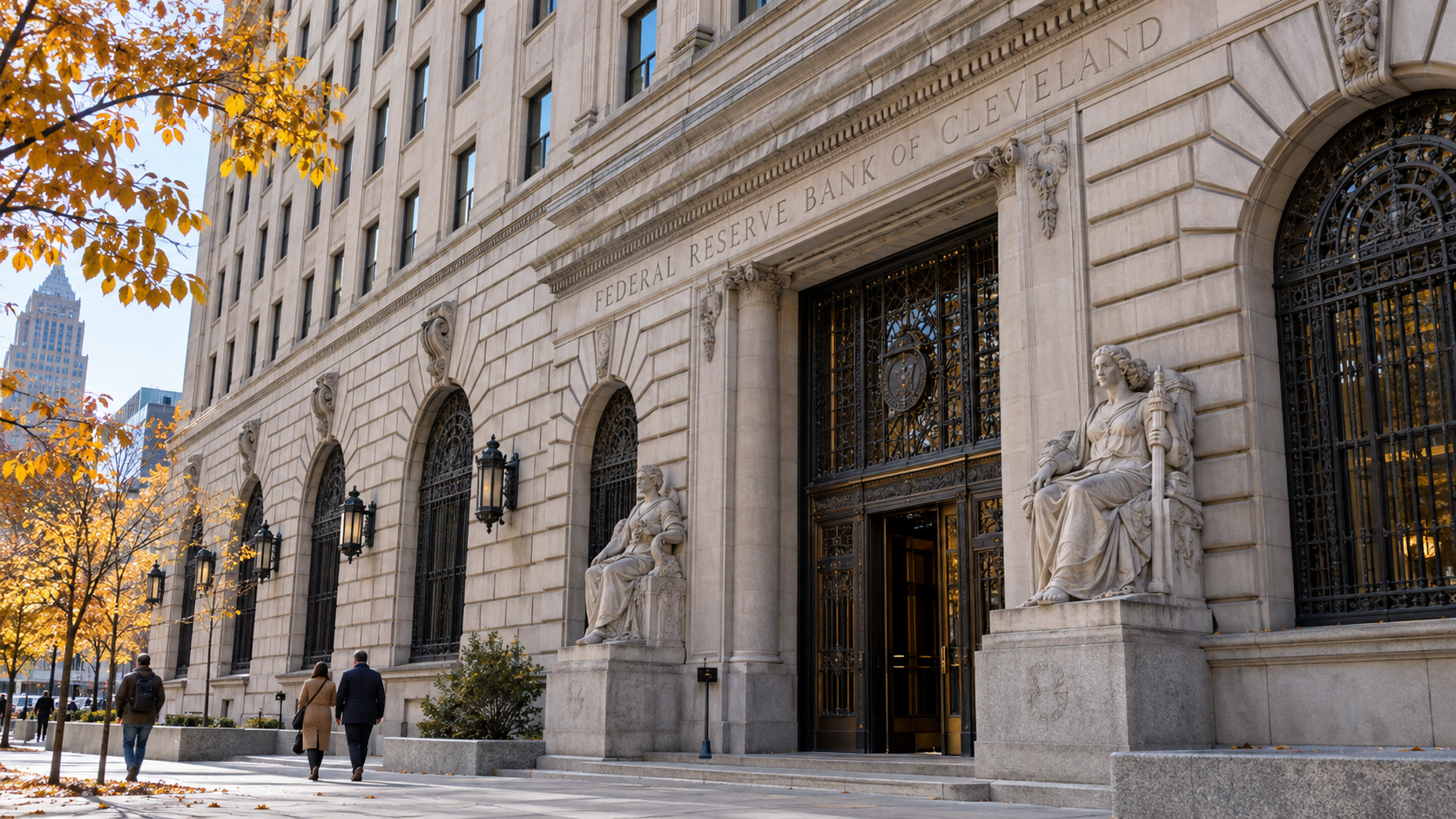
Cleveland Fed President Beth Hammack, who votes this year, made the case for small, fast moves two days before September inflation data. She stopped short of backing a rate increase at the Oct. 27 to 28 meeting, and prediction-market pricing changed little after her remarks.
One of this year's voting members of the Federal Reserve's rate committee said on Monday that monetary policy needs to be tight, and that the central bank should get there in small steps rather than wait. Event-contract traders put the chance of a hike this month at about one in five, little changed after she spoke.
Speaking at the National Association for Business Economics annual meeting in Cleveland, Cleveland Fed President Beth Hammack set out her reasoning in a prepared text. "When feasible, I generally think it's preferable to make smaller adjustments, and to do so relatively quickly, rather than to wait and risk needing a larger course correction," she said.
She was explicit about the destination. "Considering all the inputs that factor into my reaction function, a restrictive monetary policy stance is appropriate to ensure a timely return to 2 percent inflation," Ms. Hammack said. She described price pressures as spread across the economy. "I see inflation pressures as relatively broad-based rather than concentrated in one component," she said, and added that firms in her district plan to raise prices faster than their input costs are rising.
She did not say the Fed should move at its next meeting.
Where rates stand
The Fed raised its target range to 3.75% to 4% on Sept. 16. Its next decision is due Oct. 28, at the end of a two-day meeting. Investors broadly expect a hold.
Kalshi's contract on a quarter-point October increase traded at 18 cents on the dollar shortly after her remarks, roughly an 18% implied chance. It had opened the day at 15 cents and climbed before she spoke in thin holiday trading, with about $13,000 of buying behind the last cent of the rise, so the level says more about a few buyers than about a shift in expectations. It remains inside the 13 to 22 cent range it has held since early October.
Kalshi prices a December hike at about 74 to 75 cents, which suggests traders see the question as one of timing more than direction.
Treasury markets could not register a reaction. The cash bond market was closed for Columbus Day, so the 10-year yield's latest close is Friday's 5.24%.
Consumer inflation expectations
Consumers have been sending a similar message to the one Ms. Hammack described. The University of Michigan's preliminary October survey, published Friday, showed expected inflation over the next year at 4.7% and over the next five to ten years at 3.5%. Both rose from September.
Long-run expectations are the measure Fed officials watch most closely for signs that inflation is becoming entrenched. Ms. Hammack's reference to firms planning price increases above their cost growth points to the same concern from the business side.
Market implications
One reading is that the hawks are preparing the ground for a move sooner than the market expects. A voter calling a restrictive stance appropriate, using the phrase "relatively quickly," and describing inflation as broad-based would be consistent with an October or December increase.
A second reading is that the bar for October remains high. Ms. Hammack framed her preference as a general principle, conditioned it with "when feasible," and declined to endorse a specific meeting. Hiring has slowed, and Chairman Kevin Warsh has said he prefers not to signal moves in advance.
This week's calendar
September consumer prices arrive Wednesday at 8:30 a.m. Eastern. Economists expect headline inflation of about 3.6% to 3.7% from a year earlier. Fed Governor Christopher Waller speaks Tuesday in New Delhi, and Vice Chair for Supervision Michelle Bowman speaks Wednesday in Bangkok. Mr. Warsh appears late Thursday Eastern time with International Monetary Fund Managing Director Kristalina Georgieva at the IMF and World Bank meetings. Ms. Hammack speaks again Thursday afternoon.
A hot core reading on Wednesday would test whether the October contract stays near one in five. A soft one would test whether the December odds hold near 75%.