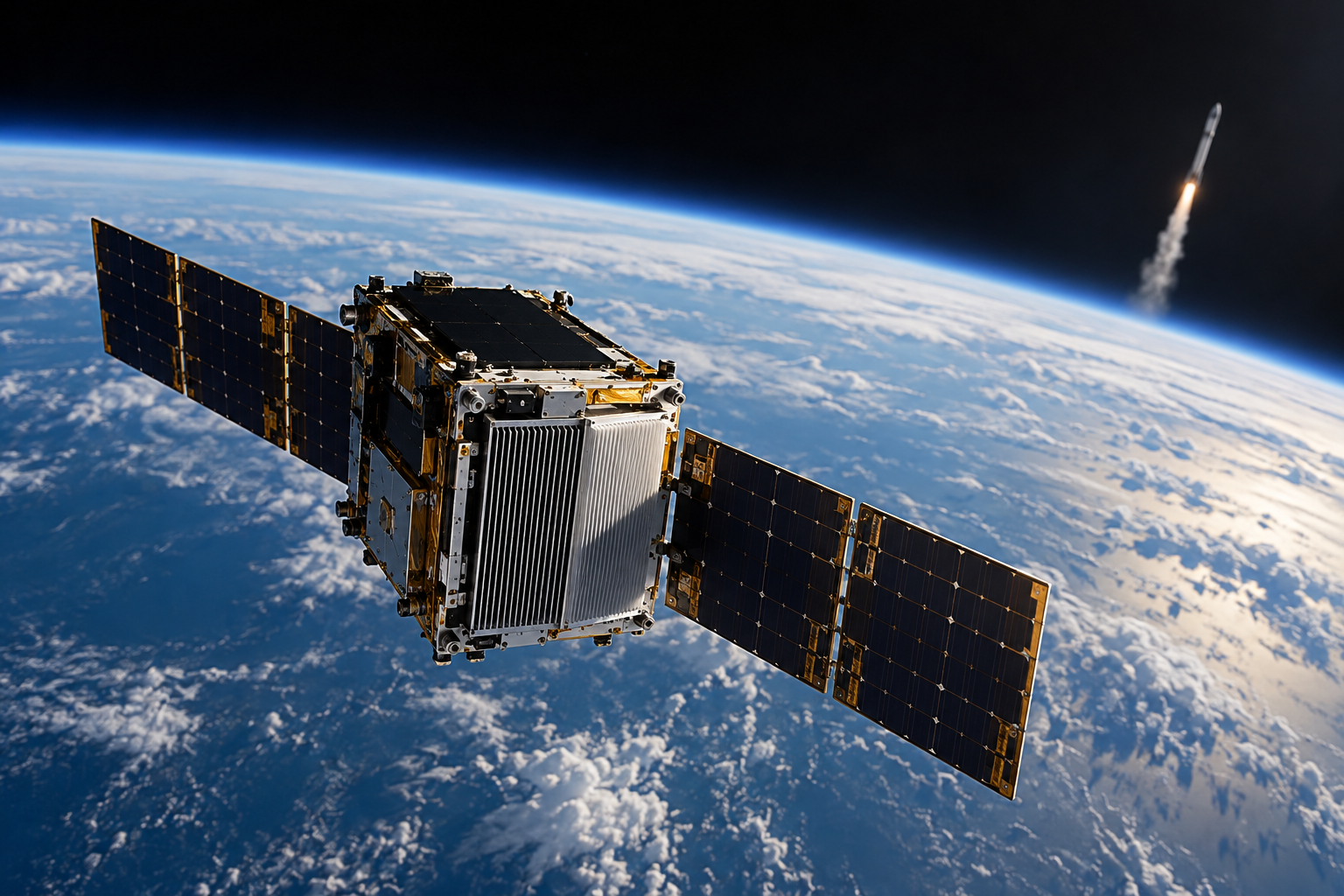
Google's Tensor Processing Units go into low Earth orbit next week on a prototype satellite built to find out what space does to them. SpaceX, which provides the launch, has orbital data center plans of its own.
Google's first attempt to learn whether its AI chips can work in space will ride to orbit on a rocket from a company pursuing the same idea.
Next week Alphabet's Google will put a prototype satellite into low Earth orbit as the opening experiment of Project Suncatcher, its research program on whether computing for artificial intelligence could one day be done in space at scale. The satellite goes up on SpaceX's Transporter-18 rideshare mission, and Planet Labs is Google's satellite partner.
The payload is a set of Google's Tensor Processing Units, and the experiment is basic by design. Engineers want to know whether the chips come through the shaking of launch, whether they hold up under orbital radiation and temperature swings, and whether they keep computing accurately once there. Radiation is the main hazard, because charged particles can corrupt stored data by flipping individual bits, or wear down circuits over time. Google has already run AI workloads on TPUs at a University of California, Davis facility, but the company says only a real orbit can show how the hardware behaves.
Heat is the other problem. Fans do nothing in a vacuum, so Google is trying a thermal system built from heat pipes and radiators.
Google has set expectations low. It describes the mission as a way to collect data and find what breaks, not as a working data center in orbit. Two more satellites follow in 2027 to try out the laser links that would carry data between clusters of orbiting computers.
The appeal of the idea is energy. In the right orbit, a satellite sees the sun almost all the time, and AI computing needs enormous amounts of power that grids on the ground are straining to deliver. Oracle's New Mexico data center campus is waiting on a gas pipeline that is running close to six months late after repeated permit rejections.
Google is not the only company working on the concept. SpaceX and Starcloud both have plans for data centers in low Earth orbit, and SpaceX is building Gigasat facilities in Bastrop County, Texas, to produce AI satellites and solar cells across as much as 11 million square feet. On the ground, Google already buys computing capacity from SpaceX under an agreement running through mid-2029.
Researchers outside the companies say orbital computing is still years from making commercial sense, pointing to launch costs, engineering limits and how slowly satellites can be manufactured.
The prototype's results will decide the next step. If the TPUs finish their workloads without piling up radiation errors, and the heat pipes keep them cool enough, the 2027 laser-link satellites go ahead as planned. If not, Suncatcher's next launch is more likely to carry a redesign.