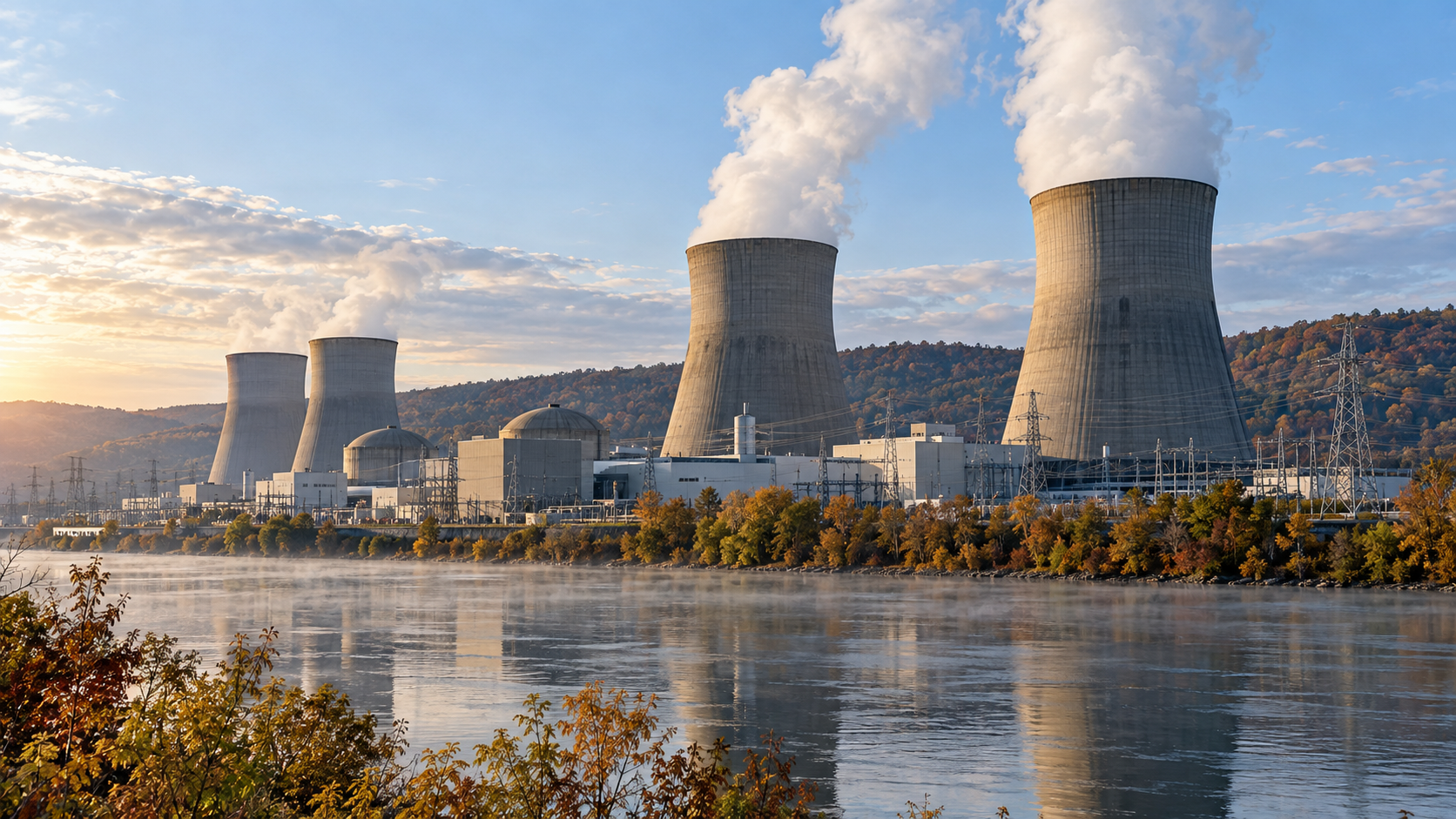
The 20-year agreement covers 890 megawatts of new capacity from upgrades at 11 reactors, plus a 15-year contract on 2,700 megawatts of existing output. Price terms were not disclosed, and Vistra and Talen rallied alongside.
Equity Markets · FinancialMarkets.com · October 6, 2026 · Tickers: CEG, GOOGL, VST, TLN, NRG, CCJ, LEU, XLU
Constellation Energy and Google announced the headline figure, 3.6 gigawatts, on Tuesday morning. The market paid for much more than the part that is new.
Under a 20-year power purchase agreement, Google will fund equipment upgrades at 11 Constellation-owned nuclear units in Illinois, Pennsylvania and New Jersey, adding 890 megawatts of capacity to the PJM Interconnection grid. Constellation said it will invest more than $4.3 billion across six plant sites, with the first of these so-called uprates expected by 2028. In a separate 15-year agreement, Google will take 2,700 megawatts from Constellation's existing PJM fleet. The companies also expanded a five-year technology alliance under which Constellation uses Google Cloud and Gemini Enterprise.
New versus existing capacity
Of the 3,590 megawatts covered, 890, or about 25%, is new. The other three-quarters is output Constellation already produces, now sold under a long-term contract instead of into the wholesale market. The 890 megawatts equal about 1.6% of the 55 gigawatts of generating capacity the company reports.
With the price kept private, revenue per megawatt-hour and the return on the $4.3 billion remain open questions. The investment works out to at least $4,830 per kilowatt of new capacity, a floor because the commitment is "more than" that sum. The $4.3 billion is Constellation's spending, not a payment from Google.
The stock move
Constellation shares opened at $291.11, up 8.8% from Monday's close of $267.62, reached $309.80 and traded near $302.92 at about 2:15 p.m. Eastern, up 13.2%. That added about $12.7 billion of market value, roughly 2.9 times the investment Constellation committed. Even after the gain, the stock sat about 27% below its 52-week high of $412.70.
The deal is Constellation's second 20-year nuclear contract with a technology company in a week. On Sept. 30 it signed a 190-megawatt agreement with Amazon at its Calvert Cliffs plant in Maryland.
The rest of the group
Companies that were not party to the agreement rose nearly as much. Among merchant generators, NRG Energy added 7.4%, Vistra 10.6% and Talen Energy 11.9%. Uranium and nuclear-supply stocks followed: Centrus Energy rose 10.6%, BWX Technologies 8.1% and Cameco 8.0%. The Utilities Select Sector SPDR fund gained about 2.5%, making utilities the best-performing sector in the S&P 500. Alphabet rose about 0.5%.
Measured against Vistra, Constellation's own outperformance was about 2.6 percentage points. Against Talen it was about 1.3 points.
The investor debate
The case for the re-rating rests on contract length and the type of capacity. Uprates add output at plants that are already running and connected, avoiding the multiyear timelines and interconnection queues facing new construction. A 15-year contract on 2,700 megawatts replaces exposure to wholesale prices with a fixed counterparty on a large share of the PJM fleet. Contracts of 15 and 20 years are the kind of revenue a merchant generator typically lacks.
The case for caution starts with the price, which is private, then the mix: three-quarters of the megawatts already exist and only the first uprate has a date. The peer rally also complicates the story. If investors were valuing Constellation's contract alone, Vistra and Talen would have had less reason to rise by double digits. Their gains suggest investors may be repricing what hyperscalers could pay for around-the-clock nuclear power across the group, including companies without a signed deal.
Signposts
Three things will separate the two. The first is whether Constellation holds its gain relative to Vistra and Talen over the coming sessions. The second is any filing or presentation that puts revenue or earnings figures on the contract. The third is whether Vistra or Talen announces a comparable agreement of its own, which would test whether the group move was anticipation or overreach.