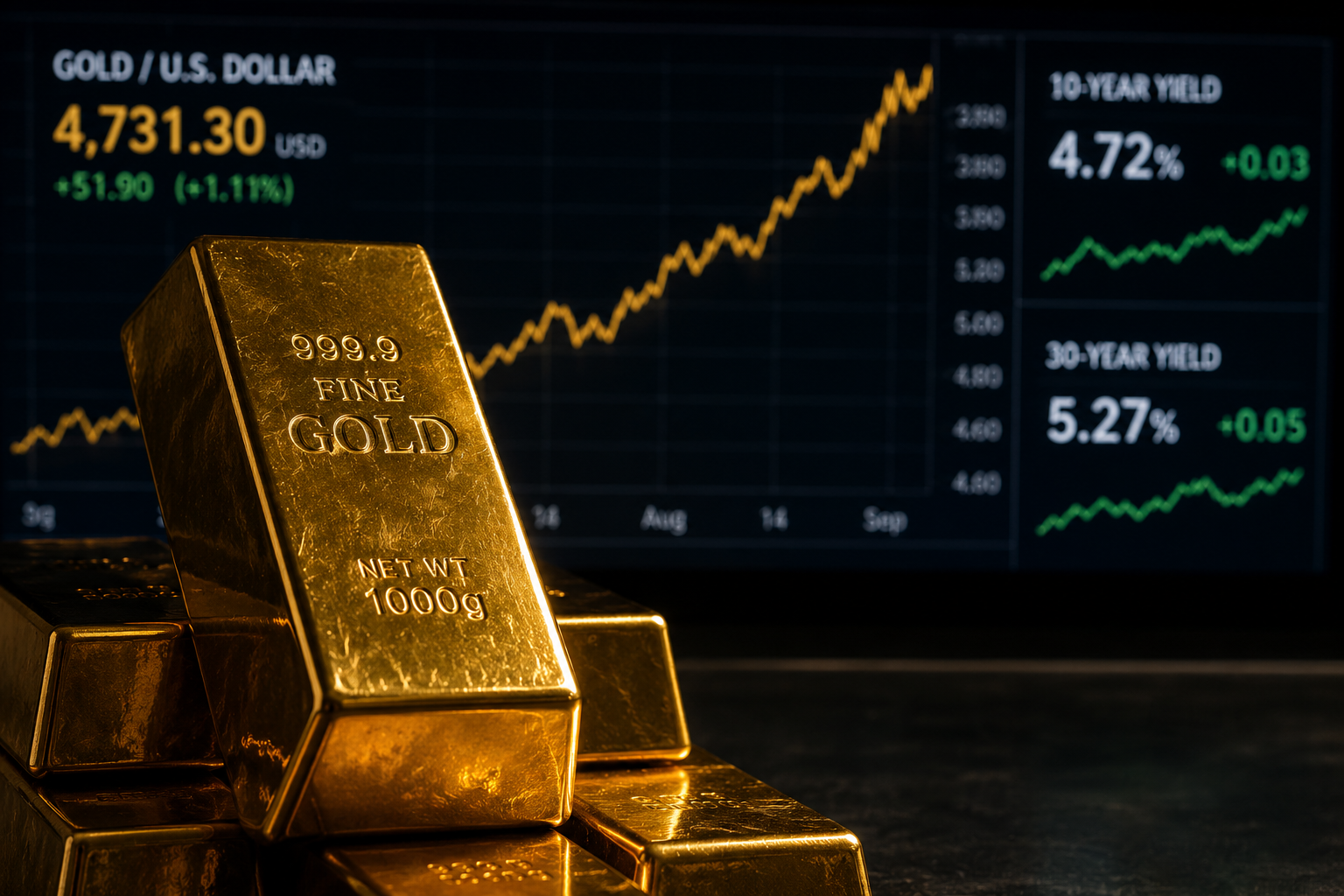
Spot gold traded near $4,731 to $4,734 an ounce Monday, up roughly 1.1% on the session and about 4% higher than the $4,540 level it touched just three sessions earlier. This is not a one-day spike. Daily closes climbed from $4,437.30 on August 14 to $4,473.70, $4,420.60, $4,545.30, $4,571.40, and $4,680.60 through last Friday before Monday's push to $4,731.30, an accelerating uptrend spanning nearly two weeks.
What makes that run worth examining is what it is running alongside. The 10-year Treasury yield has held near 4.69% to 4.74%, and the 30-year has sat between 5.23% and 5.31%, both multi-cycle highs. Under the relationship that has governed gold pricing for decades, that combination should not exist. Gold pays no coupon, so when long-end yields rise, the opportunity cost of holding bullion rises with them, and gold is supposed to fall. Instead it has climbed in the same window long yields climbed. Something in the usual mechanism has broken, and figuring out what replaced it is the story.
A fiscal story, not a growth or inflation story
Financial press has started calling gold's advance a "$40 trillion fiscal fear trade," a phrase that lands squarely on the number Treasury Secretary Bessent invoked on August 20, when he said there is "nothing magic about the $40 trillion number" while discussing the Treasury's buyback program. If gold and long yields were rising together on expectations of stronger growth or a fresh inflation impulse, the standard playbook would still hold: real yields would be climbing for a reason gold could tolerate. But the coverage attaching itself to gold's move is not describing a growth story. It is describing a credibility story, one in which markets price a widening gap between the scale of federal debt and confidence in how it eventually gets serviced. In that framing, long-end yields rise because bondholders demand more compensation for fiscal risk, and gold rises for the same underlying reason, not despite it.
Citi's Dirk Willer has put a number on that thesis, attaching a $5,000 to $6,000 an ounce price target within a year to a fiscal-debasement view of gold demand. That is a single desk's forecast, not a consensus figure, and it should be read as one bank's directional bet rather than a market-clearing price. Still, a target that far above Monday's $4,731 print signals that at least one major institutional research desk sees the current move as early rather than extended.
A second driver, not a rival theory
Dollar weakness is also cited by market coverage as a driver of gold's rise, running alongside the fiscal narrative rather than competing with it. A weaker dollar mechanically makes dollar-priced gold cheaper for holders of other currencies, which can lift demand independent of any view on U.S. fiscal credibility. The two forces overlap in practice, since a currency's weakness and doubts about the government issuing it tend to move together, and coverage does not cleanly separate how much of the advance is fiscal fear versus currency momentum versus positioning that feeds on itself once a trend is established. The fiscal-debasement framing is the dominant one in current reporting; dollar weakness is an additive factor layered on top of it, not an alternative explanation splitting the story in half.
Miners are moving faster than metal
Gold-mining equities have reportedly outpaced bullion on days when spot gold itself was flat to lower, with Newmont (NEM) up 2.2% and Agnico Eagle (AEM) up 2% on one such session. Miners carry operating leverage to the gold price, so a disproportionate equity move on a quiet metal day means positioning is running ahead of spot in places. That is a distinct signal from the debasement thesis and worth tracking on its own, via names like these or a basket such as GDX.
ByteTree's Charlie Morris has separately flagged that mine supply is growing only around 2% a year, a structural constraint that doesn't explain a two-week acceleration but helps explain why demand-side narratives can move price sharply once they take hold.
The threshold to watch
The relationship to watch is gold's correlation with the 30-year yield, not gold's level in isolation. If the 30-year stabilizes or falls while gold keeps climbing, the debasement framing gains support. If gold's rally stalls while long yields keep grinding higher, the conventional opportunity-cost relationship may simply be reasserting itself with a lag. Citi's target puts a specific number on that fork: a close above roughly $5,000 an ounce, itself a track for GLD and IAU holders, would put Willer's 6,000 call on the verge of playing out within its stated one-year window. Gold sits about 6% below that line as of Monday's close.