A second guidance raise, a 41% EPS jump, and a truck launch that has to carry 2027 across six plants.
By FinancialMarkets.com · July 22, 2026
Six months ago, the smart framing on General Motors was survival. Tariffs were biting. Commodity costs were climbing. The company was writing billion-dollar checks to unwind an electric-vehicle buildout that got ahead of demand. The year was supposed to be about absorbing all that. Instead, GM on Tuesday raised its full-year guidance for the second time. Adjusted earnings per share jumped 41%. The stock climbed more than 3% by midday.
Which means the debate has quietly changed shape. Nobody is asking anymore whether GM can get through 2026. The question now is whether the margins it is defending this year can make it through next year, when the company bets its most profitable franchise on a truck launch spread across six plants.
The Quarter Deserved the Applause
Give the print its due. Adjusted earnings of $3.57 a share sailed past a consensus that sat between $3.13 and $3.19, depending on whose estimate you prefer. Revenue of $48 billion grew 1.9% and beat the roughly $46.6 billion analysts expected. Adjusted operating profit rose 30% to $3.9 billion against a Street number near $3.7 billion.
Almost all of that came from North America, where GM earned $3.4 billion, up more than 40% from a year ago. The region''s margin expanded two and a half points to 8.6%, which puts it back inside the company''s 8% to 10% target range for the first time since tariffs knocked it out. Finance chief Paul Jacobson called that "a clear marker of the progress this team has made," and for once the numbers carry the boast comfortably.
Here is why the margin looks earned rather than manufactured. Average transaction prices ran about $52,400. GM spent 4.7% of sticker price on incentives. The industry averaged 6.3%. Dealer lots held 511,000 vehicles, about 55 days of supply, right in the middle of the target range. Chief Executive Mary Barra noted that GM''s share of full-size pickups topped 42% in the first half. That is more than ten points clear of its nearest rival, and share is still growing. Companies that discount to move metal do not post numbers like these. This is pricing power resting on products people actually want.
Even the fleet business, historically where excess production went to die, pulled its weight. GM had its best first-half fleet run in more than five years, with record pickup deliveries to commercial customers and its strongest government sales since 2009. Jacobson insists the growth came "without diluting margin." The segment results support him, though GM discloses too little fleet detail for anyone to check his math independently.
What the Adjusted Numbers Politely Omit
Now for the part that requires reading past the press release. GM''s reported net income fell 31% to $1.3 billion. Earnings on a GAAP basis dropped to $1.41 a share from $1.91. The gap between that and the celebrated $3.57 is the EV retreat, which cost another $2.3 billion this quarter. That money went three ways. It covered supplier settlements, shrank the battery joint ventures, and wrote off assets that no longer have a purpose.
The running total is now $10.9 billion in EV charges since the middle of last year. About $7.2 billion of it is real cash, and $4.5 billion has already gone out the door. Jacobson says these actions "substantially complete" the material cash charges, though he allowed that "we may have some true-ups." Fair enough. But a cost excluded from adjusted earnings is still a cost. Shareholders are paying tuition on a capacity bet that went badly wrong, and the adjusted figures simply decline to mention it.
Two more asterisks. GM bought back $2 billion of its own stock in the quarter. It now has 8% fewer shares than a year ago, and 35% fewer than in 2023. That is why operating profit rose 30% while per-share earnings rose 41%. The difference is arithmetic, not operations. The quarter''s eye-catching $5 billion of free cash flow, up 78%, also had help. Tariff reimbursements and capital-spending timing broke its way. Over the full first half, operating cash flow actually fell 21%. The cash story is good. It is just not as good as one spectacular quarter suggests.
The same honesty applies to the EV progress. Losses are on track to shrink by $1 billion to $1.5 billion this year, a real benefit to earnings. But EV shipments fell by 31,000 units while gasoline shipments rose by about the same. GM is still America''s second-largest EV seller behind Tesla, holding 13 to 14% of the market. Losing less money by building fewer cars is discipline. It is not yet a business.
A Guidance Raise Wearing a Seatbelt
The new outlook calls for $14 billion to $16 billion in adjusted operating profit, $12 to $14 in earnings per share, and $9.5 billion to $11.5 billion of free cash flow. Every number moved up. Yet the raise is more cautious than it appears, because GM already banked $8.2 billion of operating profit in the first half, more than half the new midpoint.
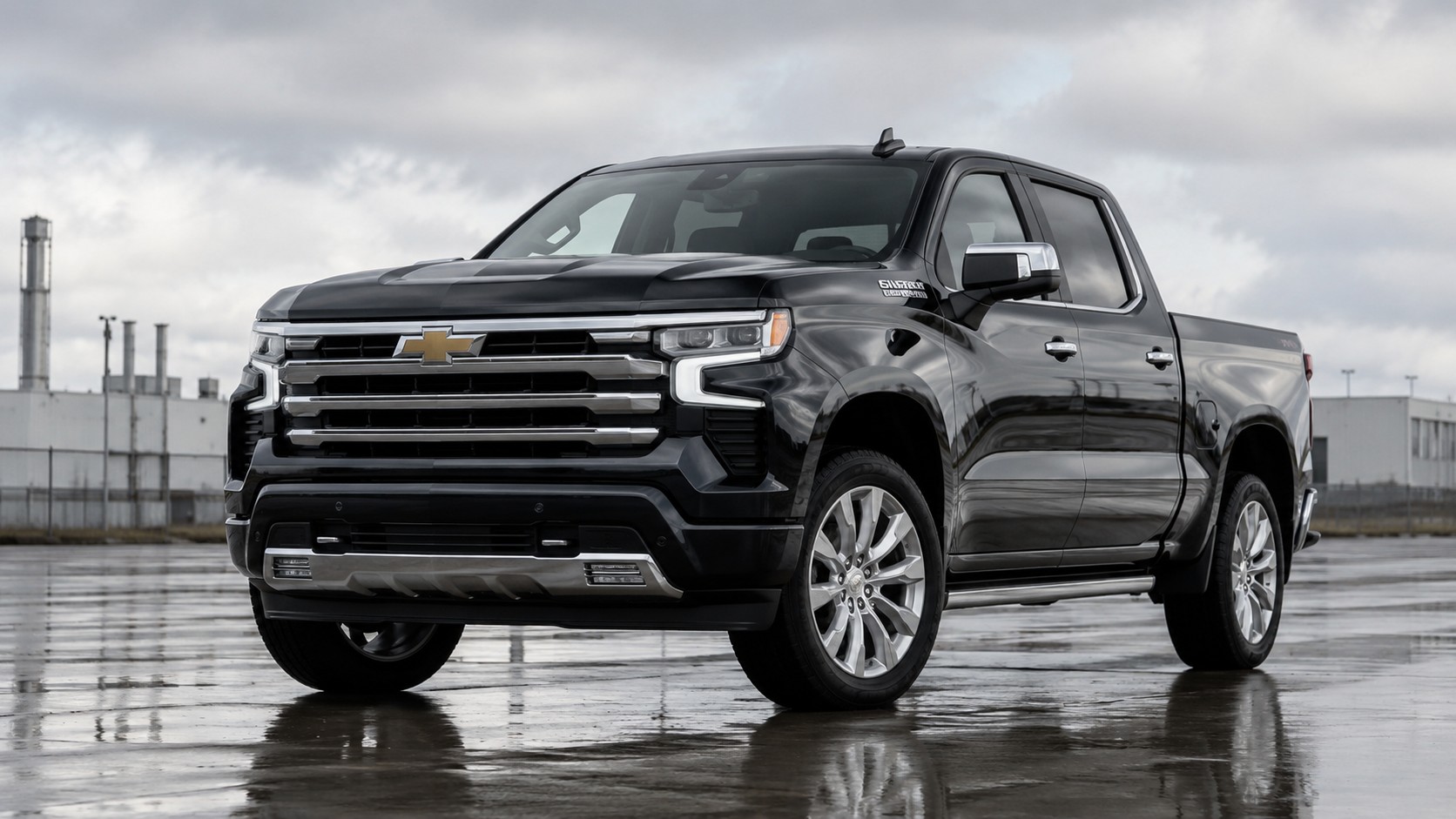
The implied second-half slowdown is intentional. Tariffs will keep costing about $900 million a quarter. The heavier share of $1.5 billion to $2 billion in commodity and memory-chip inflation lands late in the year, along with rising costs from moving production onshore. Above all, the fourth quarter belongs to the launch. The next-generation Chevy Silverado and GMC Sierra reach showrooms in December, and Jacobson warned of below-seasonal results, launch costs, and a headwind of roughly 35,000 units as three assembly plants and three engine plants change over at once.
The 2027 Promise, and the Caveat Buried in the Call
Management says 2027 brings growth in revenue, margins, operating profit and cash flow, powered by a full year of new trucks, more big-SUV capacity, double-digit growth in OnStar revenue, further warranty and EV gains, and more buybacks.
Some of that is already visible. OnStar revenue reached $800 million in the quarter, up 20%, and deferred revenue sits at $6.3 billion on its way toward $7.5 billion. Jacobson reminded listeners that GM has historically pegged OnStar margins around 70%. Super Cruise becomes standard on high-end trims of the new trucks, adding an estimated 160,000 equipped pickups next year.
But listen closely to the call and the caveats surface. Asked about truck volume, Barra said the real opportunity comes "in the very late 2027 or more in the 2028 timeframe," once every engine plant is running. Asked about truck pricing, Jacobson would commit to nothing beyond being "optimistic as we are with most new vehicle launches." And the warranty tailwind, now worth $1 billion to $1.5 billion, faces a third-quarter accrual review that Jacobson himself flagged. The 2027 bridge is plausible. It is also unquantified at its most important joints.
Tuesday''s 3% gain repriced the odds, not the company. GM still trades at the steep discount markets assign to cyclical truck profits, and part of this year''s tailwind, up to $750 million in regulatory savings, depends on Washington leaving policy alone. What investors bought was reduced risk of a stumble, earned by two guidance raises in a year that was supposed to hurt. What they have not yet bought is the future. That gets decided next year, in three truck plants, one accrual review, and a price sheet nobody has seen.