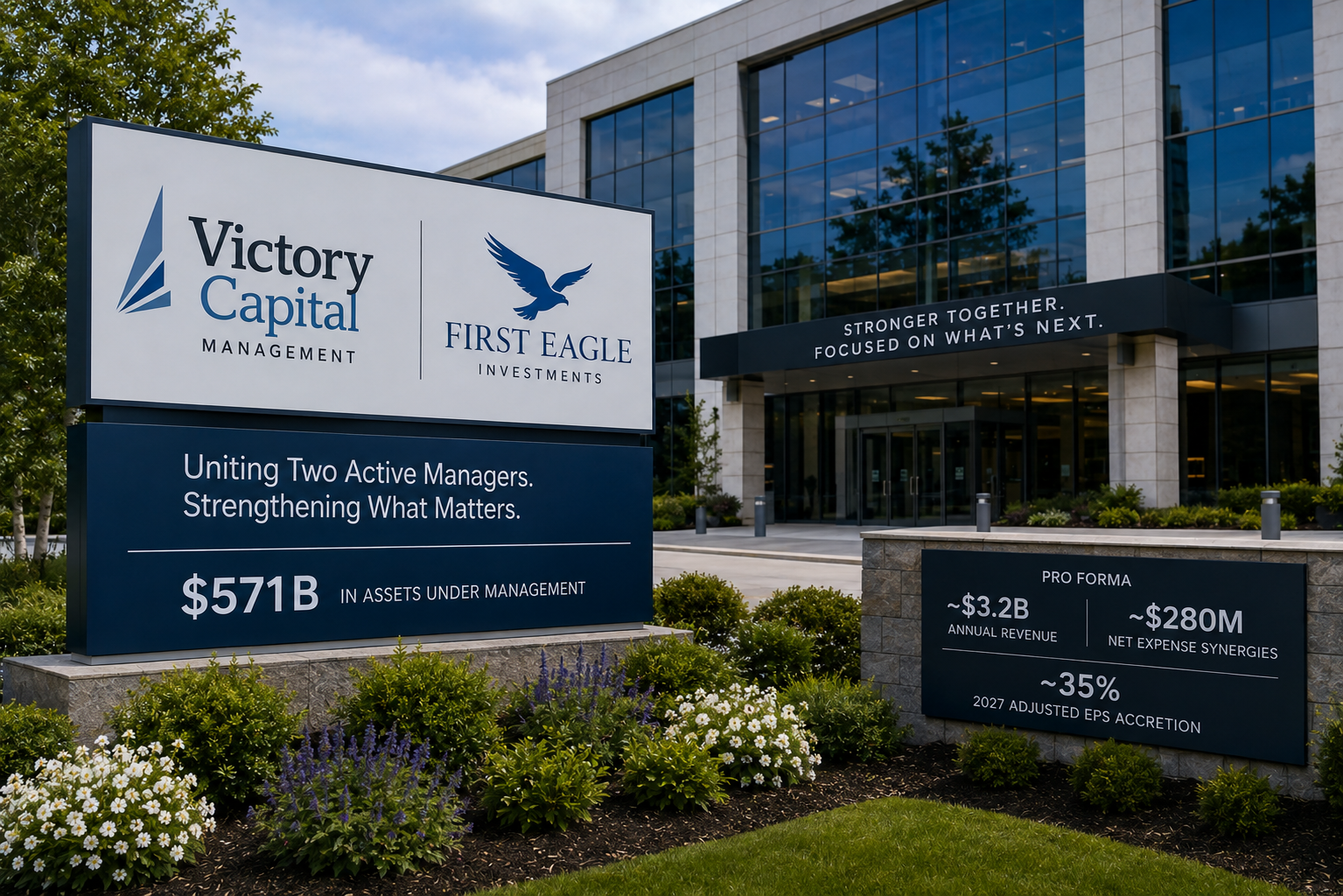
Victory Capital's purchase of First Eagle Investments closes out a roughly 17-month private equity hold and builds a $571 billion asset manager, financed with cash, new stock, and Genstar taking equity instead of a full exit.
Victory Capital Management has agreed to acquire First Eagle Investments from Genstar Capital and First Eagle's employees for approximately $7.0 billion. The deal combines two active-management firms into one with roughly $571 billion in assets under management. Victory Capital is paying with a mix of about $4.4 billion in cash, approximately $2.0 billion in newly issued common stock, and the assumption of $575 million in First Eagle's existing 7.25% senior secured notes due 2032.
The deal is notable first for its timing. Genstar took majority control of First Eagle in a transaction announced March 3, 2025, acquiring the stake from Blackstone and Corsair Capital. Selling roughly 17 to 18 months later is a short hold for a private equity firm exiting a scaled asset-management franchise. Businesses of this kind are more commonly held for several years before a sale, an IPO, or a merger with another sponsor-owned platform.
What sets this exit apart from a simple flip is what Genstar is taking in return. Rather than converting its full stake to cash, Genstar will hold approximately 14.6% of Victory Capital on a fully diluted, as-converted basis once the deal closes. That stake comes with contractually limited influence: Genstar's voting power is capped at 4.9%, well below what its economic ownership would otherwise represent. The firm is retaining meaningful upside in the combined company without the governance weight that ownership of that size would normally carry.
Victory Capital is financing the transaction with a substantial new debt package. The company has arranged a $3.5 billion term loan B, approximately $950 million in secured notes, and an upsized $200 million revolving credit facility, with BofA Securities and RBC Capital Markets arranging the financing. Combined with the $575 million in assumed First Eagle notes, the deal materially increases Victory Capital's leverage in exchange for scale.
That scale is the case management is making to shareholders. First Eagle managed approximately $222 billion as of July 31, 2026, versus Victory Capital's $348.8 billion on the same date. Together, the companies project pro forma annual revenue of approximately $3.2 billion and expect around $280 million in net expense synergies. Management is forecasting roughly 35% accretion to Victory Capital's 2027 adjusted earnings per share. The deal is expected to close by the end of the first quarter of 2027, pending regulatory approvals and client consents, the latter a standard but non-trivial requirement given First Eagle's institutional and fund client base.
The financing structure leaves one question open. A sponsor selling for cash signals confidence that a full realization is the right call. A sponsor rolling equity into the acquirer signals a bet that the combined entity's shares will appreciate. Genstar has done a version of both, taking $4.4 billion in cash off the table while still holding a stake now worth roughly $2 billion in Victory Capital stock. That split does not by itself distinguish genuine conviction in the consolidation math from a sponsor content to bank most of its gain in cash while treating the stock as a bonus with limited control attached. The voting cap points toward the latter reading: it suggests Victory Capital's board wanted Genstar's capital without giving it a proportional say in how the combined company is run, a structure closer to a financial accommodation than a strategic partnership.
Several details of the transaction remain undisclosed. The precise percentage of First Eagle held by the selling employees, distinct from Genstar's majority stake, has not been made public, and no minority co-investors beyond Genstar and First Eagle's employees have been identified. First Eagle's standalone revenue figure was not disclosed alongside the deal terms, so the transaction cannot yet be benchmarked against a revenue or AUM multiple.
For Victory Capital shareholders, the immediate exposure is on the balance sheet now: roughly $4.85 billion in new debt and a large new block of equity, both taken on to fund an acquisition nearly as large as the acquirer itself by revenue. The projected synergies and earnings accretion are management's own stated justification for that leverage, and they are the numbers against which this deal's price will be measured.