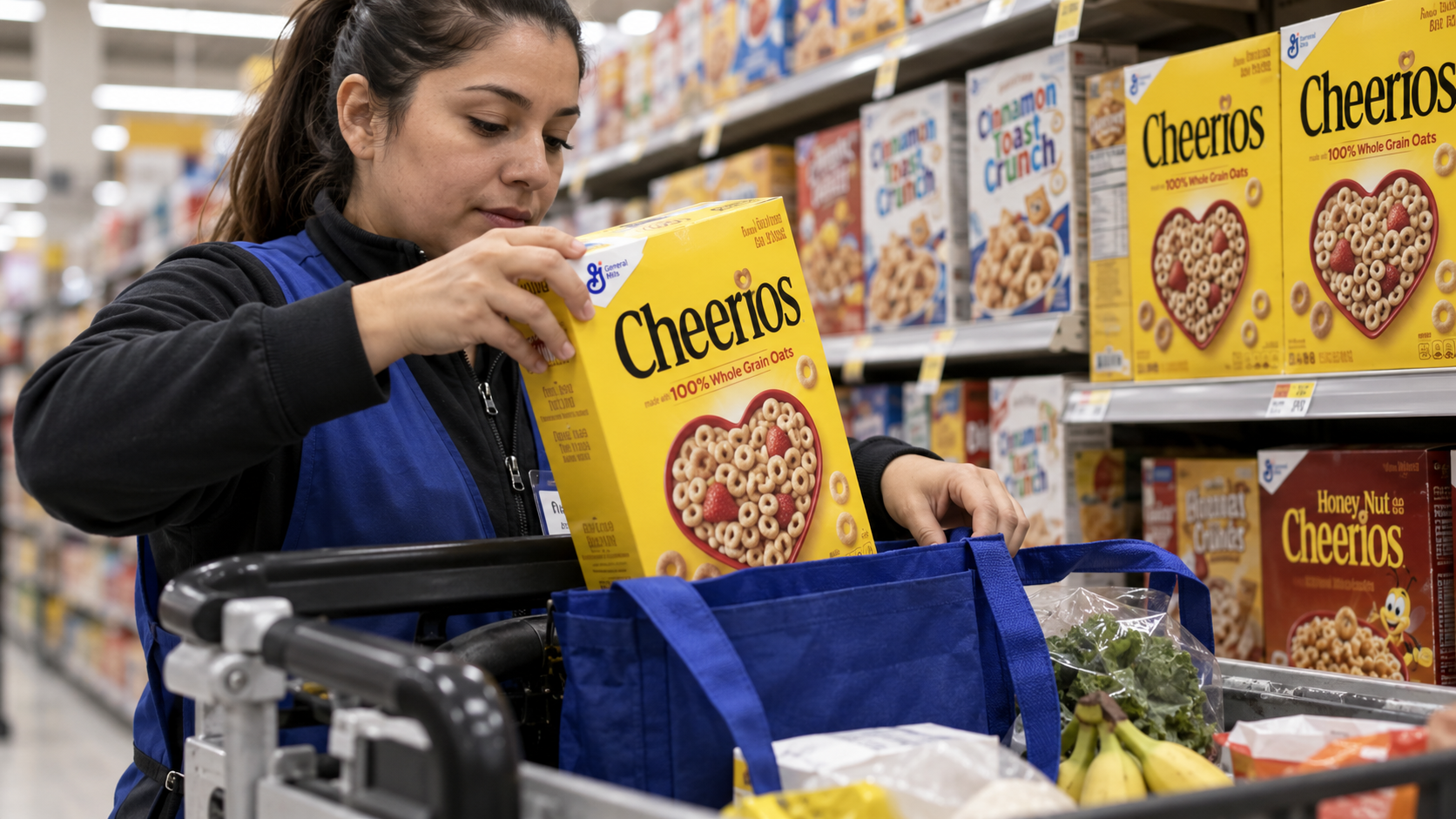
The Cheerios maker reaffirmed a forecast for lower profit this year after a quarter of flat organic sales. Its operating chief also estimated that agentic commerce will account for about 20% of food sales by 2030.
General Mills gave investors two timelines on Wednesday. One covered the current fiscal year and pointed to lower profit. The other stretched to 2030 and pointed to a very different way of selling food.
For the fiscal first quarter, net sales fell 3% to $4.39 billion, and organic sales were flat. Diluted earnings dropped 67% to 74 cents a share. Most of that decline reflects a comparison with the year-earlier quarter, which included a $1.05 billion gain on the sale of the company's yogurt business, along with lower operating profit and higher interest expense this year.
Adjusted earnings, which exclude items like that gain, came to 75 cents a share, down 13% in constant currency. Analysts had expected 72 cents. Adjusted operating profit was $634 million, down 11% in constant currency.
The company reaffirmed its full-year outlook. It expects organic net sales to range from a 1.5% decline to a 0.5% increase, adjusted operating profit to fall 8% to 13% in constant currency, and adjusted earnings of $3.00 to $3.20 a share. It expects free cash flow to equal about 95% of adjusted after-tax earnings. Shares rose about 0.5% to $35.61.
The more unusual part of the day came from Chief Operating Officer Dana McNabb. "We know just in this last month alone that 40% of consumers used an AI tool to make a purchase in food," she said. "I mean, who knows, but our early estimates are that agentic commerce will be about 20% of food sales by 2030."
That estimate points to a different kind of competition for a packaged-food company. Brands like Cheerios have been built to win attention on a store shelf. An AI agent assembling a weekly order may weigh price, nutrition, past purchases and a user's stated preferences instead.
The same week offered a live example of how contested that channel already is. Meta's new Muse agent has climbed app-store charts on its shopping and reservation features, and Amazon has blocked it from buying on Amazon's site.
General Mills did not say how it plans to compete for placement inside agent-driven orders.
Its near-term results and its long-term forecast both run through the same question: whether its brands can hold volume and pricing as the way consumers shop changes. The fiscal-year guide sets the first test. McNabb's 20% estimate, if it proves close, sets a much larger one before the end of the decade.