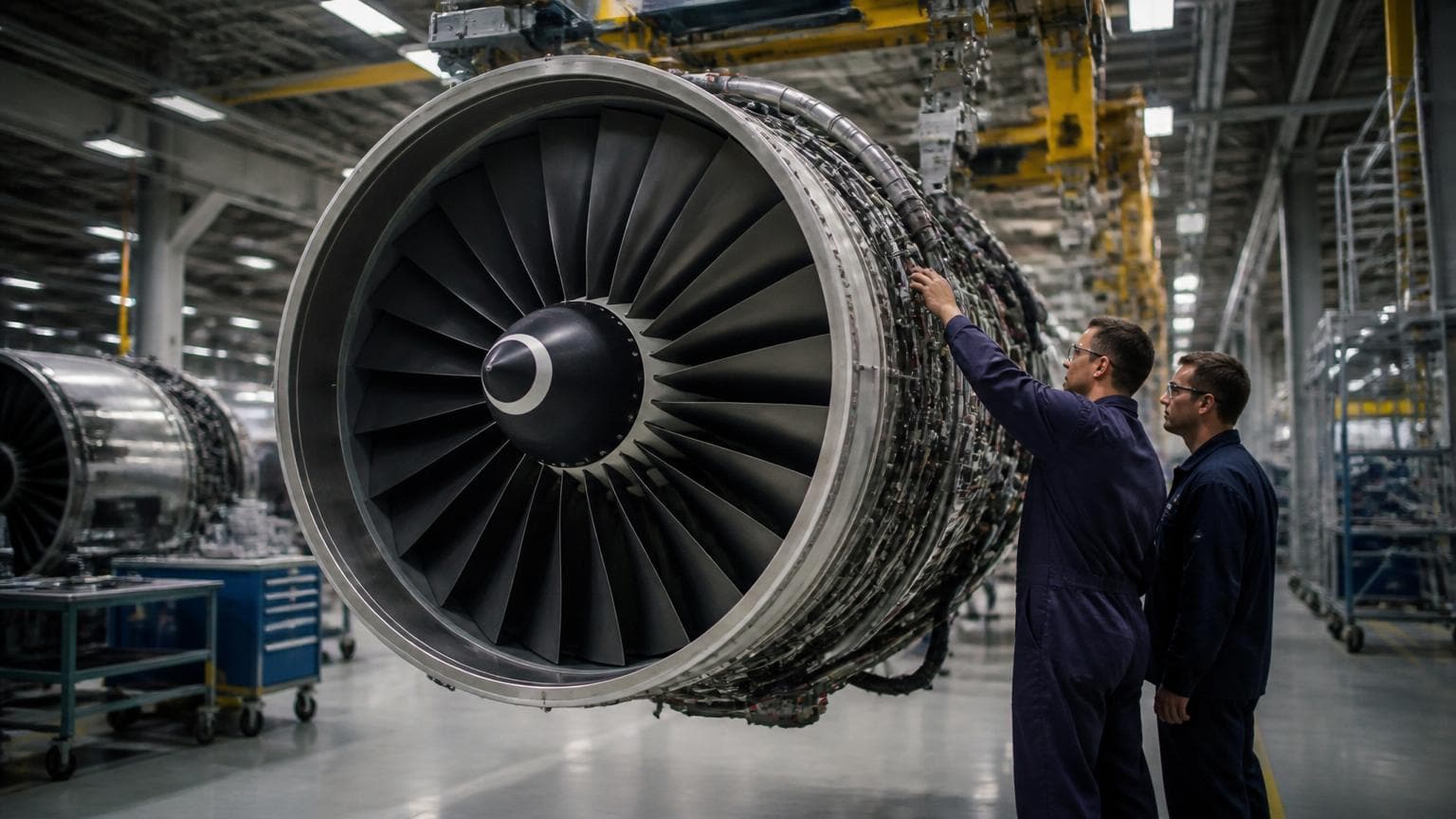
The engine maker topped every line and raised guidance across the board. The stock fell anyway. Here is why the market cares more about margins than the beat.
By FinancialMarkets.com · July 16, 2026
GE Aerospace beat on almost everything this quarter. It still fell.
The company topped estimates, raised every part of its 2026 outlook and pulled in $3 billion of quarterly free cash flow. Yet the stock dropped about 4% on the day. That gap is the story. The market has stopped asking whether demand is strong. It now asks whether GE can turn that demand into wider margins.
The answer is not in yet. That is why a very good quarter did not move conviction the way the numbers suggest it should have.
Why the beat did not lift the stock
The headline print was clean. Adjusted earnings came in at $2.02 a share, up 22% from a year ago. That beat the $1.86 consensus by nearly 9%. Adjusted revenue rose 24% to $12.63 billion, well ahead of the roughly $11.86 billion analysts expected.
The quality held up too. Of the $0.36 rise in adjusted EPS, about $0.31 came from higher operating profit. A lower tax rate and a smaller share count added the rest. The tax rate fell to 16.7%, down two points. So the beat was an operating one, not a below-the-line trick. That matters, and GE earned it.
But the stock had already priced in a lot. Shares entered the day up about 17% for the year. They trade near the mid-40s on forward earnings, far above the roughly 33 times the group average. At that level, a beat is the baseline. Investors were not asking GE to clear the bar. They were asking it to prove the bar sits higher than the price already assumes.
RBC flagged this setup before the print. The firm said the quarter might not be a catalyst because the raise was already expected. It also said investor focus is moving to 2027, when growth slows against tougher comparisons. BNP Paribas made a similar point. A strong result could still disappoint if the guidance raise fell short of bullish hopes. Both reads proved right.
Demand is no longer the question
The demand case is now hard to argue with. Commercial services revenue rose 26%. Internal shop-visit revenue grew 25%. Spare-parts revenue climbed more than 25%. First-half services revenue rose 32%, even though flights were roughly flat.
That last point is the key one. Airlines kept spending on maintenance despite high fuel costs and a soft macro backdrop. In April, GE held guidance steady and cited that same uncertainty. Three months later, it raised the outlook across the board. CEO Larry Culp said the team would make the same cautious call again. But the data forced a more confident stance.
The backlog supports the case. Commercial services obligations stand near $170 billion. The installed base should keep growing at a low- to mid-single-digit pace. Older engines still have heavy work ahead. About 70% of the GE90 fleet has yet to see a second shop visit, which carries a bigger scope. Roughly a third of the CFM56 fleet has not had a first visit yet.
Culp put it plainly. This is a supply problem now, not a demand problem. That reframes the risk, but it does not remove it. A backlog is not revenue until the engine comes off the wing, the parts arrive and the shop has room.
The margin problem the quarter did not solve
Here is the catch. CES margin fell 160 basis points to 27.3%. First-half margin dropped 190 basis points. Spare-parts delinquencies, the orders GE cannot yet fill, rose 20% from the prior quarter. Demand is outrunning supply, and that shows up in the margin.
Management calls the pressure a matter of timing, not structure. Three forces are at work. GE is shipping more new engines, which carry thin margins early. LEAP service work is profitable but still below the wider services average. And early GE9X units lose money on each build.
The company expects each of these to turn. LEAP service margins should reach the portfolio average around 2028. GE9X losses should peak around 2028, then ease. That story is plausible. It is not yet proven. GE has to fix LEAP repair costs, absorb new-engine growth, build GE9X and cover inflation all at once. More profit dollars are not the same as better margins on each new dollar.
This is the heart of the debate. The market will accept near-term dilution from engine sales that build the future base. It is less willing to trust that every headwind reverses right on schedule.
Cash and durability point the right way
Two other items cut in GE's favor. Cash came in early and strong. Free cash flow hit $3.03 billion, a 143% conversion of adjusted net income. The new full-year cash outlook of $8.9 billion to $9.2 billion already tops what GE once pegged for a later year. Management was clear that this rate will normalize as cash grows with earnings. That is the honest read. The quarter shows a stronger cash engine, not a permanent 140% rate.
The LEAP durability kit also cleared a real hurdle. GE and Safran finished certification of the upgraded part, which should roughly double time on wing. New-build cutover starts in early 2027. That lowers technical risk. It does not end the work. GE still has to build the kit at scale and retrofit the fleet over several years.
The defense arm added quiet support. Revenue rose 16% and margin ticked up. New wins included F404 engines for Turkey's HÜRJET and CT7 engines for a UK helicopter program. Defense is a firmer second leg now. It is not yet a second engine for the valuation.
The bottom line: proof over beats
This quarter changed the question, not the verdict.
GE showed that services demand holds up even with flat flights and costly fuel. It showed that its FLIGHT DECK program is lifting output and cash. It raised guidance by amounts too large to wave off. The demand risk has clearly faded.
What is left is conversion. Margins are still falling. Delinquencies are still rising. LEAP and GE9X economics still sit years out. Rich cash conversion will cool. And the stock came in with a lot of success already in the price.
So the burden of proof has shifted. Investors no longer need GE to prove the cycle is strong. They need it to show that supply can catch demand, that LEAP and GE9X margins follow the promised path, and that rising revenue can finally lift CES margins rather than press them down. Until then, the quarter raised the numbers without fully raising the conviction.