DICK'S Sporting Goods just delivered one of its best quarters in years and watched investors erase nearly a third of the company's market value in a single day.
The retailer's core business, the DICK'S banner that has anchored the company for decades, grew comparable sales 4.9% in the quarter ended August 1. That is faster growth than DICK'S posted in the same period last year, built on both higher spending per visit and more shoppers walking through the door. Gross margin at the DICK'S banner actually improved. Management said the company gained market share. None of that sounds like a company whose stock should fall 31% in a session, wiping out nearly $5 billion in market value in a single trading day.
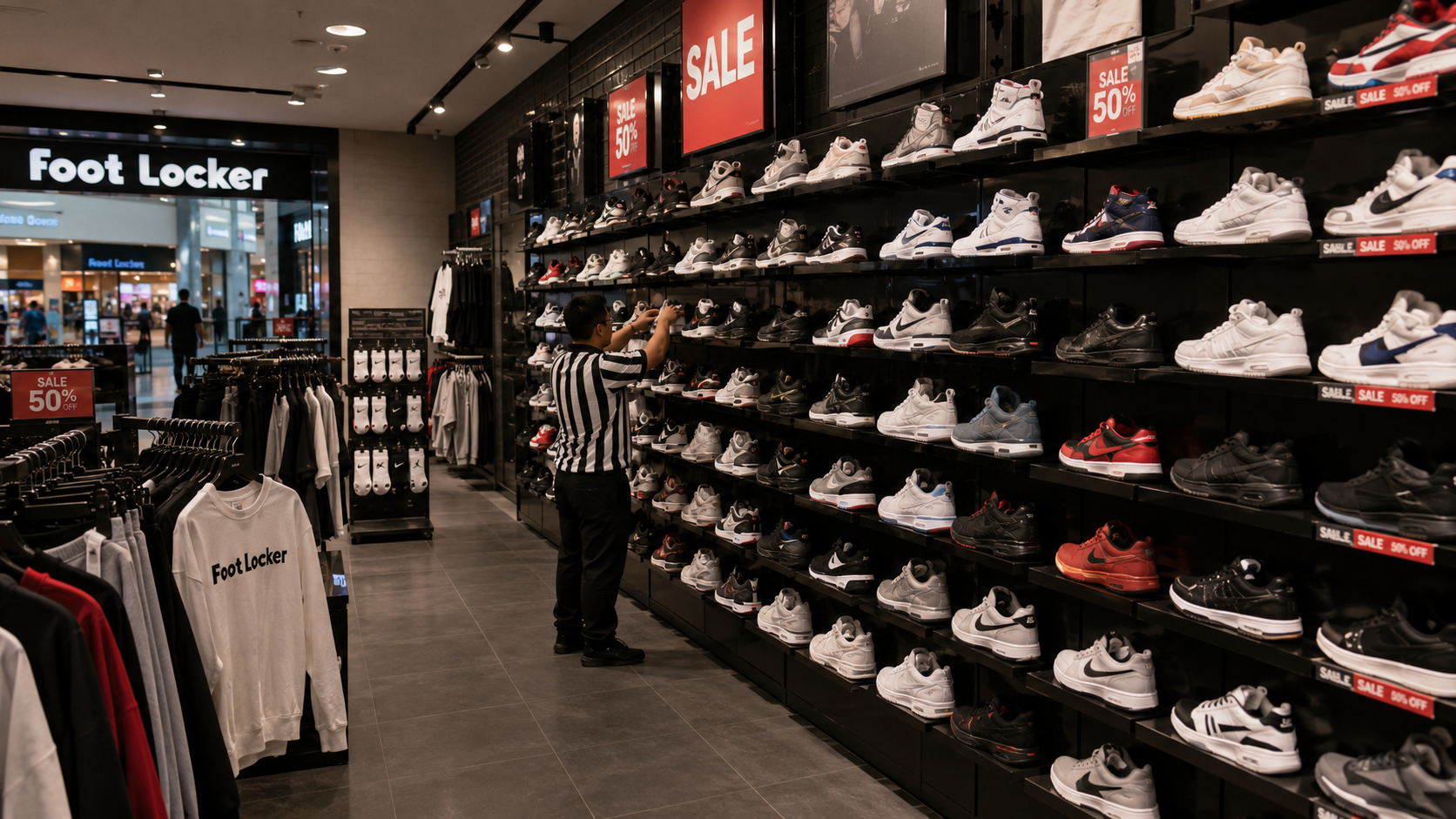
The disconnect traces back to a single deal. Last September, DICK'S closed its roughly $2.4 billion acquisition of Foot Locker, adding hundreds of footwear-focused stores across North America and Europe. This quarter, that bet went badly wrong. Foot Locker's comparable sales fell 3.6% on a combined basis, with declines in both North America and its international business. The segment posted an operating loss of nearly $32 million. And management did not just miss on Foot Locker for the quarter. It tore up the full-year plan. Just three months ago, DICK'S was guiding to Foot Locker generating $110 million to $150 million in operating profit for the year. Now it expects a loss of $40 million to $80 million. That is not a trim. It is a complete reversal, and it happened in one quarter.
Consolidated revenue reached $5.59 billion, up 53% from a year ago, almost entirely because Foot Locker's sales are now included in the total. Strip that out and the growth is real but far smaller, and the headline number actually landed just below what analysts had penciled in. Profitability told a rougher story. Adjusted earnings per share fell to $3.53 from $4.38 a year earlier, a decline of about 19%, and came in below the roughly $3.76 analysts expected. On a GAAP basis, which includes one-time integration costs that adjusted figures strip out, earnings per share fell more sharply, to $3.50 from $4.71, a drop of nearly 26%. The gap between those two numbers is itself telling: a large share of this quarter's pain is coming from costs tied specifically to digesting the Foot Locker deal, not from DICK'S underlying operations deteriorating across the board.
Executive Chairman Ed Stack was direct about what changed. Brands across the athletic footwear and apparel market turned unusually promotional as the quarter progressed, he said, and DICK'S had to respond to protect its competitive position. He argued this is not a demand problem. Shoppers are still buying, he said, but they are chasing newer, more innovative product while some of the industry's biggest legacy franchises have cooled off. He called it a natural reset that the industry has to work through periodically, language that reads as confident about the category's long-term health even while acknowledging real near-term pain. On Europe specifically, Stack was blunter: the promotional environment there is worse than in the United States, and it is weighing more heavily on results than anything happening domestically.
That confidence ran into a wall of specific questions on the earnings call that management would not fully answer. Several analysts asked for a numeric breakdown of how much of the guidance cut came from Europe versus North America. Management declined every time. Wells Fargo's Ike Boruchow asked directly why a roughly $200 million cut to Foot Locker's revenue outlook produced a roughly equal cut to its profit outlook, essentially a dollar-for-dollar hit with no cushion from cost controls. He got a qualitative answer about pricing pressure and incremental marketing spend, not the bridge he asked for. JPMorgan's Christopher Horvers asked whether the fourth quarter would look better than the third. Management said the third quarter would be tougher and declined to characterize the fourth at all.
One exchange stood apart from the rest. UBS analyst Michael Lasser asked whether there might eventually be an opportunity to rightsize or monetize parts of the Foot Locker business. Stack's answer: "the answer to your question is simply, yes." He offered no further detail. In a call otherwise dominated by defensive answers about margin pressure, that is a notably direct acknowledgment that structural changes to Foot Locker are at least on the table, even if management is not ready to describe what they would look like.
Guidance for the full year came down across the board. DICK'S now expects sales of $21.9 billion to $22.2 billion, versus $22.1 billion to $22.4 billion previously. Adjusted earnings per share guidance dropped to $11.00 to $12.00 from $13.50 to $14.50, a cut of roughly $2.50 at the midpoint, or close to a fifth of prior expectations. A higher effective tax rate, now expected near 29% versus an implied 27% before, accounts for about 35 cents of that cut on its own. Notably, guidance for the DICK'S banner's own comparable sales was left unchanged at 2.5% to 4%, reinforcing that the core business is not where the damage originated.
The market's reaction dwarfed anything happening in the sector broadly. The S&P 500 was roughly flat to slightly higher the same day, and a broad retail sector fund fell only about 1%. DICK'S alone fell 31%. Options volume ran roughly 18 times normal levels, with heavy activity in downside put contracts, a sign that traders were actively positioning for more pain rather than simply reacting to news already priced in. Peers Nike, Lululemon and On Holding all fell alongside DICK'S on the same read-through logic, even though none had company-specific news of their own that day.
What happens next depends on questions this call left open. Management insists the footwear slowdown is a temporary industry reset rather than a structural drop in demand, but it offered no data to prove that distinction, only its own read of the category. Investors will want to see whether the third quarter is genuinely worse than the fourth, as management suggested, and whether that pattern reverses on schedule. They will also want a real answer, eventually, on how much of this is Europe and how much is North America, since management's refusal to say suggests the mix may be uncomfortable. And Lasser's question about rightsizing Foot Locker deserves a follow-up. A one-word "yes" to a question about monetizing part of a $2.4 billion acquisition, only months after closing it, is the kind of admission that tends to resurface. Until DICK'S offers more than a one-word answer, the burden of proof on Foot Locker sits with the company, not with the skeptics who sent the stock down 31% in a day.