
Core inflation missed by a tenth and hike pricing jumped past 73%. The bond market moved before the data. Oil broke $100, then a second chokepoint opened in the Red Sea. Diesel passed $6. Oracle posted a record backlog and handed back its whole gap up.
Stocks fell three straight sessions this week. Then a hot inflation print sent them higher.
That reads backward. It is not. The monthly core rate ran hot. The annual core rate fell. And a rate hike was already mostly priced.
The S&P 500 closed Friday at 7,655.50, up 0.8%. The Dow closed at 52,573. The Nasdaq closed at 26,329. The VIX fell to 15.90.
The week still cost something. The S&P sits below last Friday's close of 7,718. The ten-year yield rose about 19 basis points. WTI gained roughly 10%.
Six threads, one throughline: the prices the Fed does not set are the ones deciding Wednesday.
The Market Is Already Looking Beyond the Mag 7
The Magnificent Seven reshaped the market, but leadership rarely stays concentrated forever.
As these giants mature, history shows leadership rotates toward companies with growing cash flows and scalable business models.
Our analysts believe that shift is already underway.
That’s why they created These 7 Stocks Will Be Magnificent in the second half of 2026, a FREE report highlighting the next group positioned to step into market leadership.
Core Missed by a Tenth. The Annual Rate Went the Other Way.
Core CPI rose 0.3% in August. Forecasts said 0.2%. Headline came in at 0.4%, right on target.
Then the annual figures leaned the other way. Core fell to 2.4% from 2.5%. Headline held at 3.4%.
Waller named 0.2% as his line for holding. He got 0.3%.
Contract pricing followed. A Kalshi contract on a quarter-point hike sat near 55% Thursday. By Friday afternoon the market priced better than 73%.
The Takeaway
One month broke the threshold. The trend did not. The Fed meets September 15 and 16 and decides Wednesday. It will act on a single print, not a pattern.
The Bond Market Moved Before the Data
The ten-year closed at 4.79% last Friday. It closed at 4.95% Thursday. It touched 4.985% Friday, a fresh high.
The thirty-year closed at 5.36% Thursday. Friday it reached 5.424%.
The Treasury tried to slow this. Its September 10 buyback carried a $6 billion ceiling. The operation came up short. Yields rose the same day.
The shape said more than the level. Over the week the five-year rose about 24 basis points. The thirty-year rose about 11.
Households felt it first. The thirty-year mortgage crossed 7% on one index, the first time in about 15 months. August existing home sales fell 2% from July to 3.98 million.
Builders rose with the tape anyway. D.R. Horton (DHI), PulteGroup (PHM) and Lennar (LEN) each gained more than 1.5% Friday. All three still sit far below their 52-week highs.
The Takeaway
When the middle of the curve leads, the market is pricing rates, not debt. A buyback swaps one maturity for another. Traders read it as a floor. It is not one. The next sizing update lands November 4.
He predicted the 2008 financial crisis…
He predicted Trump’s election in 2016….
He even predicted the rise of COVID-19 writing:
“The chance we don’t have something on the scale of a national pandemic in the next few years is near zero”
That was three months before the first reported case.
If he’s right again, God Bless America…
Because this crisis will be tectonic in scale…and it's going to begin with the bubble popping in AI.
Oil Broke $100, Then a Second Chokepoint Opened
WTI closed at $91.48 last Friday. It settled at $102.48 Thursday. Brent settled at $107.63.
Both pulled back Friday. WTI closed at $100.48. Brent closed at $104.82.
The energy watchdog explained part of it. The IEA cut its 2026 demand view. It said the fighting delays the recovery in oil flows into next year.
Then the map changed. Houthi forces took the Yemeni port of Mokha on Thursday. Mokha sits 50 miles from Bab el-Mandeb. Roughly 12% of world trade passes there.
Freight priced that. The Breakwave Tanker Shipping ETF (BWET) rose 11.8% Friday to a 52-week high while crude fell. Chevron (CVX) and Exxon Mobil (XOM) edged up the same session.
Goldman's Daan Struyven still calls continued Gulf exports the base case. He now calls $120 Brent plausible if attacks step up.
The Takeaway
Hormuz carries crude. Bab el-Mandeb carries containers and fuel. The two lanes now price apart. Crude fell on demand. Shipping rose on risk. Both can be right at once.
Diesel Passed $6 and a Truce Does Not Fix It
Diesel topped $6 a gallon for the first time.
Patrick De Haan of GasBuddy called it a silent killer of the economy. His point was the path. Diesel does not reach most people at the pump. It arrives inside food, goods and freight.
Those are CPI categories. The cost gets there late.
The strain is refining, not crude. The Iran and Ukraine conflicts cut refined product flows and tied up capacity.
The tape agrees. Marathon Petroleum (MPC), Phillips 66 (PSX) and Valero (VLO) each touched fresh 52-week highs Friday. Crude fell that same day.
The Takeaway
A ceasefire reopens a lane in a week. It does not rebuild a refinery. That bill lands in the October and November prints, well after Wednesday's vote.
The REAL Reason Trump Is Invading Iran
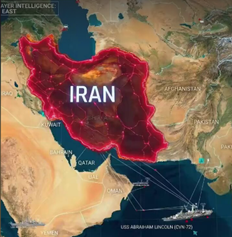
For a moment…
Forget about Trump’s ties to Israel.
Forget about reports of Iran’s nuclear program.
Because my research has led me to believe we’re risking World War 3 with Iran for a completely different reason.
Click here to find out what it is.
If you have even a single dollar invested in the U.S. stock market, this is going to directly impact you.
Oracle Gave Back Its Entire Gap Up
Oracle (ORCL) reported a record book. Remaining obligations reached $664 billion, up $209 billion in a year. Revenue rose 30%. Cloud infrastructure rose 121%.
Now the other half. Capital spending hit $28 billion in one quarter. Free cash flow ran to negative $5 billion. Full-year capex guidance is $90 to $95 billion. The revenue floor for next year is $90 billion. The company added a $20 billion equity program.
The stock opened Friday at $164.43, about 7% above Thursday's close. It closed at $150.15, below where the session started and below Thursday.
The Pentagon is separately in talks to lend $5 billion to an AI cloud startup. No terms are disclosed.
The Takeaway
Spending what you earn is not growth. It is funding. Buyers handed that book a gap up and took all of it back in one session. When private money reprices this fast, federal credit starts to look like the patient lender.
The Memory Trade Met Its First Real Argument
The case ran all week. AI needs memory. Memory is short. Prices rise.
Apple (AAPL) priced into it. Its first foldable starts at $2,000 and tops out at $3,000. That is roughly double a flagship phone, and Apple held the line rather than buy adoption.
Thursday complicated the story. Chip stocks fell hard. Nvidia (NVDA) lost 2.4%. Intel (INTC) lost 5.6%. A leveraged chip fund dropped 8%.
One outlet blamed a new Chinese model that wakes only a slice of itself per answer. Less memory per token, in theory. Five other outlets never mentioned it. They pointed to yields near 4.95%, Brent above $105, and profit-taking after a long run.
Friday settled nothing. Micron (MU) closed flat. Broadcom (AVGO) barely moved. Sandisk (SNDK) fell 3.3%.
The Takeaway
Nobody agrees why the memory trade broke. That is the finding. A position this crowded should have one clean reason. It has six. Unresolved is the honest word for it.
Why are companies flying spy planes over Elon's closely-guarded AI lab?
Elon did the seemingly impossible – far faster than anyone expected...
And it's sent the tech industry into PANIC MODE.
ChatGPT, Claude, Google Gemini, and DeepSeek could soon become obsolete.
And three little-known firms could soar 10X or higher as a result.
The week did not argue about direction. It argued about who pays.
Core inflation missed by a tenth and hike pricing jumped past 73%. The long end moved before the data and the buyback could not hold it. Oil broke $100, then gave some back as a second chokepoint opened. Diesel passed $6 with no refinery fix before winter. Oracle posted a record backlog and could not hold a gap up. And the memory trade, the cleanest story of the year, lost its clean explanation.
The earnings tape said it another way. Adobe (ADBE) beat, and the coverage went straight to the quarter that has not happened yet. Beating is no longer the question.
Monday brings the next test. The Treasury says it will sanction a large bank. It has not said which one.
Then Wednesday. The Fed votes on a price it did not set.
THE MARKET WON’T WAIT FOR YOUR INBOX
Get the Alerts That Could Move Your Money
Breaking market news, actionable trade ideas, analyst signals, and major catalysts—sent straight to your phone when they matter.
Join FinancialMarkets.comFREE market alert list today.
SEND ME THE NEXT ALERT →(free)