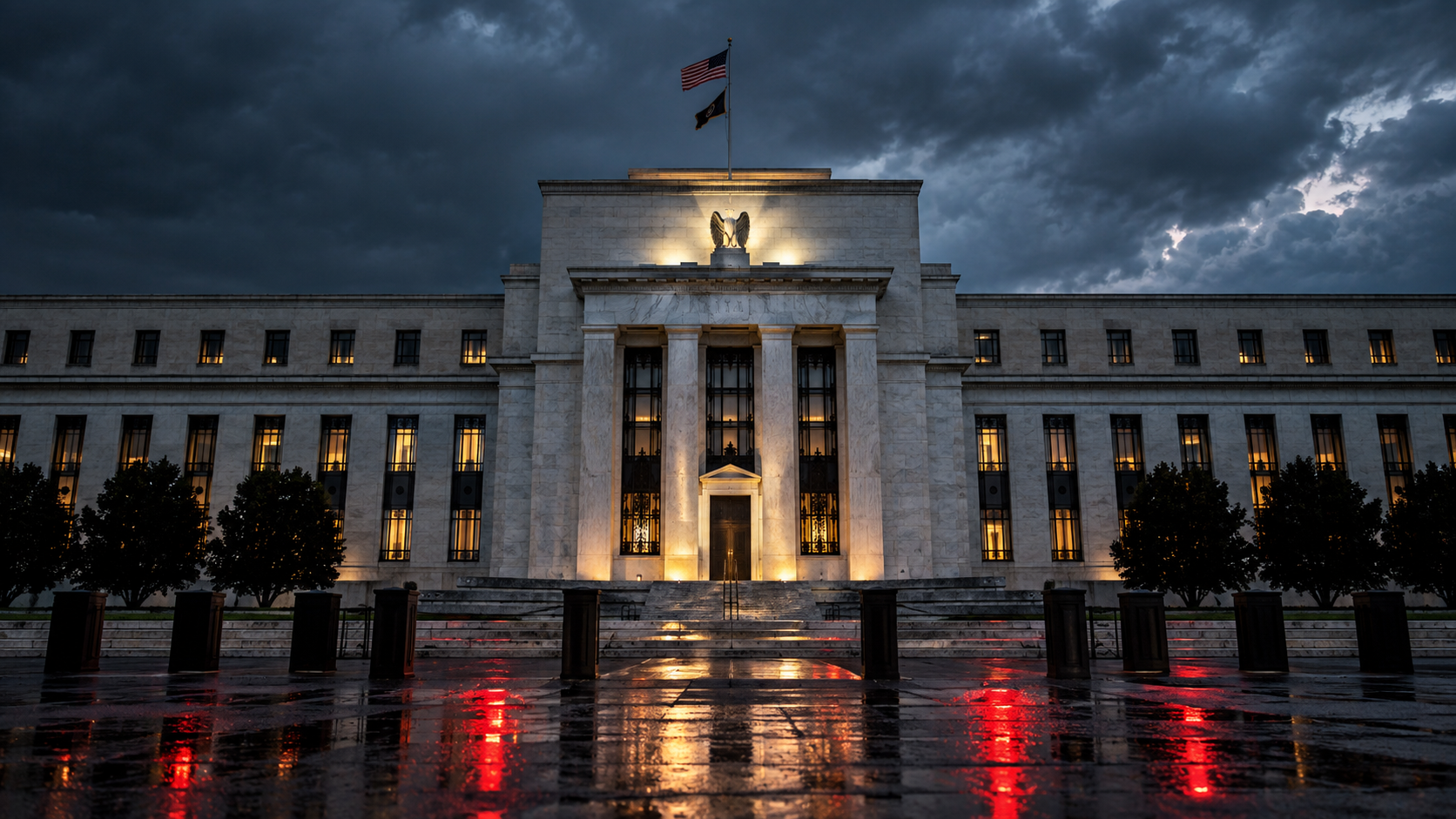
The hike was priced. The projections and Kevin Warsh's press conference were not, and stocks gave up the whole day inside 45 minutes.
The Federal Open Market Committee raised the federal funds target range by 25 basis points to 3.75% to 4.00% on Wednesday, the first increase since 2023, on a unanimous vote with no dissents.
The decision itself carried almost no surprise. Futures had assigned roughly 90% to 93% probability to a quarter-point move going in. What markets had not priced was the Committee's own projection of where rates go from here, and the Chair's description of the standard the Fed intends to apply.
The dot plot is the news
Of the 18 officials submitting projections, 12 put the appropriate policy rate at the equivalent of 4.125% by the end of 2026, one quarter-point above the midpoint of the range set on Wednesday. Four projected a further 50 basis points of increases this year. Only two indicated that the new 3.75% to 4.00% range is where policy should stay.
That is 16 of 18 officials projecting at least one additional hike in 2026, with two meetings left on the calendar. The projections are published without attributing individual dots to named officials.
Warsh set a bar the Fed says has not been met
Chair Kevin Warsh opened his 2:30 p.m. press conference by defining the test explicitly: "We must be confident that underlying inflation is moving to our objective, clearly and at sufficient speed." He followed it with the finding: "Today, the FOMC decided that this standard has not been satisfied."
He was blunter later. "The plain fact is that inflation is too high and has been for too long." On the summer's data: "This summer's inflation readings do not tell me that underlying trends have meaningfully improved." On the mandate: "Our predominant focus is on the price stability side of our mandate."
Warsh has consistently declined to offer forward guidance, and he offered none about October or December. He did not have to. The projections did the work.
The statement's redline shows what the Committee stopped saying
Three changes from the July statement matter.
The Committee deleted July's language attributing price pressure to "supply shocks that have driven price increases in certain sectors, including energy." That clause functioned as a reason to look through inflation. It is gone.
It also replaced July's reference to uncertainty owing to "the conflict in the Middle East" with the broader formulation that "while uncertainty remains elevated owing, in part, to geopolitical developments, domestic spending has been resilient." And it added a flat commitment: "The Committee will deliver price stability." A separate addition notes the Committee "is continuing its policy of maintaining ample reserves in the banking system."
The July statement also carried a dissent line that has now disappeared. Beth M. Hammack, Neel Kashkari and Lorie K. Logan voted against holding rates steady in July because they preferred a quarter-point increase at that meeting. Seven weeks later the rest of the Committee joined them, unanimously. The three officials who lost the July argument won the September one.
Markets took 30 minutes to work it out
The statement itself barely registered. The S&P 500 was at roughly 7,613 at 2:00 p.m. and roughly 7,609 at 2:30 p.m.
Then the press conference started. The index fell to 7,550 by 3:00 p.m. and reached a session low of 7,507.77 shortly after, before stabilizing. At approximately 3:45 p.m. the S&P 500 was at 7,539.92, down 0.60% against Tuesday's 7,585.73 close, having been as high as 7,626.79 in the morning.
The Dow Jones Industrial Average was down 734.84 points, or 1.41%, at 51,358.27. The Nasdaq Composite was down 0.16% at 25,940.56, cushioned by strength in semiconductors. The 10-year Treasury yield sat at 5.006%, at its session high after trading as low as 4.939% earlier in the day. The dollar index rose 0.35% to 99.968. Gold reversed a session gain of more than 1.8% to trade down 0.78%.
That is a textbook hawkish repricing, and it happened after the decision rather than on it.
What comes next
Ahead of the meeting, futures implied roughly a 50% chance of two total increases by December and about 25% for three. Analysts at BofA Securities expect hikes at both remaining meetings this year, with senior U.S. economist Stephen Juneau arguing the Committee is "basically going to undo what they did last year." Deutsche Bank chief U.S. economist Matt Luzzetti argued before the decision that "it is not clear the Fed is sufficiently restrictive," citing energy prices among forward-looking indicators pointing to a persistent inflation overshoot.
October is now the live question, and the first evidence arrives Thursday with weekly jobless claims and August housing data.