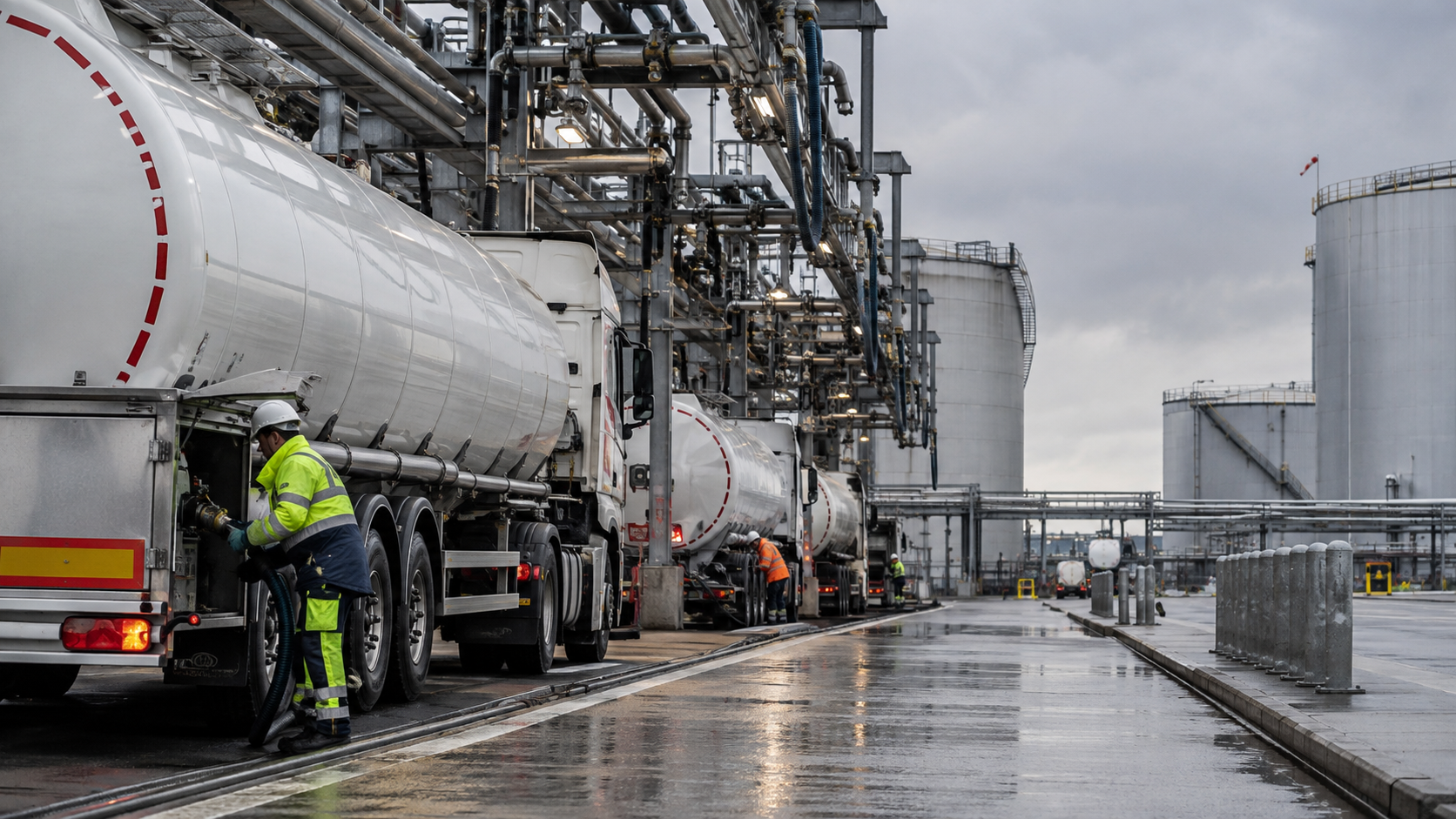
European gasoil futures jumped as much as 7% after President Trump backed the idea of a U.S. diesel export ban. New York diesel barely moved, which tells investors exactly who would bear the cost.
A policy aimed at American voters hit the market across the Atlantic first. ICE gasoil futures, the benchmark for diesel in Europe, jumped as much as 7% on Wednesday before paring gains to trade about 3% higher near $1,472 a tonne, after President Trump said he would back a ban on U.S. diesel exports. The contract is now up more than 135% this year.
New York diesel futures, by contrast, were flat. That split is the clearest read on where the burden of an export ban would land. The United States is the world's largest diesel exporter, accounting for about 20% of globally traded seaborne diesel. Keeping those barrels at home would add supply to a U.S. market where the national average price has reached $6.53 a gallon, and subtract it from a European market that has already lost access to much of its usual supply from Russia and the Middle East.
"A full or partial US export ban would therefore hit a market that is already severely short of supplies from the Middle East and Russia," Danish commodity trading firm Global Risk Management said. "Europe is particularly exposed and would have to compete more aggressively for alternative cargoes."
The administration has not committed to a design. Treasury Secretary Scott Bessent said Tuesday that officials were "examining whether it's feasible in terms of the overall refining capacity and whether a full or partial ban would work." The U.S. oil industry has opposed the idea, since export markets have been among the most profitable outlets for American refiners during this year's price surge.
European equities sorted the winners quickly. Spanish refiner Repsol gained more than 2% and Finnish refiner Neste also advanced, as investors bet that tighter transatlantic supply would widen margins for European companies with their own refining capacity. For fuel-intensive European industries, airlines and truckers, the same move points the other way.
The timing compounds a squeeze Europe has been absorbing since the U.S. war with Iran choked off liquefied natural gas shipments through the Strait of Hormuz, leaving the continent short of gas heading into winter. A diesel export ban would add a second energy shortfall to the first, this time originating with a supplier Europe had been counting on to fill gaps rather than create them.
For U.S. investors, the more immediate question is what happens to domestic refiners if their most lucrative outlet is closed. A ban would likely lower pump prices at home in the near term, but it would do so by compressing the export margins that have powered refiners' profits this year. Until the White House settles on a full ban, a partial one, or neither, European gasoil is likely to remain the market where that uncertainty shows up first and loudest.