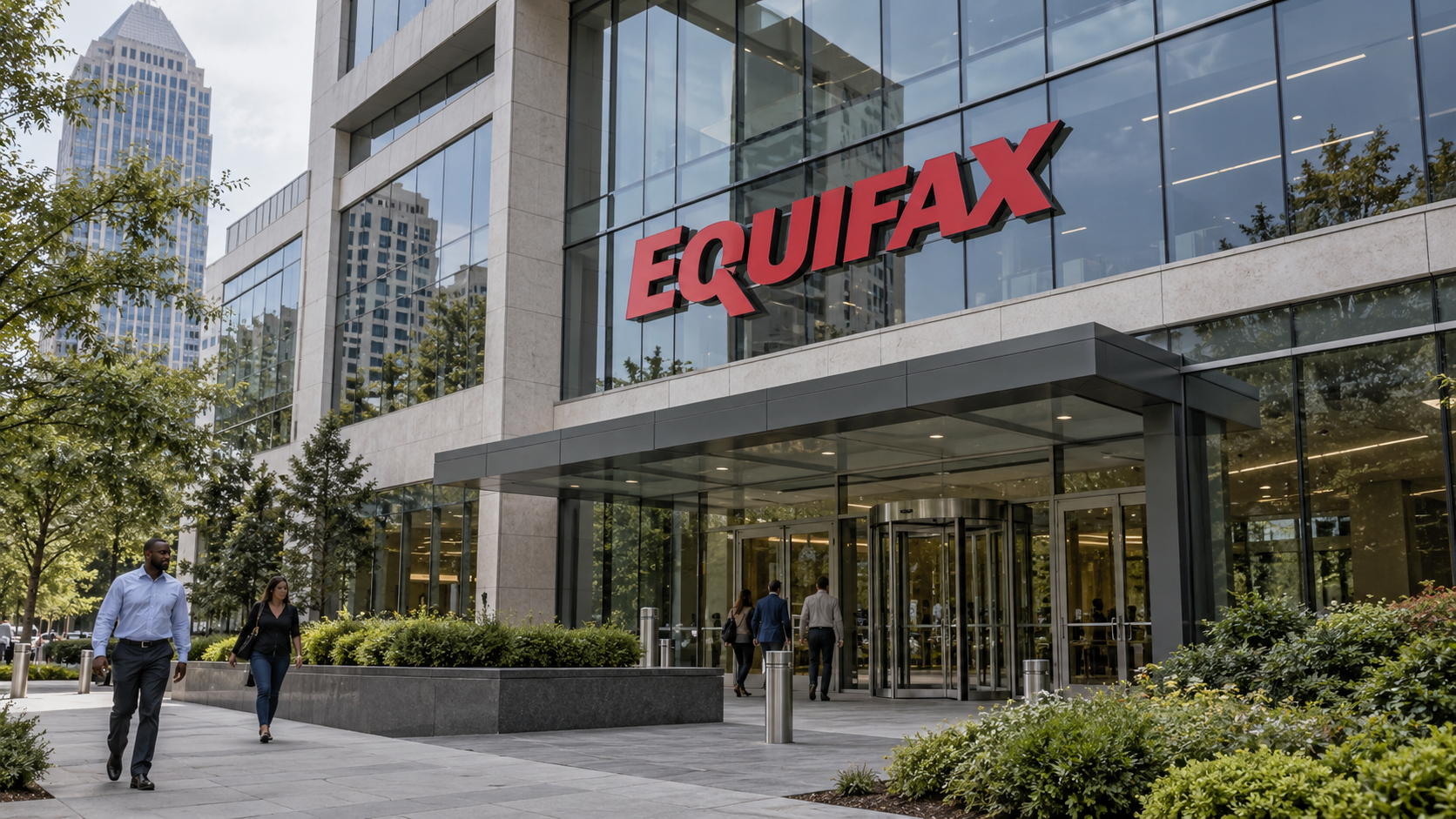
Third-quarter adjusted earnings of $2.26 a share beat estimates, and revenue rose 10%. The company lowered its full-year range and guided the fourth quarter below forecasts, but the earnings cut amounted to 4 cents at the midpoint. Several analysts had cut price targets in the week before the report.
Equifax lowered its outlook on Tuesday. Investors treated the news as better than they had feared.
The credit-reporting company said third-quarter revenue rose 10% to $1.69 billion, or 9% in local currencies, in line with forecasts. Adjusted earnings were $2.26 a share, up 11% from $2.04 and above the FactSet consensus of $2.20. The adjusted EBITDA margin widened to 33.1% from 32.7%.
It then cut its full-year forecasts. Equifax now expects 2026 revenue of $6.646 billion to $6.676 billion and adjusted earnings of $8.45 to $8.55 a share, which it described as "a reduction of only $0.04 per share at the midpoint." For the fourth quarter, it guided to revenue of $1.605 billion to $1.635 billion and adjusted earnings of $2.07 to $2.17 a share, both below analysts' average estimates of $1.682 billion and $2.18.
Equifax shares were up 10.5% at $175.24 at about 2 p.m. Eastern.
The mortgage drag
The reason for the cut is housing. "We expect the much weaker U.S. mortgage market that we saw in the latter half of the third quarter to continue through the remainder of 2026," Chief Executive Mark Begor said.
Equifax earns fees every time a lender pulls a credit file or verifies a borrower's income, so mortgage volumes flow directly into its revenue. The data released the same morning showed why the company is cautious: pending sales of existing homes fell 7.3% in September, and contracts were down in every region. Workforce Solutions, the unit that verifies employment and income, grew revenue 7% to $693.9 million, but its mortgage revenue was flat.
Why the stock rose
The rest of the business is growing faster than mortgages are shrinking. U.S. Information Solutions, the traditional credit-reporting unit, grew 13% to $599.1 million. International revenue rose 9% to $399.5 million. Non-mortgage verification, such as checks for consumer lending and government programs, is carrying Workforce Solutions while mortgage volumes stall.
Expectations also played a part. Several analysts cut their price targets on Equifax in the week before the report, and Oppenheimer downgraded the stock. A company that reports a modest cut after a run of target cuts can rally because the worst case did not arrive.
The size of the cut supports that reading. On the earnings line, four cents at the midpoint is less than half a percent of the full-year figure. The fourth-quarter revenue guide is about 3.7% below consensus at the midpoint, and the earnings guide about 2.8% below. Those are real misses, but smaller than the run of target cuts may have led investors to expect.
Market implications
One reading is that Equifax has shown its non-mortgage businesses can carry it through a housing slump. Credit reporting is growing at double digits, margins are expanding and the earnings cut was small.
A second reading is that the rally is relief, not conviction. Mortgage weakness is expected to last at least through year-end, the fourth-quarter guide is below forecasts, and a stock that rises on a guidance cut has to deliver in the next quarter or give the gain back.
What to watch
Mortgage application data on Wednesday and through the fourth quarter; Workforce Solutions' non-mortgage growth; TransUnion's next report for a read on the credit-reporting cycle; any further analyst rating changes; and the Federal Reserve's decision on Oct. 28. A further rise in mortgage rates would test whether the non-mortgage growth can keep offsetting the drag.