

Stanley Druckenmiller published an op-ed in the Wall Street Journal on Monday calling his former protégé Scott Bessent's expanded bond buyback plan a "mistake." That's already a story. But the layer beneath it is what should keep every institutional desk up at night. Bessent isn't just any Treasury Secretary meddling with yields. He was in London in 1992, on the team that made $1 billion breaking the Bank of England for doing exactly this. Druckenmiller's message to his student is really one sentence long: You know how this ends.
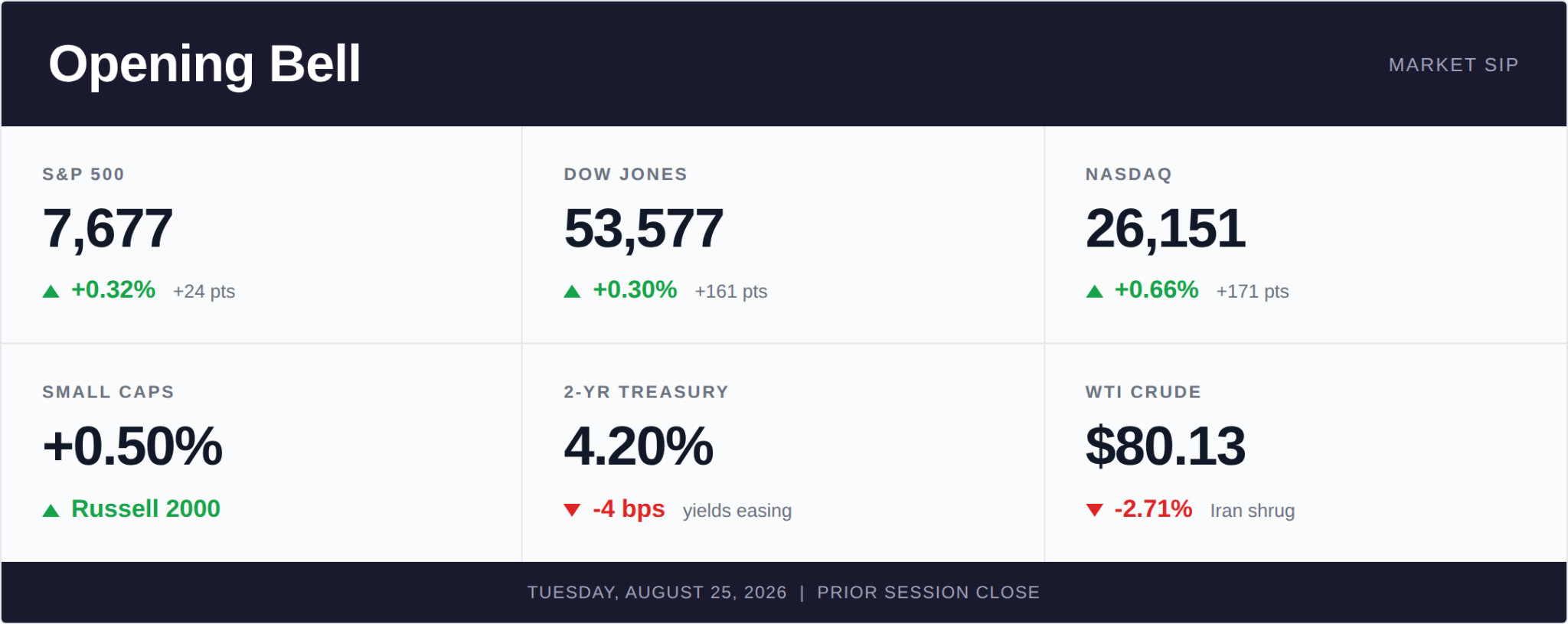
3 Movers in 3 Minutes
1. Dick's dropped a $2.4 billion mistake. Dick's Sporting Goods (DKS) crashed nearly 31% on Tuesday, its worst single-day drop on record, after Q2 EPS came in at $3.53 versus the $3.76 consensus and management cut full-year operating income guidance for both banners, blaming Foot Locker (FL) integration costs and a promotional athletic footwear market. The plunge to $124.31 marked a 52-week low. Nike (NKE) fell 3% in sympathy. Dick's bought Foot Locker for $2.4 billion in September 2025 to build a "global sports platform." Eleven months in, the acquirer has become the wounded party.
2. Chips reclaimed lost ground before the main event. Nvidia (NVDA) rose about 2% Tuesday, ending an eight-session decline, as traders repositioned ahead of tonight's earnings. Sandisk (SNDK) and Micron (MU) rebounded from Monday's weekend-report selloff on Nvidia's server pricing move. The semiconductor index recovered about half of Monday's losses. This is the setup you want to notice: the sector spent Monday pricing risk and Tuesday walking it back. Whichever direction Nvidia moves after the close will move it by more.
3. Oil shrugged off sanctions and cracked $80. WTI crude fell 2.71% to settle around $80.13, a one-week low, even as Treasury Secretary Scott Bessent unveiled "Operation Economic Outcast," a sanctions campaign targeting entities intermediating Iranian oil trade. The market read the escalation as economic pressure rather than a supply threat and sold the news. When sanctions can't move oil, the price is telling you something about demand that the White House can't fix with a press release.
3 Signals for Today
Nvidia (NVDA) Q2 FY27 earnings, after the close. Consensus expects $91.9 billion in revenue and $2.08 EPS, roughly doubling last year's Q2. The number to watch isn't the beat, it's the Q3 guide and the data center commentary. Every AI capex assumption on the Street is downstream of what Jensen Huang says at 5:00 PM ET.
July durable goods orders. Consensus looks for a headline decline, mostly aircraft noise. The core capital goods reading, which strips out defense and aircraft, is the number that matters. It has been the quiet tell on whether corporate capex outside of AI is decelerating.
Salesforce (CRM), CrowdStrike (CRWD), HP (HPQ), Okta (OKTA) report after the bell. Salesforce's Agentforce monetization commentary and CrowdStrike's net new ARR will together read as an enterprise software temperature check. If both disappoint against Nvidia beating, the rotation trade gets uncomfortable.
Nuclear Stocks Are Doing Something Unexpected
Nuclear energy is moving back into the spotlight as power demand surges and grid reliability becomes a priority.
Cash flow is improving, long-term contracts are locking in revenue, and capital is rushing back into parts of the sector that were ignored for years.
Our analysts believe this shift is happening faster than most investors realize.
Their FREE report reveals 7 Top Nuclear Stocks to Buy Now — including high-growth uranium plays and steadier contract-backed names.
Get the full list free now before it disappears behind the paywall.
And with that, let's get into today's story: the mentor who watched his student walk into the same trade he once destroyed.
The Sip
The op-ed that landed like a warning shot
On Monday morning, the Wall Street Journal ran an op-ed by Stanley Druckenmiller with the kind of headline that makes Treasury officials cancel their calendars. He called Scott Bessent's decision to double the size of the government's long-end bond buybacks a "mistake." Not a debatable choice. Not a policy tradeoff. A mistake. And the phrase he used to describe what Bessent was actually doing landed harder than the criticism itself. "Governments defending prices against fundamentals always lose," Druckenmiller wrote, in an op-ed he later admitted he had drafted with the help of AI.
The Treasury announced the expansion last Wednesday, doubling the ceiling on long-dated Treasury buyback operations from $2 billion to $4 billion. Bessent framed it as liquidity support. The 30-year yield fell for a few hours, then climbed right back to where it started. Druckenmiller's read was simpler. "The market's verdict was swift and correct," he wrote. "This wasn't liquidity management. It was price management, and a mistake far larger than $4 billion suggests."
Then came the sentence that reframes the entire bond vigilante narrative of the last three years. "The bond market wasn't being a vigilante. It was being a pushover that had finally begun to clear its throat, and Treasury moved to quiet even that."
Why this particular voice matters more than the message
Druckenmiller and Bessent are not strangers. They worked together at Soros Fund Management in the early 1990s. Bessent, in that period, ran the London office. Druckenmiller was Soros's chief strategist. Both men speak of that era with reverence, and Bessent has described daily calls with Druckenmiller as the formative discipline of his career.
What they did together in 1992 is the story every macro trader learns before they learn anything else. The Bank of England was defending the pound's peg to the European Exchange Rate Mechanism. Britain's economy could not support the price. Soros and Druckenmiller sized their short at $10 billion, more than the fund's own capital, and dared the central bank to hold the line. On September 16, 1992, the Bank of England burned through £3.4 billion of taxpayer money in a single day before pulling the pound from the ERM. Soros made $1 billion. Bessent watched it happen from the trading floor.
That is the context in which Druckenmiller wrote his op-ed. He is not lecturing an academic. He is telling a colleague who has been to the movie that the sequel plays the same way.
The mechanism nobody wants to name
The tell in Druckenmiller's piece is his phrase about how these interventions evolve. "Yield management always begins as a technical operation and ends as a policy commitment," he wrote. What he means is precise. Once a Treasury signals to the market that it will step in to keep long yields from rising too far, the market prices in the intervention as permanent. Every future auction gets priced against the assumption that the Treasury will absorb supply if buyers don't. The Bank of Japan lived this for a decade under its yield curve control regime. It bought bonds until it owned more than half the market, then abandoned the framework anyway in July 2024 after the yen collapsed and imported inflation began eating household savings.
The Man Who Called Nvidia Before It Soared 1,000% Issues New Elon Musk BUY Alert

Luke Lango was ranked America's #1 stock picker in 2020. He was mentored by two hedge fund billionaires from the Soros network and trained at Caltech. His readers have had the chance to see gains as high as AMD +8,500%... Nvidia +5,000%... Tesla +3,500%... Palantir +1,000%... and Apple +890%. Now he's releasing his next big pick.
This ad is sent on behalf of InvestorPlace Media at 1125 N. Charles Street, Baltimore, Maryland 21201. If you're not interested in this opportunity, please click here.
The domestic version has a shorter runway. The Treasury General Account, which CNBC reported may be tapped to fund the expanded buybacks, holds roughly $1 trillion. That sounds like a lot. It funds about six weeks of the deficit at the current run rate. And once it is spent, the Treasury either issues more debt to replenish it, which puts yields right back where they started, or it stops buying, which admits the intervention was theater.
It is the pushover Treasury silenced, not the vigilante.
Why Friday matters more than the buyback itself
Fed Chair Kevin Warsh delivers his first Jackson Hole keynote on Friday morning. Every desk on the Street is now watching for one specific tell. Will Warsh validate the Treasury's yield defense by signaling patient policy, or will he treat it as a fiscal problem the Fed refuses to monetize?
If Warsh gives Bessent air cover, the intervention becomes durable and Druckenmiller's warning becomes a slow bleed rather than a fast break. If Warsh distances the Fed from the Treasury's project, the 30-year auction on Thursday and the September buyback launch become the first real tests. Bond futures, priced for a slight compression, will move violently either way.
And there is a fourth character in this drama nobody is naming yet. Boston Fed President Susan Collins said Tuesday that the Fed will need to raise rates soon unless inflation shows a continued decline. That is a hawkish dissent forming in real time, and it lands on Warsh's desk the same week his Treasury Secretary is asking the market to trust a yield ceiling.
The lesson from 1992 was not that governments cannot defend prices. It is that the market decides how long the defense lasts, and the number is never as long as the government thinks. Bessent knows this. He made his career on it.
Whether he can act on that knowledge from the other side of the trade is the only question that matters this week.
AI CEO Issues Code Red: Prepare for Meltdown
The CEO of this AI company (click here to get the name, 100% free) just issued a CODE RED in an internal memo…
Warning his employees that they’re dealing with a critical situation.
Another company executive even implied they might need a government bailout.
And now Jim Rickards is predicting this company is about to go bust, in a full-blown AI meltdown that could be 10 times bigger than Lehman Brothers.
The MarketSipsTakeaway
The Treasury bond buyback has stopped being a technical footnote and become the central question of American fiscal credibility. Warsh's Jackson Hole keynote Friday is now a referendum on whether the Fed will endorse or resist Treasury's price-setting ambition. Watch the 30-year auction Thursday for the first market vote, and watch bank stress test guidance next week for how regulators are positioning banks against a Treasury market that might, per Druckenmiller, finally stop being polite.
Until then, sip slowly!
The Market Sip Desk
Tickers: UI MS DKS EPS FL NKE NVDA SNDK MU WTI PM ET CRM CRWD HP HPQ OKTA ARR ERM AMD CNBC CODE RED