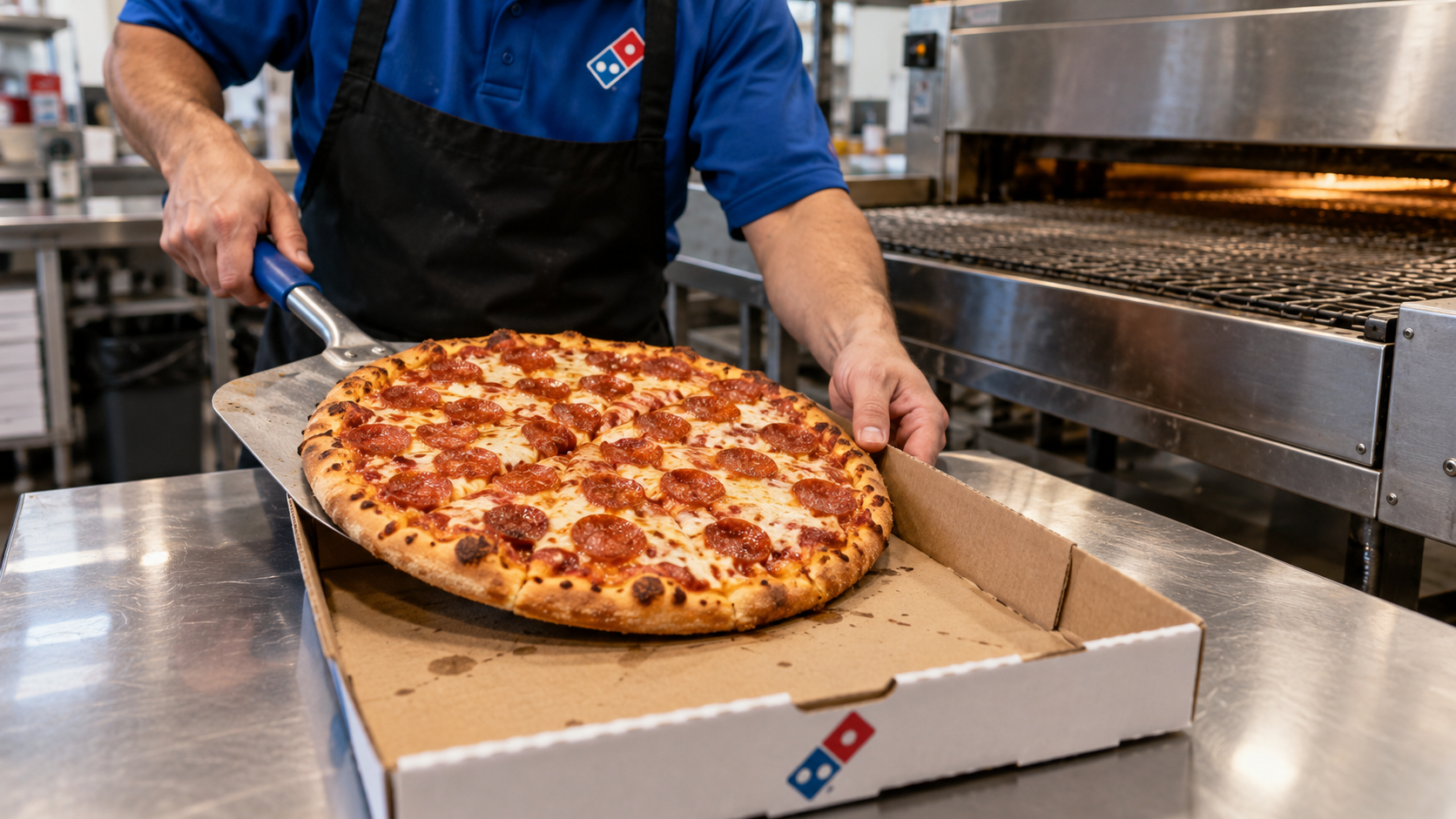
Per-share profit rose to $4.60 and beat forecasts even though U.S. comparable sales grew 0.3%. The new chief executive blamed gasoline above $4 a gallon for smaller orders, and some franchisees have put new stores on hold.
Domino's Pizza grew its earnings per share at a double-digit pace in the third quarter. Almost none of that came from selling more pizza in the U.S.
The company earned $4.60 a share, compared with $4.08 a year earlier, an increase of about 13% that topped the roughly $4.36 analysts had forecast, according to Financial Modeling Prep. Over the same period, sales at U.S. stores open at least a year rose 0.3%. A year ago that measure grew 5.2%.
Where the profit came from
The earnings math rests on three things other than U.S. comparable sales. The top line grew faster than store sales. Revenue reached $1.19 billion, 3.4% above last year, as the ingredient-supply arm and franchise royalty income both expanded. Operating income climbed 8.3%. And the share count shrank.
Net income grew 9.2%, to $152.2 million, slower than earnings per share. Dividing one by the other implies about 33.1 million diluted shares, roughly 3% fewer than a year earlier. The smaller share count added about 3 points to per-share growth.
Outside the U.S., momentum also faded. International comparable sales rose 0.2% excluding currency, against 1.7% a year ago, and growth in worldwide retail sales was cut roughly in half, to 3.2%.
Smaller baskets
Joe Jordan, who replaced Russell Weiner as chief executive this month, said customers are still coming but spending less per visit. "Man, when the gas prices hit a bit over $4, you start to really see some pressure," he said in a newspaper interview.
In that interview he said traffic is rising, but the chain is relying on promotions to get there, and diners are dropping items from their orders. Executives want to aim discounts more precisely to get customers to add items to their orders. Fuel also hits Domino's directly, because diesel is a cost the company itself pays, and that cost has climbed.
The slowdown is reaching expansion. Mr. Jordan said in the interview that a number of franchisees have put planned openings on hold. On the earnings call, the company cut its outlook for net new U.S. stores this year to 125 to 150, from about 175.
"Our opportunity now is to capitalize on those strengths by getting even closer to our customers, helping our franchisees grow their profitability and turning our best performance into our everyday performance," he said in the results release.
The trading
The market's first reaction was harsh. The stock opened at $286.45, about 7.9% below Monday's close, and fell as low as $283.07. By about 1:45 p.m. Eastern it stood at $300.81, a loss of 3.2%, having recovered more than half of the early drop.
Market implications
One reading is that Domino's business model is absorbing the squeeze. Supply-chain income and royalties keep growing with the store base, buybacks lift per-share results, and visits are still increasing even as each order shrinks.
A second reading is that the forces protecting earnings are the ones now under threat. Royalty and supply-chain growth depend on new stores, and franchisees are delaying them. Promotions that sustain traffic cost margin, and the slowdown also reached international markets, where last year's comparison was a softer 1.7%.
What to watch
The split between order count and average ticket in the fourth quarter will show whether promotions are rebuilding baskets. Net store openings, and whether paused franchise projects restart, are the gauge for the royalty stream. Gasoline prices remain the outside variable.