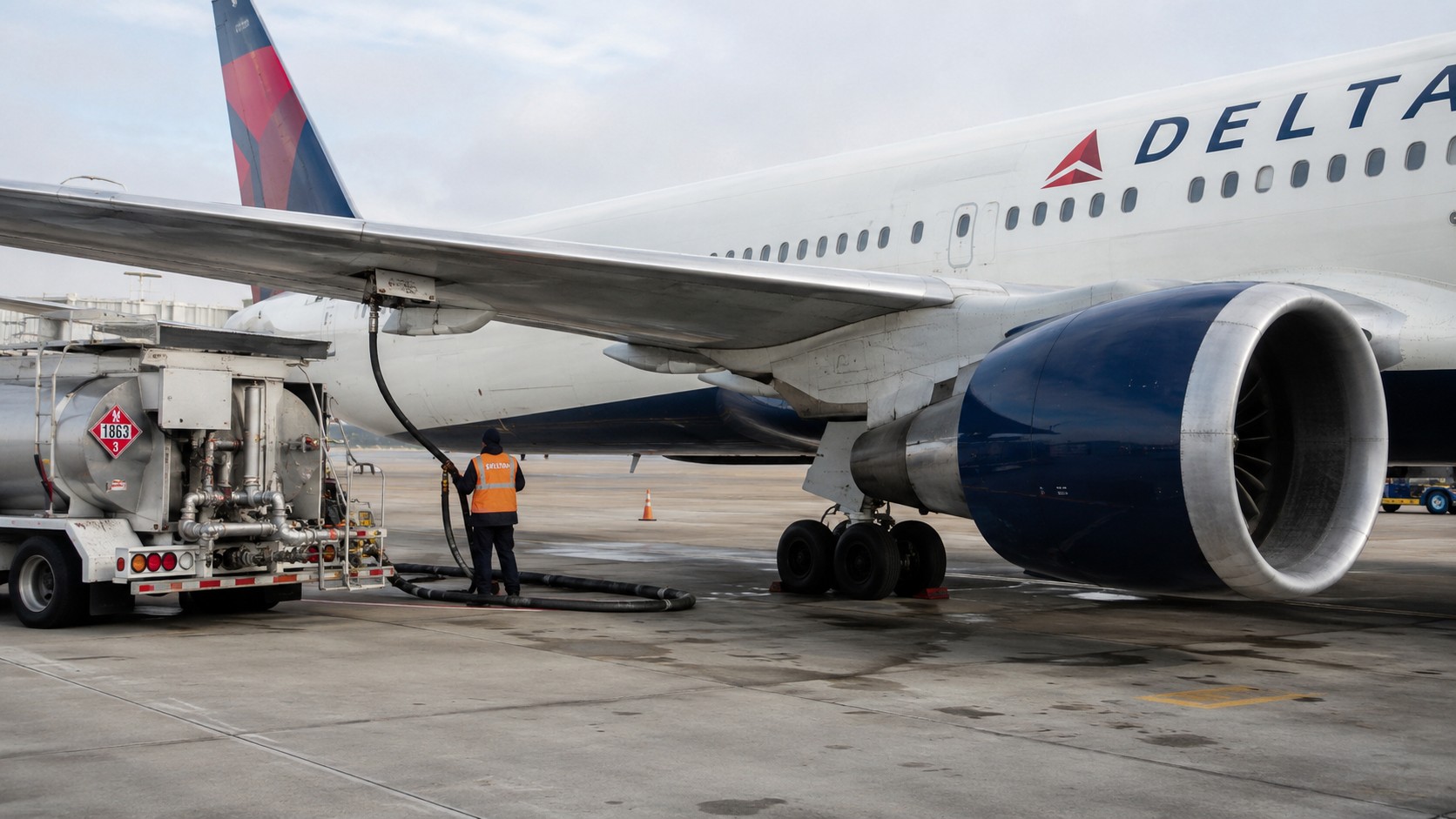
Delta Air Lines just posted a quarter that splits in two. Revenue grew almost 14% while capacity grew about 1%. That is real pricing power. But adjusted operating income fell 24%, and margins shrank by 4.5 points, because record fuel costs ate into the gains. The stock rose in early trading, then reversed into a loss as oil spiked on new Iran tension. The real question for investors isn't whether Delta can raise fares during a fuel shock. It's whether those fares survive once the shock fades.
The Case for a Structural Shift
Executives made the case that this goes beyond fuel recapture. Chief Commercial Officer Joe Esposito said low-cost carriers no longer have the cost edge that let them undercut fares whenever oil dropped, since labor, aircraft, and airport costs have risen across the industry. “The industry has no other choice,” he said, when analysts pushed on whether fare gains would hold. CEO Ed Bastian struck the same note, telling reporters he expects current revenue momentum to “remain sustainable, even if fuel prices moderate.”
That's more than a talking point. Esposito said Delta's unit revenue exit rate for the quarter finished well above where it started, in both main cabin and premium. That means pricing power built steadily through the quarter, not just in one strong month. Bookings 90 to 120 days out were stronger than bookings closer to departure. Early fourth-quarter bookings looked strong too.
The catch: Bastian can't promise United, American, Southwest, and the budget carriers will hold the line once fuel drops further. Airlines have a long history of adding capacity to defend a hub even when it doesn't pay off. Reuters framed this as the central question hanging over the stock: can spring's fare increases survive as fuel eases, especially once Delta itself ramps capacity back to 2% to 3% growth in the fourth quarter.
Main Cabin, Not Premium, Is the More Important Number
Premium tickets brought in $6.92 billion this quarter, edging past main cabin's $6.85 billion for the first time. That crossover got most of the attention. But main-cabin unit revenue actually grew faster than premium unit revenue during the quarter, hitting a mid-teens growth rate in June alone.
That matters because it means the improvement wasn't confined to travelers buying up premium seats. Delta has cut main-cabin capacity by 2% to 3% this year, and Esposito said the airline won't grow it next year either. Budget-carrier capacity across the industry has also shrunk this year, following Spirit Airlines' shutdown in May, according to separate airline-industry reporting. Less competing supply, plus Delta's own discipline, pushed up prices in the cabin that's historically hardest to raise fares on.
Premium still delivered more new dollars. Per Delta's own revenue disclosures, premium ticket revenue grew about $1 billion year over year, versus roughly $500 million from main cabin. So Delta's mix keeps shifting toward premium and corporate travelers even as its most price-sensitive cabin got healthier too. That's a good combination. It also leaves Delta more exposed to a pullback in corporate travel or affluent spending than a purely economy-driven airline would be.
Some of the Improvement Isn't Operating Strength
Not every dollar this quarter reflects durable pricing power. Corporate sales grew at a double-digit rate, with growth in core and coastal hubs topping 20%. Executives said most of that came from higher fares, not more corporate travelers flying. Fine for now, but it means the growth rate could slow fast if companies push back on price or tighten travel budgets.
Cargo revenue jumped 39%, but the company said that was mostly volume, including freight rerouted away from the Middle East. Management doesn't expect that growth rate to hold.
Then there's the refinery. It added 11 cents a gallon of benefit this quarter, but a temporary outage cut into that, and management expects a further 5-to-7-cent hit next quarter before the benefit recovers. The refinery is a crack-spread bet tied to Delta's own fuel exposure, not a clean hedge against high oil prices. Fuel is still expected to cost Delta roughly $4 billion more this year than last year, even with the refinery's help.
None of this means the quarter was weak. It means investors should separate what came from better pricing and mix from what came from one-time or cyclical items.
Wall Street Wants More
Delta beat both major estimate trackers, though the trackers didn't agree with each other. LSEG had adjusted earnings pegged at $1.48 a share. FactSet had $1.54. Delta reported $1.56. On a GAAP basis, net income fell 25% to $1.6 billion, or $2.44 a share, as average fuel prices rose 75% and adjusted fuel expense climbed 77%.
The stock rose about 2% before the opening bell, then gave that back and traded lower by midday, down roughly 2%. Shares had already rallied roughly 28% in 2026 before the print, outpacing the S&P 500's gain of about 10%, which raised the bar for what would count as a good quarter. The reversal tracked a broader airline selloff after President Trump said a ceasefire with Iran was over and oil prices jumped more than 6%. Investors weren't punishing the quarter. They were repricing the fuel assumption baked into Delta's own third-quarter guidance, which uses a fuel price near $3.15 a gallon based on a forward curve dated before the latest escalation.
Sell-side sentiment stayed broadly supportive. Heading into the print, the large majority of analysts covering the stock rated it a buy. Separately, a Jefferies analyst pointed to industry-wide ticket prices up 15% to 20%, calling it evidence this pricing shift extends beyond Delta alone, a framing that echoes the “no other choice” argument from Delta's own call. Still, Delta reaffirmed its full-year guidance rather than raising it. Hitting the top of that range implies a fourth quarter well above last year's, using the company's own guidance math. Management didn't lay out a detailed bridge for how it gets there.
The Burden of Proof
Delta has better tools than it had in the last fuel shock: a bigger premium business, a growing loyalty and card partnership, a maintenance business scaling toward $1.2 billion in revenue, and capacity discipline that's held for years. Those are real, durable advantages. What the quarter didn't prove is that competitors will keep behaving the same way once fuel drops further, or that non-fuel costs, up 6.8% this quarter, come back down to the low-single-digit growth Delta is promising.
The evidence arrives after Labor Day. If fares hold even as Delta and its rivals add back capacity, the structural case wins. If discounting creeps back in, this quarter will look more like a well-timed fuel pass-through than a lasting shift in industry behavior. For now, Delta has out-executed its peers. It hasn't yet proven the industry's old capacity habits are gone for good.