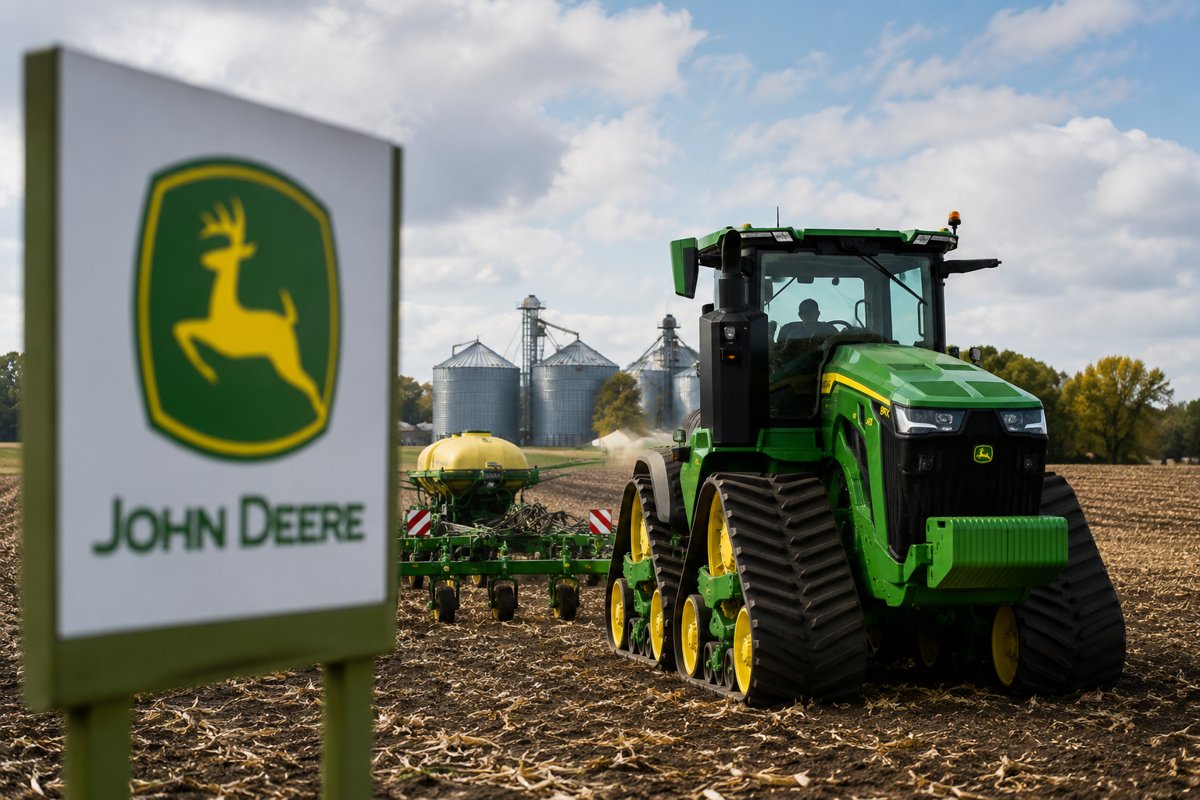
Deere's stock jumped 6.9% on August 20, its best session in months, even as the S&P 500 fell the same day. The rally followed a quarter in which the company's largest and historically most closely watched division, Production & Precision Agriculture, was the only segment to post a year-over-year sales decline. What actually carried the results were two segments investors rarely treat as the main event: Construction & Forestry and Small Ag & Turf. The question for investors is not whether Deere beat estimates. It is whether this mix shift signals a real turn in the farm equipment cycle, or whether two smaller franchises are covering for a core business that has not yet stabilized.
A Beat Built On Two Segments, Not the One Investors Watch Closely
Deere earned $5.10 per share in fiscal third quarter 2026, up from $4.75 a year earlier and comfortably ahead of the roughly $4.70 analysts expected. Net income attributable to the company rose 7% to $1.379 billion. Equipment operations net sales, the figure comparable to analyst estimates since it excludes Financial Services revenue, came in at $10.999 billion, up 6% year over year and about 1.7% ahead of the roughly $10.8 billion analysts had modeled on that same basis. That is a real but modest beat, not the double-digit figure that results from comparing Deere's total $12.608 billion revenue line, which includes Financial Services, against estimates built on the narrower equipment-operations basis.
The segment detail explains where the improvement actually came from. Production & Precision Agriculture, the company's largest franchise, posted net sales of $3.998 billion, down 6%, with operating margin slipping to 13.2% from 13.6%. Construction & Forestry sales rose 18% to $3.618 billion, and its operating margin jumped to 12.1% from 7.7% a year earlier, a 4.4 point improvement. Small Ag & Turf sales rose 12% to $3.383 billion, with margin improving to 18.4% from 16.0%, which management attributed to healthier dairy and livestock customer cash flow and a normalizing turf market. In short, the quarter's profit growth came almost entirely from two smaller segments expanding margin sharply, while the flagship farm equipment business kept shrinking.
The Guidance Raise Reached Only the Low End
Deere raised its full-year net income guidance to $4.75 billion to $5.00 billion, from a prior $4.50 billion to $5.00 billion. Only the low end moved, by $250 million. The high end was unchanged. Segment guidance tells the same story as the quarter itself: Production & Precision Ag sales are now expected to fall about 10% for the year, with margin guidance narrowed to 11% to 12%, while Small Ag & Turf and Construction & Forestry guidance for sales growth (roughly 15% and 20%, respectively) held steady, with margin ranges narrowed higher. This is confirmation that the smaller segments are carrying the fiscal year, not evidence that the core agriculture business has found a floor.
The stock's reaction should be read against expectations, not in isolation. Options positioning ahead of the print had been unusually bearish, with the ten-day put-to-call ratio near a one-year high, and call volume tripled average levels after the release, concentrated in contracts well above the pre-earnings price. That pattern points to a relief rally against skeptical positioning as much as a wholesale re-rating of the ag cycle. Notably, the two sell-side price target increases confirmed after the print, one from an analyst maintaining a neutral rating and one from an analyst maintaining an outperform rating, both landed below the pre-existing consensus price target, suggesting sell-side estimates have not fully caught up to the size of the stock's move.
What the Tariff Numbers Actually Show
Two distinct tariff mechanics are at work, and they should not be conflated. First, Deere recorded $110 million in tariff recoveries in the quarter and $382 million over nine months. These are refunds of tariffs the company already paid under a federal emergency powers program, not a reduction in the tariff rate itself, and management does not expect further refunds this fiscal year. Second, a separate and genuine rate cut took effect June 1: tariffs on certain European imports fell from about 25% to about 15%, which does lower Deere's go-forward cost structure.
Deere expects roughly $1.1 billion in gross tariff costs this fiscal year. After $382 million in recognized refunds, that leaves the company facing about $720 million in net tariff costs. Management expects gross tariff expense to remain close to $1 billion in fiscal 2027, while this year's refund benefit is not expected to repeat, a real, underappreciated cost headwind heading into next year even with the lower European tariff rate now in place.
The Cycle-Bottom Call Still Needs Confirmation
Deere's chief executive stated in the written earnings release that the company continues to believe 2026 will mark the bottom of the current agricultural equipment cycle. Similar language, independently phrased, came separately from the chief financial officer and the president of the worldwide agriculture and turf division on the earnings call itself. Three executives, in two separate documents, made a version of the same claim. Notably, the chief executive did not participate in the earnings call, so no analyst had the chance to question him directly on it.
The claim also comes with its own internal caveat. The agriculture and turf president described any 2027 recovery as measured, not a sharp rebound, a materially softer framing than "bottom of the cycle" implies on its own. A reported nearly 39% year-over-year decline in July sales of large four-wheel-drive tractors sits uncomfortably next to a narrative that the trough has passed. Construction & Forestry's order book reportedly extends into fiscal 2027, with management citing large infrastructure, data-center, and energy-related projects as contributors, a plausible link that the company has not quantified. Part of the segment's 8% pricing contribution this quarter was also attributed by the company to an easier prior-year comparison rather than to stronger underlying pricing power, a detail that tempers how much of the margin gain reflects durable strength.
What should investors watch now. The real test is whether Production & Precision Ag orders and pricing stabilize over the next two quarters, not whether executives keep repeating that the bottom has arrived. A broader guidance raise, one that lifts the high end rather than just the low end, would strengthen the recovery case. Continued softness in South America and Europe, a widening gap between reported industry tractor data and management's tone, or a bigger-than-expected net tariff cost in fiscal 2027 would validate the skeptical case instead. This quarter shifted the burden of proof toward management. It did not yet meet it.