

Crypto was built on a promise: no bank, no government, no one can freeze your money. On Thursday, the biggest theft in its history ran straight into that promise. An attacker pulled an estimated $6.3 billion out of Binance, most of it in about 20 minutes by one analytics firm's count. Within hours, roughly half of it had stopped moving, frozen by companies with a button most crypto users forget exists. The half that got away went into the coins with no button at all. That split is today's story.
But before we get to that, a quick look at what moved overnight and what matters on the last trading day of October…
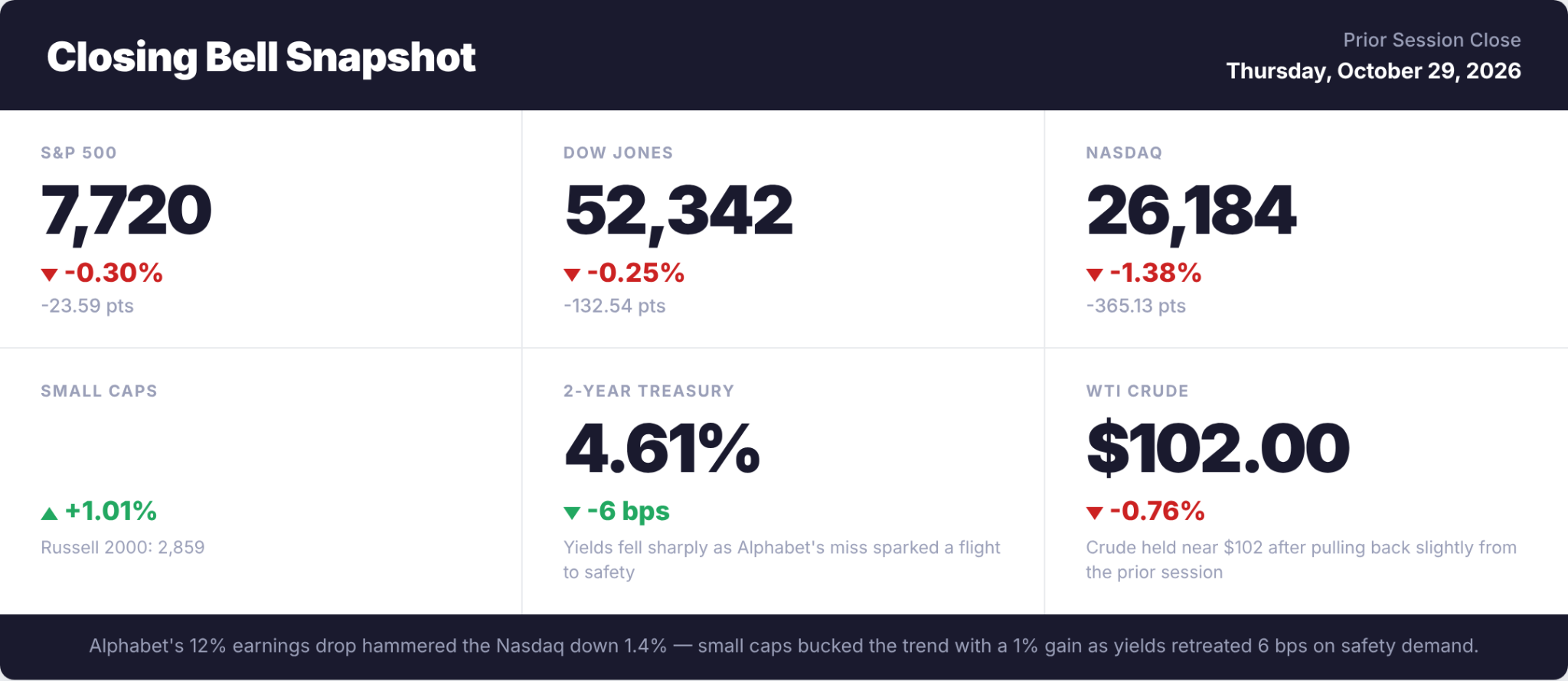
3 Movers in 3 Minutes
1. The AI bill reached Amazon and Intel from opposite ends. Amazon (AMZN) posted its highest operating margin ever and grew AWS 39%, then slid about 7% before the bell. The problem is cash. Over the past 12 months, free cash flow was an outflow of $42.4 billion, against an inflow of $14.8 billion a year earlier, as spending on property and equipment jumped $94.8 billion. Andy Jassy signaled 2027 spending will be meaningfully higher. Intel (INTC) grew data center and AI sales 78%, then guided about $1.6 billion below Wall Street on weak PCs and an explosion at its Israel plant. It was down about 26% premarket. One company is spending faster than its cash comes in. The other earns AI money and loses it elsewhere. Investors sold both.
2. Reddit grew 53% and lost about a fifth of its value premarket. Reddit (RDDT) beat on the quarter, with revenue of $895 million. Then it said search referrals fell by more than 1 million a week on average in October, and that daily users could drop by a low-double-digit percentage from 130 million this quarter. Its fourth-quarter guide of $1.00 billion to $1.03 billion missed the roughly $1.05 billion expected, and shares were about 22% lower premarket. CEO Steve Huffman pointed at Google's AI answers: "People still want Reddit. It is just Google is not sending them to Reddit the way they used to." The uncomfortable math: non-ad revenue, which includes AI data licensing, was $48 million. Ads, which run on visitors, brought in $847 million. Selling its posts to AI is the small business. The traffic AI keeps is the big one.
3. Canada bought into an AI company, and a supermarket group led the round. Cohere, the private Toronto AI developer, opened a Series E targeting up to C35.7 billion if fully raised. The lead is Schwarz Group, the German retailer behind Lidl. Ottawa committed up to C1.7 billion on Canadian computing by 2030. Nvidia (NVDA) came back in. On a pre-money basis, the price is roughly triple last year's, and Cohere hasn't said how much it has actually raised. This isn't a venture check. It's an industrial policy with a cap table.
3 Signals for Today
1. Exxon kept its buyback flat. Chevron is next. Exxon (XOM) beat, earning an adjusted $4.23 a share against $4.08 expected, as refining profit more than doubled from the second quarter to $9 billion. Upstream earnings fell 20% on lower Brent. Shares were about 2% higher premarket. The tell is the buyback: $20 billion for 2027, the same as this year. Exxon is banking the refining windfall without promising more, in line with a futures curve that prices Brent more than $25 lower a year out. Chevron (CVX) reports before the bell, with WTI near $104. A bigger buyback would be a bet that these margins last. Matching Exxon would say the majors don't trust $100 oil either.
2. The wage report lands on a rate hike traders already own. The third-quarter employment cost index is expected to rise about 0.8%, after 0.9% last quarter. Prediction markets put a December hike at about 73%, down from the high 70s on Thursday. The backdrop is awkward: in September, real disposable income fell 0.3% and real spending was flat. A hot print says wages are keeping pace and the hike stays the base case. A soft one says households are paying for energy inflation out of their own pockets, which makes a December hike harder to defend.
3. The Iran contract that crashed and came back has one day left. Polymarket's contract on the U.S.-Iran ceasefire holding through Oct. 31 fell from about 96 cents to 68 cents on Thursday evening, as reports spread that the top U.S. commander in the region had briefed President Trump on strike options. It is back near 91 cents. The Nov. 15 contract sits near 49 cents, a coin flip on a strike in the weeks after the midterms. If the October contract settles yes, the risk doesn't disappear. It moves to the post-vote window, and Brent near $113 keeps that calendar in view.
Better Than Oil Stocks

The best way to profit from energy is NOT a stock...
Rather, it's this little-known alternative investment.
And with that out of the way, let's get to today's big story: the record crypto heist, and the off switch it exposed.
The Sip
The heist that found crypto's off switch
Late Thursday afternoon in New York, Binance's wallets started emptying.
By TRM Labs' count, about $6.36 billion left the world's largest crypto exchange across ten blockchains, most of it in roughly 20 minutes. Binance puts the damage at about $6.3 billion. That is more than four times the roughly $1.5 billion taken from Bybit in February 2025, the previous record.
Binance says its initial investigation points to a compromised DevOps engineer's laptop, which let an attacker reach a service container and submit unauthorized withdrawals. It has found no evidence that a wallet private key leaked. TRM Labs and Chainalysis attribute the attack to TraderTraitor, a North Korean state-backed group. Binance has not named anyone, and law enforcement has not confirmed it.
Then something happened that crypto's founding story says shouldn't be possible. A large share of the money stopped moving.
Who pressed freeze
Tether froze more than $1.567 billion of its USDT. Circle froze more than $800 million of USDC. Ripple and World Liberty Financial froze more, and the security council that governs the Arbitrum network moved 8,426 ether out of the attacker's reach. Aave, the largest decentralized lender, froze its markets so the attacker couldn't keep borrowing. Binance's tally of frozen assets is about $3 billion.
Bitcoin was designed so no one could do this. Stablecoins were designed so someone could.
Every major dollar stablecoin is issued by a company that can blacklist an address. Crypto purists have long called that a weakness. U.S. law calls it a requirement: the GENIUS Act, signed in July 2025, expects regulated issuers to be technically able to freeze, seize or burn tokens when lawfully ordered. On Thursday night, the feature the purists hated was the industry's best defense.
The thief knew which coins to dump
The attacker understood the split better than most investors do.
According to TRM, the attacker "raced the freezes by selling USDT to market makers and borrowing ETH against USDT on Aave." The result, in TRM's words: more than 420,000 ether and 18,270 bitcoin, about USD 2.4 billion in assets beyond any issuer's reach.
So the haul sorted itself into two piles. Dollars, which could be stopped. Bitcoin and ether, which could not.
The asset the industry markets as uncensorable did exactly what it promised. It just did it for the thief.
Who pays the bill
Binance says it will cover all losses from the SAFU fund and the company's funds. SAFU is the emergency fund it set up in 2018 and first tapped in 2019, to cover a 7,000-bitcoin theft.
Could This Stock Be “Trump’s Next Big Buy”?
Jim Rickards believes the Trump administration is about to take a direct stake in a tiny $2 stock.
The Trump administration has taken a direct stake in MP Materials, Lithium America, Trilogy Metals, and USA Rare Earth.
Each time, shares sprinted higher. Click here to see why Jim believes this one is next.
This bill is a different size. If Binance's own figures hold, about $3.3 billion of the affected assets is still unfrozen. One estimate puts SAFU near $1.2 billion. Even if every frozen dollar comes back, the insurance fund covers roughly a third of the gap, and Binance's own balance sheet has to carry the rest.
Binance is privately held, so outsiders can't check that balance sheet the way they can a listed company's. That's why its promise of an updated proof of reserves matters more than any statement that user funds are safe. Co-CEO Richard Teng also said the attack "did not simply use one engineer's permissions," and Binance says it has uncovered additional points of breach. The post-mortem isn't written yet.
Deposits are working again. Withdrawals are still paused, and Binance says it expects to resume them within 48 hours.
Where the damage landed this morning
Bitcoin sat near $77,500, down from about $80,650 on Thursday afternoon. Part of that drop started before Binance said anything, in the hour Amazon and Intel reported. BNB, the token tied most closely to Binance, fell harder over the same stretch, nearly 6%.
U.S.-listed crypto names fell premarket. Coinbase (COIN) and Strategy (MSTR), which both reported third-quarter results after Thursday's close, were about 5% and 6% lower. Robinhood (HOOD) was down about 6%. Circle (CRCL) fell about 6%, even though its freeze was part of what contained the damage.
That's the disconnect worth watching. The market sold Circle with everything else. The night arguably made its case.
The other reading points the opposite way. Standard Chartered said the breach could speed a shift toward decentralized exchanges. Maybe. But the decentralized side reached for the same tool. Aave froze. Arbitrum's council stepped in. When the stress hit, almost everyone who could press pause did.
What would prove it contained
Three things settle this.
First, withdrawals. If Binance reopens inside its 48-hour window without a rush for the exits, the "contained" view wins. A delay would turn a theft into a confidence problem at the largest exchange in the world.
Second, the attacker's 420,000 ether and 18,270 bitcoin. Together that's roughly $2.4 billion of supply that could hit thin markets whenever the thief decides to sell.
Third, the post-mortem. "Additional points of breach" is not a phrase you want to read twice.
Crypto spent years promising money no one could stop. On Thursday night, its best defense was the money someone could.
This #1 stock for the next AI boom?

Behind the scenes, America's top AI scientists have been hard at work. They've been building a new category of AI-powered device so powerful… It'll trigger something AI scientists call an "intelligence explosion…" A sudden 360-fold acceleration in major AI-powered breakthroughs. That means it'd shrink AI breakthrough times from 3 years… down to 3 days. In the process, it's poised to spark a $100 trillion reset of the AI markets… starting THIS YEAR. That's why Louis Navellier believes this event could send certain AI stocks tumbling… While creating a new generation of AI millionaires and billionaires… Starting with the company he reveals here (down to the ticker) in his new presentation.
This ad is sent on behalf of InvestorPlace Media at 1125 N. Charles Street, Baltimore, Maryland 21201. If you're not interested in this opportunity, pleaseclick here.
The MarketSipsTakeaway
Treat the freeze as the real headline, not the theft. It shows that a large share of crypto's money now moves on rails a company can stop, which is exactly what regulators and banks have asked for. The thesis is confirmed if Binance reopens withdrawals inside its 48-hour window, publishes a clean proof of reserves and avoids a wave of outflows. It breaks if the reopening slips, the post-mortem widens the breach, or the attacker starts selling roughly 420,000 ether into thin markets. The second-order names: Circle, whose freeze power just became its sales pitch; Coinbase, the regulated alternative that traded down with the group after its own results; and Strategy, with bitcoin less than 3% above its average cost of roughly $75,446.
Until then, sip slowly!
The Market Sip Desk
Reply prompt: Would you rather hold crypto in a coin someone can freeze, or one no one can? Hit reply and tell us why.
Rates Just Reset. Who Feels It First?
On January 2, the 10-year yielded 4.19%. By September 30, 5.29% — most of it in one quarter.
Some companies earn from higher rates. Some pay. Each runs on a different clock.
We traced three: IBKR, WRB and FIS. One has already reported. The other two report next, and the report tells you the exact line to check.
Free report, texted to your phone.