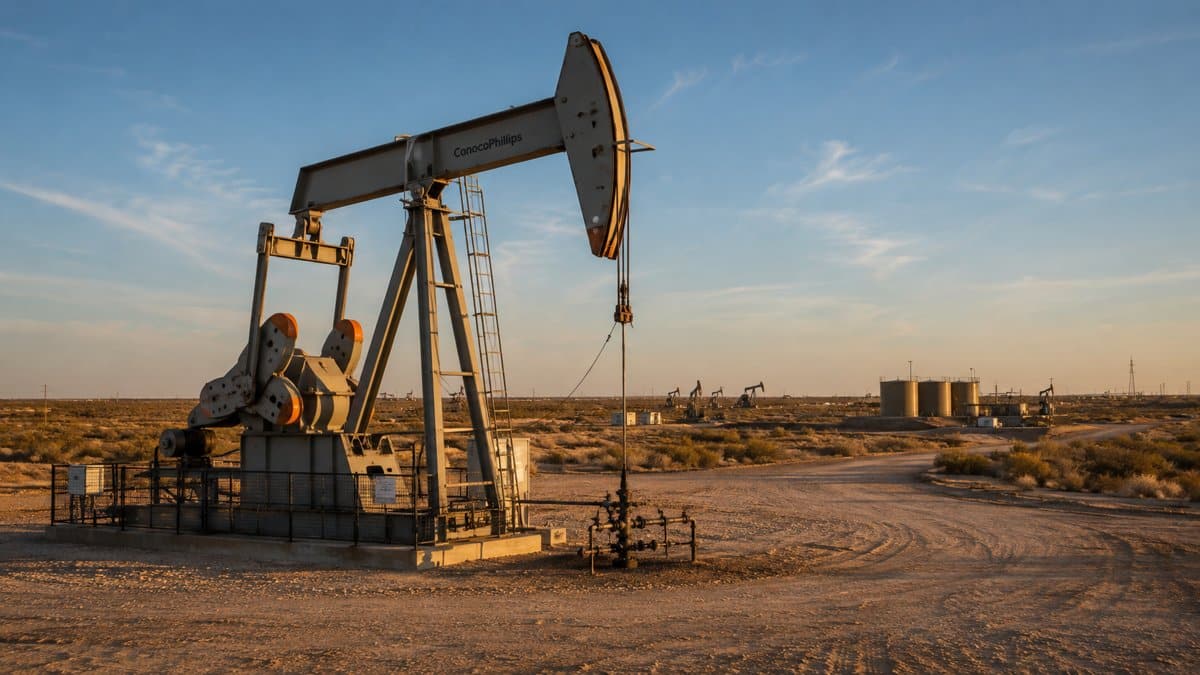
Adjusted earnings more than doubled on a 36% rise in realized prices, reported production fell 6%, and ConocoPhillips replaced both its chief executive and its chief financial officer on the same morning.
ConocoPhillips reported adjusted earnings of $3.24 a share, up 128%, and announced that Ryan Lance will retire as chief executive after 14 years. Chief Financial Officer Andy O'Brien becomes president and chief executive on 1 September. Konnie Haynes-Welsh, currently vice president for finance and controller, becomes chief financial officer on the same date. The shares rose modestly on the day and again in the following session. Two questions now sit together. One is how much of the quarter came from prices the company does not set. The other is what a first-time chief executive and a first-time finance chief inherit.
The earnings came from price
Realized prices did the work. The total realized price was $62.33 a barrel of oil equivalent, up 36% from $45.77. The company credits higher prices as the main reason earnings rose. Reported earnings were $3,931 million, or $3.23 a share. Adjusted earnings were $3,951 million, or $3.24.
The gap between those two figures is a single cent, which is unusual in this sector. After-tax special items netted to $20 million. The pieces were $25 million of deal and restructuring items and $23 million on pending claims, less a $28 million hedge gain on a gas investment. The year-over-year adjusted increase of 128% exceeds the reported 107% because the prior-year adjusted figure sat below reported earnings, on an asset-sale gain that was excluded.
Production moved the other way. Total production fell to 2,248 thousand barrels of oil equivalent per day from 2,391, a decline of 6%. On a pro-forma underlying basis, adjusting for closed acquisitions and disposals, the decline was about 4%. The company attributes it to organic Lower 48 growth being more than offset by the Middle East conflict's effect on Qatar and by higher royalties at Surmont. Output still came in above the high end of the quarterly guidance range.
Inside that total, the Permian set a record above 900 thousand barrels a day. That is roughly 40% of company output. Lance's release quote describes record production from the Permian position. Both statements hold, on different measures. Lower 48 output was 1,479 thousand barrels a day. The Delaware Basin ran at 720, Eagle Ford at 363, Midland at 202 and Bakken at 189.
The handover lands on earnings day
O'Brien joins the board with his appointment. Lance becomes executive chair in what the company calls a transitional role. He spent 14 years as chief executive and more than 40 years at the company and its predecessors. Lead independent director Robert Niblock said O'Brien knows the business well and has a record of delivery. Haynes-Welsh joined ConocoPhillips in 2012 and has worked across corporate strategy, treasury and the Lower 48 organisation.
Asked on the call why now, Lance said succession planning has been a standing process with the board. He said he would not leave unless the company were in its strongest position. He said every project is on track for the free-cash-flow step-up the company targets for 2029.
That date is the point analysts picked up. JPMorgan's Arun Jayaram wrote that O'Brien had long been seen as the likely successor. He said the timing would still surprise investors who expected Lance to stay through 2029. He wrote that the share price had carried what he called a premium for Lance. Lance bought when prices were low. Concho Resources came in 2021, and Shell's Permian assets later the same year. Those deals built the position that now sets Permian records. ConocoPhillips joins Occidental, Devon and Diamondback in changing chief executives inside a year.
Guidance was reaffirmed and the third quarter steps up
Every full-year guidance item was left unchanged. Third-quarter production is guided to 2.29 to 2.32 million barrels of oil equivalent per day, above the 2.248 million just delivered. Management is therefore pointing to faster output in the second half. The disruption that cut the second quarter is still in place.
That guide rests on Qatar. The second-quarter guidance had left Qatar out entirely, given uncertainty around the conflict. The full-year guidance carried a 20 thousand barrel a day cut for Qatar. It also carried a 15 thousand barrel royalty cut at Surmont on higher oil prices. Call commentary flagged that the third-quarter guide assumes a Qatar recovery that may not arrive on schedule. The company names the Middle East conflict and does not go further, and sharper characterisations of that conflict belong to the outlets running them.
The cash went out faster than the barrels came in
Distributions reached $3.0 billion, made up of $2.0 billion of repurchases, double the prior quarter, and $1.0 billion of ordinary dividends. A third-quarter dividend of $0.84 a share was declared, payable 1 September. The release does not describe it as an increase.
The payout ratio depends on which measure is used. Cash from operations excluding working capital was $7,176 million. Cash provided by operating activities was $7,434 million. Free cash flow was $4.2 billion. The $3.0 billion of distributions is 41.8% of the first figure and 71.4% of the second. ConocoPhillips frames its pledge against cash from operations. It says it is on track to return 45% of that measure this year. Capital spending and investments came to $3.0 billion. The working-capital adjustment added $258 million in the quarter and subtracted $834 million across six months.
What the new chief executive inherits
The strategic slate this quarter is heavier than usual. The $5 billion disposal target was met ahead of schedule, with $1.7 billion of noncore Lower 48 sales closing in July. The company agreed to acquire a 42% interest in a joint venture in the Kirkuk area of northern Iraq, with closing expected by the end of 2026. It executed an agreement for re-entry into Syria, using existing infrastructure to restore and raise onshore production. Liquefied natural gas offtake rose to 12 million tonnes a year. The Iraq position adds nothing to results yet, because the deal has not closed. The release's own cautionary language flags Middle East conflict risk and collections in Venezuela.
The burden of proof has moved from the portfolio to the handover. The quarter showed that the assets turn a 36% price rise into double the earnings and $4.2 billion of free cash flow. It also showed the Permian running at record rates. Three things remain unproven. The second-half output step-up has to arrive while Qatar is still disrupted. The moves into Iraq and Syria have to land on the timetable the departing chief executive set. The 2029 cash-flow goal has to survive a change in both top finance and top executive roles at once. The share price reaction was mild in both directions, which suggests the market has not yet decided which of those matters most.