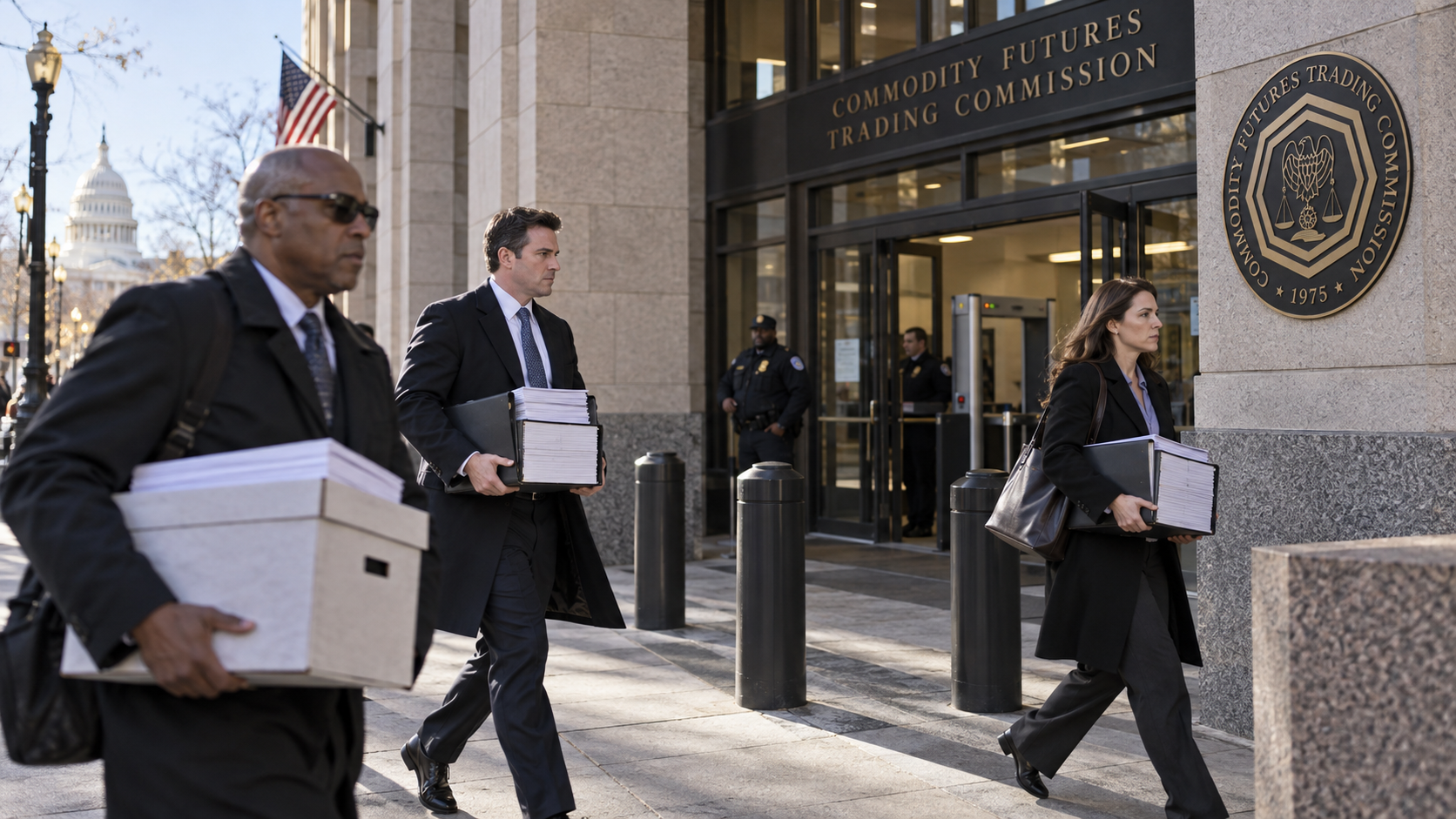
Both companies filed within a day of each other to bring crypto-style perpetual contracts to individual U.S. stocks, just as a pending court case threatens to unravel the legal basis for the entire product category before either one launches.
Coinbase Derivatives filed with the Commodity Futures Trading Commission on September 18 to list perpetual futures tied to individual U.S. stocks, a derivative structure with no expiration date that has so far existed almost exclusively in crypto markets. The filing names Apple as its representative listing, with roughly 50 to 60 additional stocks planned, including Microsoft, Tesla and Nvidia, and proposes contracts sized at 0.01 of a share with hourly funding payments capped at 0.10%. The CFTC's standard review period for such a filing runs 45 days, putting a decision deadline around November 2, extendable another 45 days for more complex issues. Kalshi filed its own, separate proposal with both the CFTC and the Securities and Exchange Commission the following day, September 19, for equity perpetuals that would clear through its own CFTC-registered clearinghouse rather than through Coinbase's structure.
Both filings extend into traditional single-stock derivatives markets a product structure that has so far been almost entirely crypto-native, and both companies are moving quickly to be first to market with regulatory approval in hand. What neither company's public filing materials address is a lawsuit that has been quietly working its way through federal court since June, one that specifically challenges whether the CFTC had the legal authority to approve this type of product at all.
CME Group sued CFTC Chair Michael Selig on June 18, arguing that perpetual futures contracts, which have no delivery date, should legally be classified as swaps under the Dodd-Frank Act rather than as futures, and that the CFTC's approval earlier this year of Kalshi's existing Bitcoin perpetual futures contract reversed positions the agency had taken in five prior enforcement actions against other crypto platforms. The CFTC moved to dismiss the case on September 2, arguing CME lacks legal standing and has not suffered a cognizable injury from a product it does not itself offer. CME's opposition to that motion is due October 2, before Judge Colleen Kollar-Kotelly in the U.S. District Court for the District of Columbia, with no ruling yet issued on either the motion or the underlying merits of the case.
The timing is what makes the overlap worth watching. CME's opposition brief comes due roughly a month before the CFTC's own decision deadline on Coinbase's new equity-perpetuals filing, meaning the legal foundation for the entire perpetual-futures approval framework will still be an open question in federal court right around the time regulators are set to decide whether to approve an entirely new category of equity products built on that same foundation. No court has yet ruled that a win for CME would retroactively unwind Kalshi's existing Bitcoin perpetual contract or block the new stock-perpetual filings specifically. The overlap is worth understanding as background for anyone evaluating what durable regulatory certainty actually looks like for either company's new product, rather than as a prediction about how the litigation will ultimately resolve.