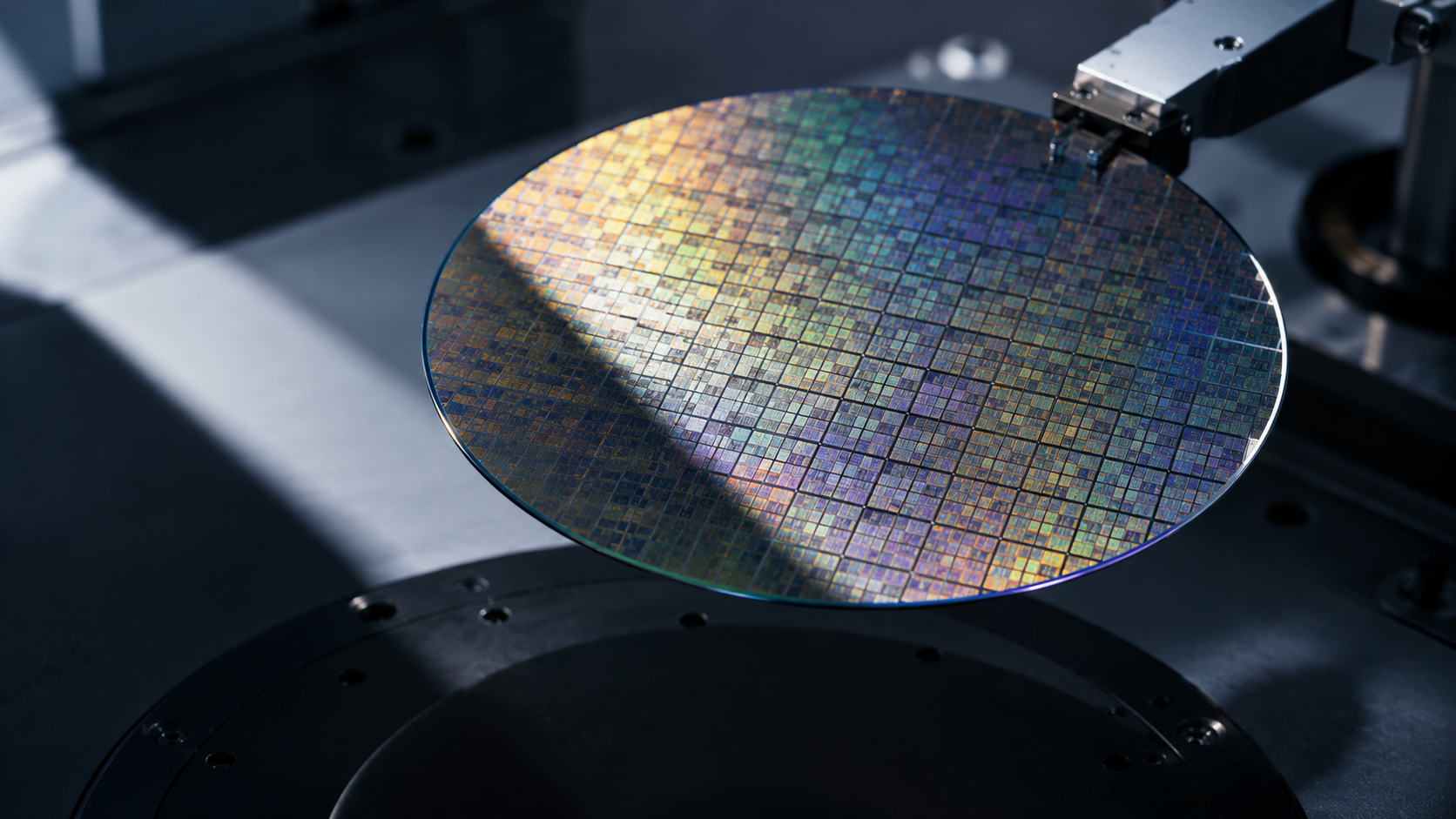
Test and photonics names fell hardest while the largest AI accelerator maker fell least, an ordering a clean demand-destruction story does not predict.
Semiconductor and AI-infrastructure stocks fell broadly on Monday, and the explanation running across most coverage of the move is a single essay. The sequence is real. The mechanism is thinner than the narrative suggests, and the ordering of the declines actively works against it.
What was actually said
On Saturday, , Anthropic chief executive Dario Amodei published an essay titled "We Must Pace the Frontier," arguing that AI companies should slow the pace of capability improvement, not halt training, to let safety practices keep up. He cited an OpenAI and Hugging Face incident as motivation. The essay recommends continuing export controls on advanced AI chips and semiconductor manufacturing equipment to China.
What the essay does not contain is any discussion of AI capital expenditure, chip demand or semiconductor spending, as either mechanism or consequence. The transmission chain the market is trading, that pacing capability growth leads hyperscalers to moderate infrastructure spending which reduces demand for accelerators, memory and equipment, is an investor inference. It is not something Amodei, or anyone else, stated.
Elon Musk posted support the same day. Sam Altman followed Monday morning, saying he agreed that the frontier needs pacing, and separately said OpenAI would not pursue an IPO this year.
The move, and the problem with it
In Monday afternoon trading, with the market still open, Nvidia was down 2.70% at $212.40, AMD down 3.71% at $497.00, Marvell down 5.40% at $223.36 after narrowing from a pre-market decline of roughly 7.6% to 8%, Intel down 4.17% at $98.65, Micron down 4.66% at $929.83, SanDisk down 3.39% at $1,577.99, Teradyne down 12.20% at $333.39, Lam Research down 7.39% at $276.18 and Coherent down 10.93% at $271.99. The SOXX semiconductor ETF was down 4.96% at $500.93, against a Nasdaq Composite decline in the range of 0.4% to 1.2%. SK Hynix fell 5.24% in the earlier Seoul session.
Now put those numbers next to the thesis. If investors were repricing AI chip demand, the pure-play accelerator leader should have taken the worst of it. Instead Nvidia fell least among the chip names, and the hardest-hit names were a test-equipment maker, a photonics supplier and a wafer-fab equipment maker, all of whom sell into fab and customer capital budgets rather than selling AI chips directly. Teradyne fell more than four times as far as Nvidia. That is the inverse of what a demand-destruction story predicts.
Two other facts sit badly with the narrative. Alphabet, Microsoft and Meta rose on the session, which fits a story about hyperscalers protecting margin by spending less but sits oddly beside a claim that the industry is reassessing AI economics. And regional commentary on SK Hynix's Seoul decline attributed it to Middle East tension and Fed dynamics, with no reference to the essay at all.
The competing explanation
A live macro backdrop was running the same morning. A hot core CPI reading carried over from Friday had already lifted rate-hike expectations ahead of Wednesday's Fed decision. Brent crude spiked toward $108 a barrel and the 10-year Treasury yield reached 5%. None of that is semiconductor-specific, and all of it hits long-duration, high-multiple equities hardest.
Several of these names have run extraordinarily far this year, with SanDisk reported up more than 600% year to date. A richly valued, high-beta cohort unwinding on a risk-off morning, with a convenient narrative available to attach to the move, is at minimum as consistent with the tape as a demand reassessment.
Bank of America has characterized the selloff as noise relative to a secular market in which AI capital expenditure could rise threefold to more than $3 trillion by the end of the decade. Separately, Baird downgraded Teradyne to Neutral on on capital-expenditure sustainability and valuation concerns, three and a half weeks before Monday and not a same-day trigger, but a marker that the valuation fragility predates the essay.
The one name nobody can place
Coherent's 10.93% decline is roughly double the peer median with no distinct same-day catalyst inside this story. It is also caught up in an entirely separate development, Corning's $2 billion equity program, covered next in this batch. Neither explanation cleanly owns it, and it should not be assigned to either.
What comes next
Monday's close will firm up the actual magnitude, since several of these names moved materially between the pre-market and mid-afternoon and in different directions. Wednesday's Fed decision is capable of overwhelming this narrative entirely. And Micron reports fiscal fourth-quarter results on , which is the next hard data point on memory and AI demand rather than sentiment about it.