

Over the weekend, a Chinese memory maker that didn't trade publicly until July said it plans to ship server DRAM on an architecture none of the big three has commercialized. By Tuesday, SK Hynix had fallen 10.1% in a single session in Seoul and Micron had shed more than 7% in two days.
Nothing has shipped. No customer has qualified it. The market sold anyway. The real question isn't whether CXMT can mass-produce the chip by December. It's what memory margins are worth once a fourth supplier with roughly 10% of the market has a credible path to cheaper bits.
But before we get to that, let's take a quick look at the markets and what matters today…
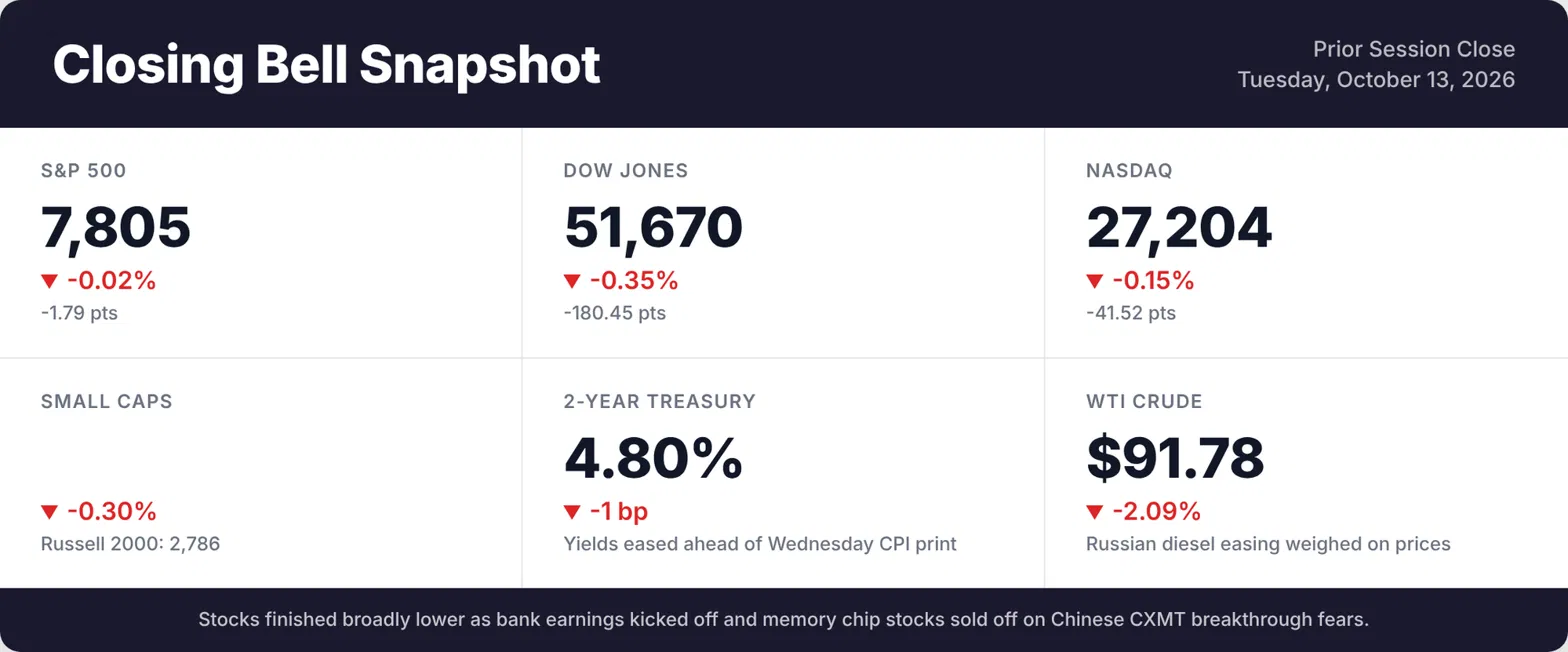
3 Movers in 3 Minutes
- Memory Stocks Slide on CXMT's Server Chip Plan. ChangXin Memory Technologies (CXMT) said over the weekend it plans to launch DDR5 server memory built on a 4F-squared DRAM architecture by year-end. Micron (MU) fell 3.6% on Tuesday after dropping 3.9% on Monday, Samsung Electronics lost 7.4% in Seoul, and SK Hynix tumbled 10.1%. More on this in The Sip.
- Goldman Beats, JPMorgan Misses as Bank Earnings Kick Off. Goldman Sachs (GS) earned $17.01 per share against LSEG's $13.02 consensus, powered by equities trading revenue that surged 72% year over year. JPMorgan (JPM) reported net income of $15.3 billion, up from $14.4 billion a year earlier, but fell short of analyst expectations. Same season, same tape, very different quarters: trading is carrying the Street right now.
- J&J Falls Nearly 6% Despite Raising Guidance. Johnson & Johnson (JNJ) dropped 5.7% to $248.61 even after lifting its full-year outlook. Net profit fell 96% on a roughly $5.5 billion talc-related charge, and MedTech sales grew just 2.5%. Adjusted earnings beat estimates, which says investors were grading something other than the quarter's headline number.
3 Signals for Today
September CPI Report (8:30 AM ET). Consensus expects headline inflation at 3.6% year over year, up from 3.4%, with core near 2.4%. With the Fed already in a hiking cycle, the reading could decide whether the next hike comes in October or December.
Bank of America (BAC) Q3 Earnings. The second-largest U.S. bank by assets reports today. Traders will watch net interest income and how the $1.2 billion Treasury fine announced Tuesday shows up in the quarter. After a Goldman beat and a JPMorgan miss, BofA is the tiebreaker on how strong bank earnings really are.
Fed Hike Odds After Williams. The Fed's John Williams said Tuesday that one more hike this year may be appropriate. Kalshi prices a December hike near 74%, while FedWatch puts the odds of an October move near 19%. If CPI runs hot, that October number is where the surprise shows up first.
The MarketBeat Analyst Team Just Released Their Top 5 Stocks to Buy Now — Fully Updated for October.
Every stock on this list carries a high consensus rating across Wall Street and has passed our strict criteria:
- Robust analyst coverage
- Market cap of $5 billion or more
- Full bull and bear case built from MarketBeat data and recent news
Today, you can get the complete list absolutely FREE.
And with that out of the way, let's get to today's big story: how a single chip conference in Shanghai may have permanently changed the memory market's power dynamics.
The Sip
The Number That Started a Selloff
Thirty to fifty percent. That is how much more memory TrendForce estimates can fit into the same die area when DRAM is built on a 4F-squared cell layout instead of the conventional 6F-squared design that Samsung, SK Hynix, and Micron have relied on for years.
On Saturday in Shanghai, ChangXin Memory Technologies President Cao Kanyu said CXMT plans to ship DDR5 RDIMM server memory modules built on that architecture before 2026 is over. 4F-squared has sat on every major memory maker's roadmap. The hard part has been producing it reliably at scale.
On Monday, memory stocks buckled. On Tuesday, they buckled harder. Micron fell more than 7% across both sessions, from Friday's $1,029 to $953 at Tuesday's close. Samsung Electronics slid 7.4% in Seoul. SK Hynix sank 10.1%.
Why This One Hit Different
CXMT has rattled incumbents before. Its IPO on the Shanghai STAR Market in late July sent shares up 466% on debut, and the next day Seoul's Kospi fell nearly 11% as chip stocks sold off. But the IPO was about narrative: a Chinese memory champion arriving on the public stage. This announcement is about engineering.
The math is simple. Moving from 6F-squared to 4F-squared cuts the area of each memory cell by about a third. That is the kind of gain the industry usually chases through process shrinks, delivered instead through a redesign of the cell itself. For server memory, where the money is, more bits per wafer is a pricing weapon.
And CXMT is not a bit player anymore. According to Counterpoint Research, its share of global DRAM revenue climbed from under 1% in 2023 to roughly 10% by mid-2026. Samsung still leads at roughly 38%, with SK Hynix and Micron near a quarter each.
The timing stung Micron in particular. Its Core Data Center and Cloud Memory units accounted for about 63% of revenue in its fiscal fourth quarter. Its gross margin climbed from 37.7% in the quarter ended May 2025 to 86.8% in the quarter ended September 2026. Margins like that are an invitation.
The Case for Staying Calm
The bull case is not hard to make. CXMT has announced a plan, not a product. No customer qualifications have been disclosed. No specifications have been released. And U.S. export controls still limit the equipment CXMT can access for advanced manufacturing.
A "bloodbath" Is Coming

Silicon Valley billionaires are hoarding guns, gold, and even military grade gas masks... or fleeing the country altogether. What do they know that you don't? This AI insider is stepping forward with this time-critical message: Move your money before October 31st, ahead of the dangerous next phase of the AI market. Here's the one urgent move you need to make with your money immediately.
This ad is sent on behalf of TradeSmith at 1125 N. Charles Street, Baltimore, Maryland 21201. If you're not interested in this opportunity, please click here.
There is truth in that. A conference presentation is not stable mass production at scale. Samsung, SK Hynix, and Micron all have their own 4F-squared and 3D DRAM roadmaps in development, and none of the three has commercialized a 4F-squared product either.
But the market is not pricing the product. It is pricing the probability. If CXMT can deliver even a functional first-generation server module on 4F-squared by year-end, the conversation moves from "if" to "when," and the margin assumptions under the entire memory trade get reset.
It did not help that Broadcom CEO Hock Tan, speaking in Singapore on Monday, compared AI investing to a casino and warned that "a lot of investors have no clue what they are investing in." Memory sits where AI enthusiasm meets real capital spending, which made the one-two punch of CXMT's announcement and Tan's comments especially painful.
What the Market Is Really Asking
The deeper question is structural. For more than a decade, DRAM has been a three-player market with disciplined capacity and, lately, extraordinary margins. CXMT's climb from under 1% to about 10% share in three years already challenged that equilibrium. The 4F-squared plan accelerates the challenge.
If one company can fit 30% to 50% more memory on the same slice of silicon, pricing power shifts.
That does not mean Samsung or Micron are in trouble tomorrow. It means the premise behind today's memory margins, that competition is limited and supply is disciplined, is being questioned in a way it hasn't been since the industry consolidated.
Consider the margin line. An 86.8% gross margin is not a cyclical number. It is a scarcity number. Scarcity is exactly what a credible fourth supplier threatens. CXMT is not a theoretical fear anymore. It is a company valued near $485 billion at its July debut, with about a tenth of global DRAM revenue and a public timeline for the architecture that could reset density economics.
Satellite Confirms: Elon Musk Activating Strange 'Dark Energy' Across U.S. South

Confirmed by satellites 300 miles above the Earth's surface... Elon Musk is rolling out a breakthrough technology that could replace our need for foreign oil and ignite a $10 trillion boom a small group of stocks. Click here to learn how you can invest in this before it becomes mainstream.
The MarketSips Takeaway
CXMT's 4F-squared announcement is not a product launch. It is a timeline, from a company that has already scaled faster than the incumbents expected. The signal is not to dump memory stocks today. It is to watch whether server DRAM pricing and margins start to compress over the next two quarters.
What confirms the threat: CXMT ships a qualified DDR5 RDIMM by December, or a major server customer says it is testing one. What breaks it: the timeline slips, specifications never surface, or export controls choke the tools needed to scale. Watch Micron's next earnings call for any mention of competitive pricing pressure in data center. If that language shows up, the decade-old oligopoly has a fourth seat at the table.
Quick Poll: What concerns you more about the CXMT 4F-squared breakthrough?
A) The margin compression risk for Micron and Samsung
B) The geopolitical angle, given U.S. export controls
C) Neither, this is a paper announcement until proven otherwise
D) All of the above, memory stocks are uninvestable until clarity arrives
Until then, sip slowly!
The Market Sip Desk
Reply prompt: Is a challenger with 10% of the market enough to break a decade-old oligopoly?
3 STOCKS OUR SIGNAL ENGINE SAYS TO WATCH CAREFULLY
Three stocks. Three signals. Two weeks later, the story changed.
On September 2, we published three market questions around KLAC, HPE and PG&E.
Two weeks later, every one of them produced new evidence.
One company delivered record revenue and raised its outlook.
Another saw weakness spread across its entire peer group.
And in the third, a market risk that had only been showing up beneath the surface suddenly became explicit.
Yet none of these stories is finished.
That’s why we built Market Tell.
To track the signals that keep moving after the headline is gone — and show you what investors should be watching next.
We’ve put the latest analysis into a new FREE Special Report:
3 Stocks at a Major Turning Point
See what changed… what still hasn’t been resolved… and the signals we’re watching now.