
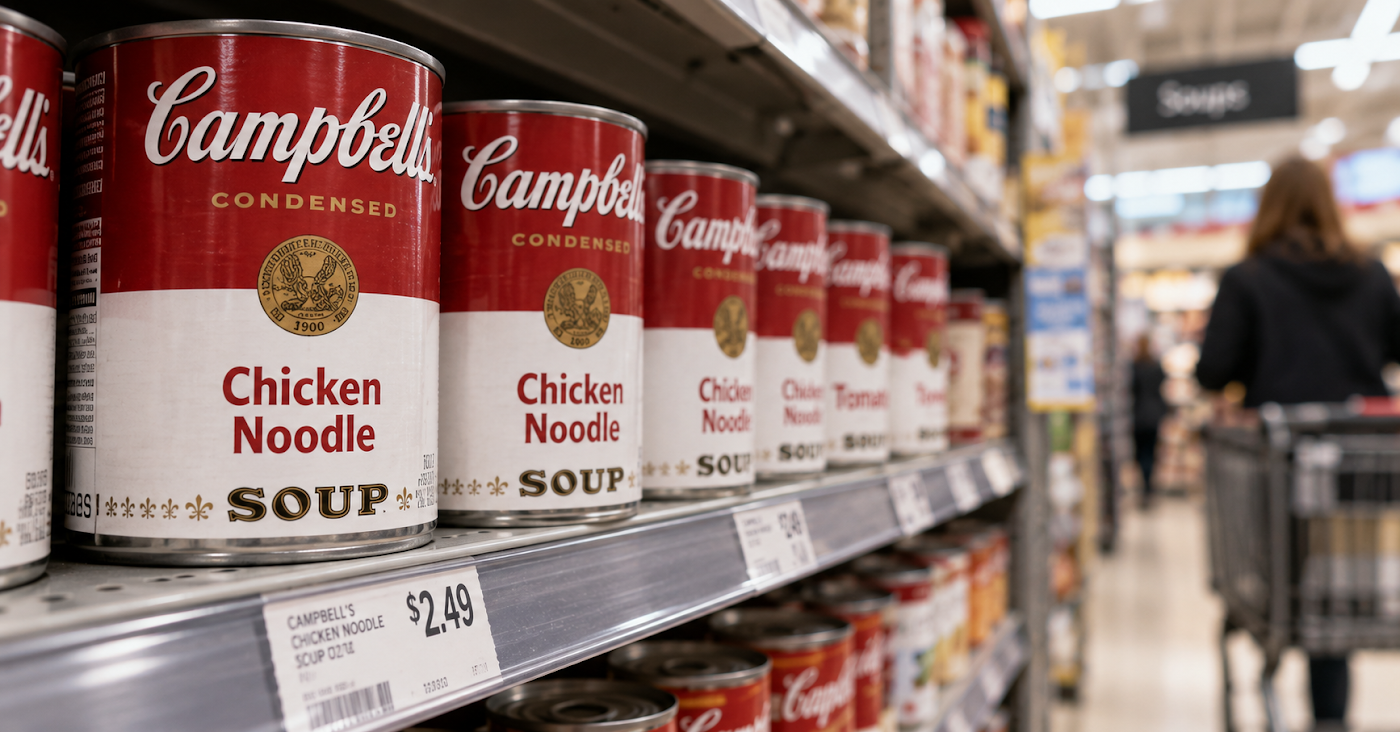
Campbell's called price increases the last resort in June and is now raising them on more than half its portfolio. Treasury shorts are the most crowded since early 2025. And 12% of the smallest private credit borrowers are marked below 90 cents.
0.5 points.
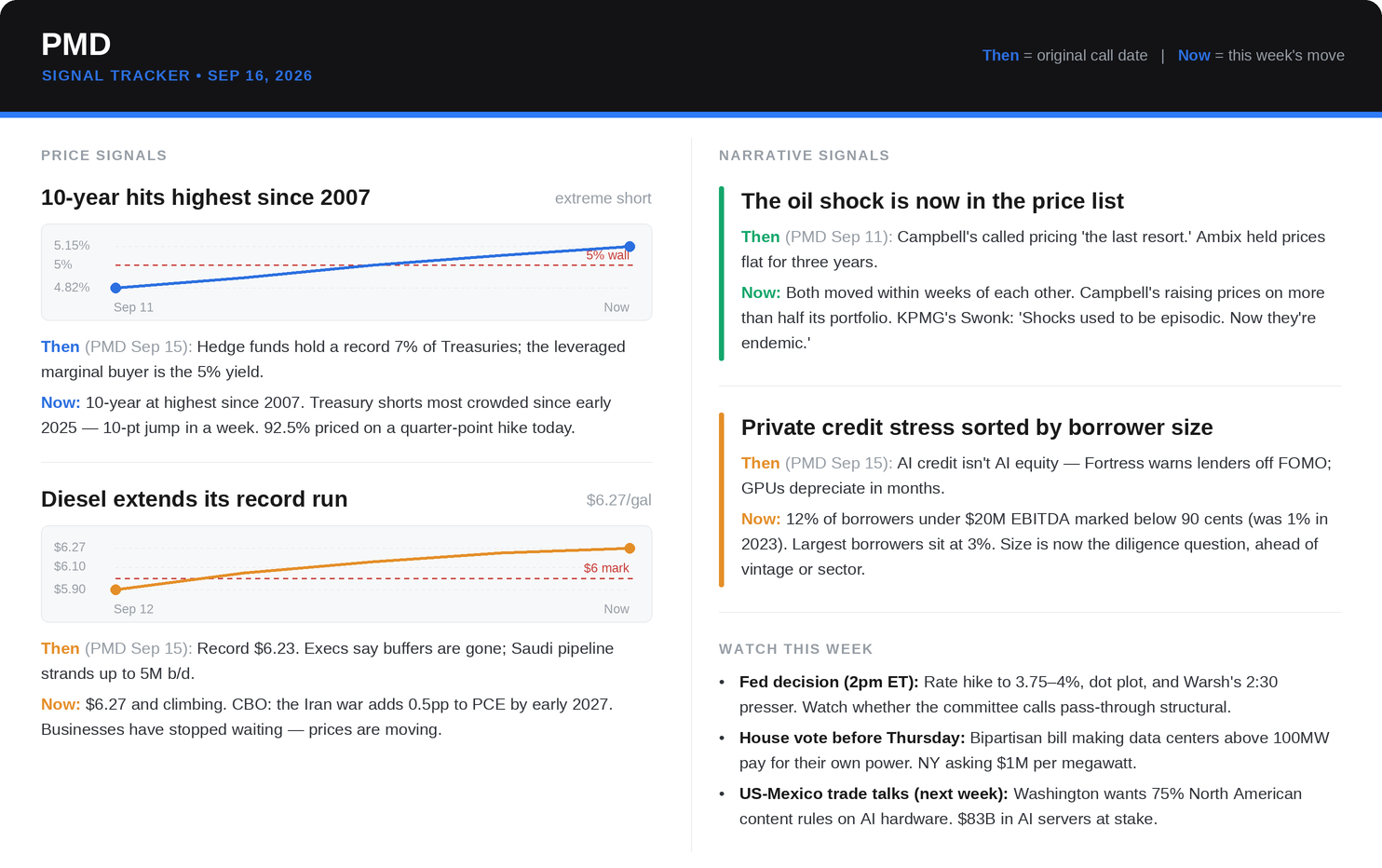
What the Iran war will add to year-over-year PCE inflation by early 2027, the Congressional Budget Office estimated Tuesday. Core takes 0.3 of it. PCE is the measure the Fed targets. The committee votes today on a rate that reaches almost none of it.
Kevin Warsh delivers the rate decision this afternoon, with questions at 2:30.
The 10-year reached its highest level since 2007 on Tuesday.
Brent closed at $108.75. Retail diesel averaged $6.27.
PMD LENS
The Fed can cool demand this afternoon. It cannot reopen a price list.
Businesses have started answering the question they argued over all year, and the answer is in their price lists. Price lists do not reverse when oil does.
That is the floor the Fed votes into this afternoon.
Great Companies Don’t Stay Under the Radar Forever
Most great stocks look boring when the real opportunity begins.
They’re still building scale, executing quietly, and being ignored by most investors.
That’s often when long-term winners are made.
The original market leaders didn’t become obvious overnight.
Our analysts believe the same pattern is forming again.
In These 7 Stocks Will Be Magnificent in 2026, we highlight companies that may look unremarkable today…
But you’ll soon see they all have the traits that historically define future market leaders.
- Brookfield (BN) agreed to buy Australia's Reliance Worldwide for $2.9 billion in cash. Plumbing fittings, unanimous board recommendation.
- The House moved on a bipartisan bill making data centers above 100 megawatts pay for their own power. New York's governor asked developers for $1 million per megawatt.
- Dave & Buster's (PLAY) swung to a $12.5 million loss. The shares closed down 19.01%.
Businesses Decided the Oil Shock Is Permanent and Started Passing It Through
Are high energy costs a temporary nuisance to wait out, or a long-term reality that calls for price increases now?
Businesses are answering. Ambix Manufacturing raised prices between 10% and 21% this summer, after three years without an increase. "We reached the breaking point," Melissa Florio said. Campbell's (CPB) called pricing "kind of the last resort" in June and is now raising it to more than half its portfolio.
KPMG's Diane Swonk named the change. "Shocks used to be episodic. You could ride it out. Now they're endemic."
The household side is thin. Americans have spent about $107 billion more on fuel since the war began, more than $500 million a day. The savings rate hit 3% in July.
The CBO calls the cost durable, because "the price of almost every product reflects shipping costs." BCA's Roukaya Ibrahim says diesel is "probably already leading to demand destruction."
The Pass-Through Signal
A rate hike does not un-set a price. Ambix and Campbell's both held for months on the view that the shock was temporary. Then they moved within weeks of each other. That is a cost base resetting, not demand a rate can cool, and it reaches a portfolio company's margin long before a CPI print. Watch the projections at 2:00 for whether the committee calls pass-through structural. Watch diesel for the demand destruction Ibrahim already sees.
The current economic chaos is just a preview …
What's coming next could be way scarier.
That's according to a strange investment secret - discovered just before the Great Depression…
And it's likely to catch most Americans by surprise.
If you're retired or planning to retire …
If you have any kind of money in the stock market …
Click here to learn more - before it's too late!
11780 US Highway 1,
Palm Beach Gardens, FL 33408-3080
Would you like to edit your e-mail notification preferences or unsubscribe from our mailing list?
Copyright © 2025 Weiss Ratings. All rights reserved.
SIGNAL 1: Bond Traders Piled Into an "Extreme" Short Betting the Selloff Continues
Traders have crowded into bearish Treasury positions ahead of today's meeting. JPMorgan's client survey shows shorts jumped 10 percentage points in a week, the fastest since early 2025. Citi's David Bieber called the positioning "tactically extreme." Swaps price 50 basis points of tightening for the rest of the year.
There is little evidence of dip-buying in duration. Traders put 92.5% on a quarter point today, to a 3.75% to 4% range. The danger sits in a hawkish hold or an ambiguous hike.
When Everyone Is on One Side of the Boat
The market is short bonds into a hike it treats as certain. That is rational given what businesses just did to the price level. It also means there is nobody left to sell to. A muddled hike snaps the long end back hard, and the long end is what every long-dated private mark discounts against. The risk today is not the rate. It is a violent move in a number nobody is positioned for.
SIGNAL 2: Mexico's AI-Hardware Exports Hit $83 Billion as Washington Moves to Box Out China
The US is pressuring Mexico to accept rules-of-origin limits on AI hardware, to stop Chinese firms routing through it tariff-free. Chips and servers are now Mexico's top export to the US, past autos. Mexico shipped $83 billion of AI servers in the first half, 94% of it north, up more than 170%. Washington wants the auto industry's 75% North American content threshold applied.
US data centers may burn about 18 billion cubic feet of gas a day by 2035, nearly double BloombergNEF's forecast of nine months ago.
The Buildout Just Became a Trade-War Front
Washington wants Chinese content out of the servers the boom runs on. Rerouting that supply chain is a cost line, not a headline. Underwriting that assumed cheap hardware and cheap gas now carries a tariff negotiation and an energy market at once. The boom's hardware just joined the decoupling everything else already faced.
SIGNAL 3: Private Credit Defaults Are Rising, Concentrated in the Smallest Borrowers
About 12% of borrowers under $20 million of EBITDA were marked below 90 cents on the dollar in the second quarter, Houlihan Lokey reports. In 2023 that was 1%. The $20 million to $100 million tier is at 6%. The largest borrowers are at 3%. Default risk, the firm writes, is "primarily a function of borrower scale."
Defaults reached 2.5% of borrowers by count and 0.8% of principal. Blue Owl placed its Loparex loan on non-accrual after a $1.5 billion recapitalization collapsed.
The Stress Is Real, and It's Sorted by Size
Private credit is not cracking broadly. It is cracking at the bottom, where the markdown rate went from 1% to 12% while the largest borrowers sit at 3%. Structural input costs and 5% money land first on the companies with the least room to pass either through. That makes borrower size the diligence question this quarter, ahead of vintage and ahead of sector. An index-level default rate tells an allocator almost nothing about the book they own.
On December 10th, a powerful new law signed by President Trump
will trigger a radical shift in America’s money system...
When a small group of private companies — not the Fed — will perform a major mint of a new kind of money.
And those who act before this new system fully kicks in could see gains as high as 40X by 2032.
But those who fail to prepare will be blindsided by this sea change to the U.S. dollar.
Go here now for the details — before the December 10th mint hits the market.
The statement, the projections and the dot plot at 2:00 p.m. ET. The House vote before Thursday's recess. US and Mexico trade talks in Washington as early as next week.
Four assumptions are carrying more weight than the evidence supports. That the energy shock is temporary, when the firms setting prices have stopped acting like it. That a policy rate reaches an inflation the CBO traces to shipping. That a crowded position is a protected one. That private credit's stress is a cycle, when the firm measuring it reads it as a size problem.
The hike is the small half of today. The projections are the half the long end will believe or price against, and that is what private marks discount to. Businesses have already built a floor under the price level that no rate decision removes. The middle market pays for that floor first, and Houlihan Lokey has already put a number on it.
THE MARKET WON’T WAIT FOR YOUR INBOX
Get the Alerts That Could Move Your Money
Breaking market news, actionable trade ideas, analyst signals, and major catalysts—sent straight to your phone when they matter.
Join FinancialMarkets.comFREE market alert list today.
SEND ME THE NEXT ALERT → (free)