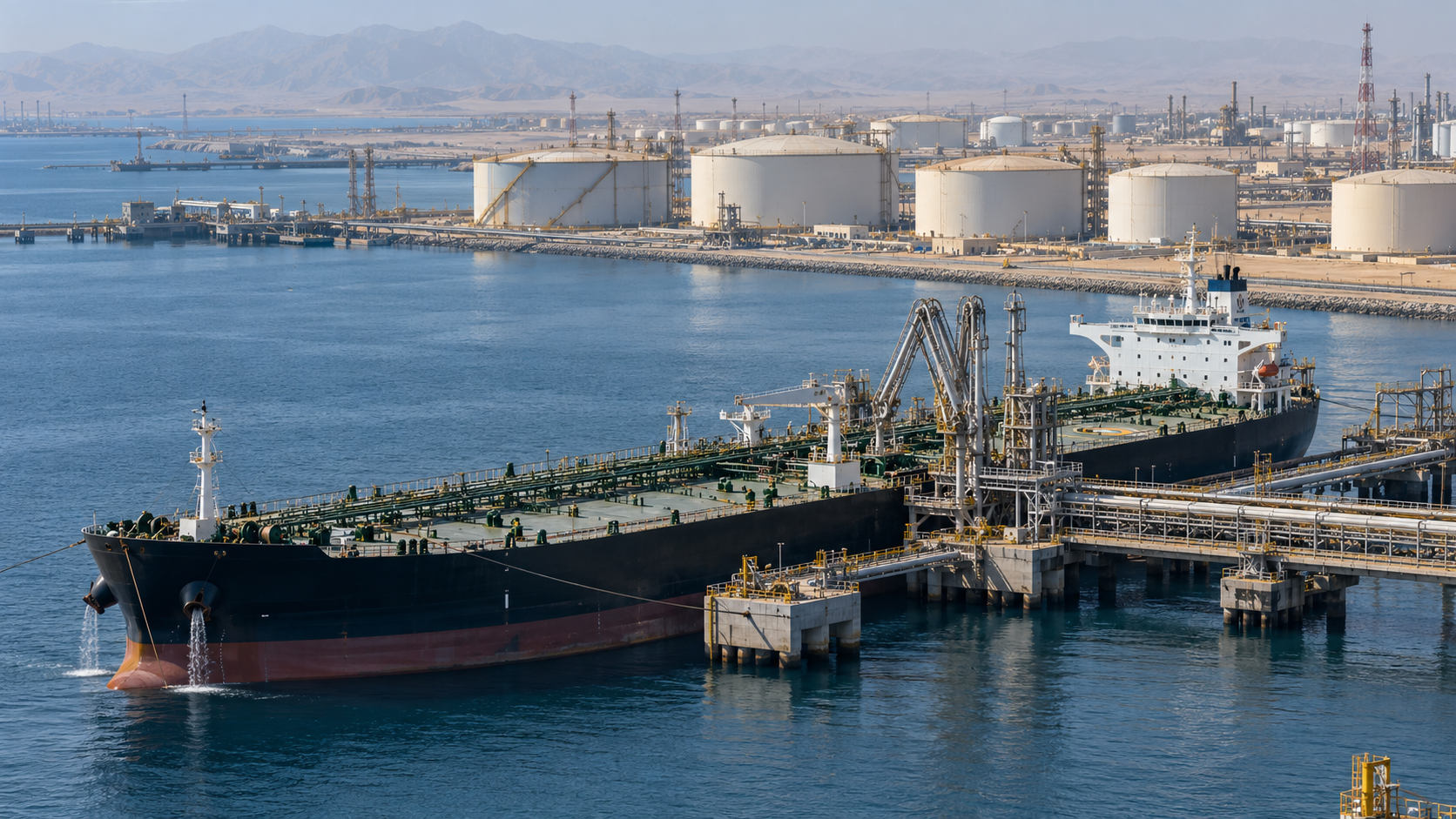
The global benchmark was up about 1.6% at around $111.30 early Tuesday, near a five-month high, after Yemen's Houthis claimed attacks on Saudi energy sites including an Aramco facility at Yanbu. Saudi authorities have not confirmed any damage. Washington's waiver suspends tariffs aimed at buyers of Russian crude, but the only new supply it has pointed to is Russian diesel.
Two supply stories have been competing for the oil price since Friday. By Tuesday morning, the price was moving in the direction the crude story points.
Brent crude traded around $111.30 a barrel at about 6:20 a.m. Eastern on Tuesday, up about 1.6% from Monday's settlement of $109.55, after touching about $111.75 in the 5 a.m. hour. That is above Monday's intraday high near $110.70, which had been the highest level since May 20, and about 4% above the low of about $106.80 it touched in Asian trading on Monday, by this publication's arithmetic.
That Monday low came as traders weighed Washington's decision to ease sanctions on Russia. By the U.S. close the move had largely reversed, with Brent settling down only 0.3%. Since then, the news flow has come from the Gulf.
What the Houthis claim
Yemen's Houthi movement said it carried out six attacks on Saudi Arabia over 48 hours, naming an Aramco facility at Yanbu on the Red Sea coast, the Shaybah oilfield, King Khalid International Airport in Riyadh, Abha International Airport in the southwest and Saudi naval forces. Saudi authorities have not confirmed the strikes or reported damage. Separately, Iran's Revolutionary Guard said a tanker caught fire and exploded after striking a naval mine in the southern Strait of Hormuz on Sunday, an account carried by Iranian media.
Saudi Arabia has also postponed its Future Investment Initiative, the flagship investment conference scheduled for Oct. 26 to 29, until 2027.
Yanbu matters more than the other targets on that list. It is the outlet Saudi Arabia uses to export crude to the west without sending tankers through the Strait of Hormuz. A credible threat to that route would touch the barrels that have kept Gulf supply moving during the war.
What Washington eased
On paper, the policy relief is broad. President Trump signed an executive order on Oct. 16 implementing the Lindsey O. Graham Sanctioning Russia and Iran Act of 2026 and waiving its sanctions and tariffs under the law's section 115, including the duties aimed at the largest buyers of Russian crude and gas. Russia sanctions imposed under earlier executive orders are unaffected, according to the order. In practice, the one new physical supply Washington has pointed to is diesel: Trump has said Russia would initially supply more than 300,000 metric tons of it to the United States.
Estimates of Gulf flows diverge. Energy Secretary Chris Wright has put them at about 80% of their pre-conflict level, an estimate the Energy Department has not published. Ship-tracking data from Kpler point lower: Gulf crude flows averaged about 8.5 million barrels a day last week, down from more than 20 million the week before, with at least 10 confirmed incidents.
The two channels do not offset each other neatly. The tariff relief helps buyers of Russian crude keep buying, and additional Russian diesel addresses a shortage of refined fuel. The Houthi claims and the mine reports concern crude and the routes it travels. A market can absorb more diesel and still pay a premium for crude it fears may not arrive, which may help explain why Monday's relief proved short-lived.
What analysts are saying
Priyanka Sachdeva of Phillip Nova said the waiver "did little to address the physical supply disruptions." ING took the other side of the argument, saying the risk premium "will likely gradually decline" if supplies continue without interruption.
Market implications
One reading is that physical risk now sets the price. The claimed targets include the bypass route for Hormuz, a major Gulf investment conference has been called off, Kpler's figures show crude flows well below normal, and the only new supply Washington has announced is a refined product.
A second reading is that the premium is fragile. No damage has been confirmed at Yanbu or Shaybah, Wright says flows are near four-fifths of normal, the tariff waiver keeps Russian crude moving to its biggest buyers, and a premium built on claims rather than lost barrels can unwind quickly if loadings continue.
The test is simple to state. Confirmed damage at a Saudi export site would support the first reading; a week of uninterrupted Red Sea loadings would support the second.
What to watch
Any Saudi or Aramco statement on Yanbu and Shaybah; the industry inventory estimate at 4:30 p.m. Eastern on Tuesday and the Energy Department's weekly report at 10:30 a.m. Wednesday; United Airlines' results after Tuesday's close for comment on jet fuel; Egypt's parliamentary debate on supporting Saudi Arabia, due to resume Oct. 26; and the OPEC+ meeting on Nov. 1.