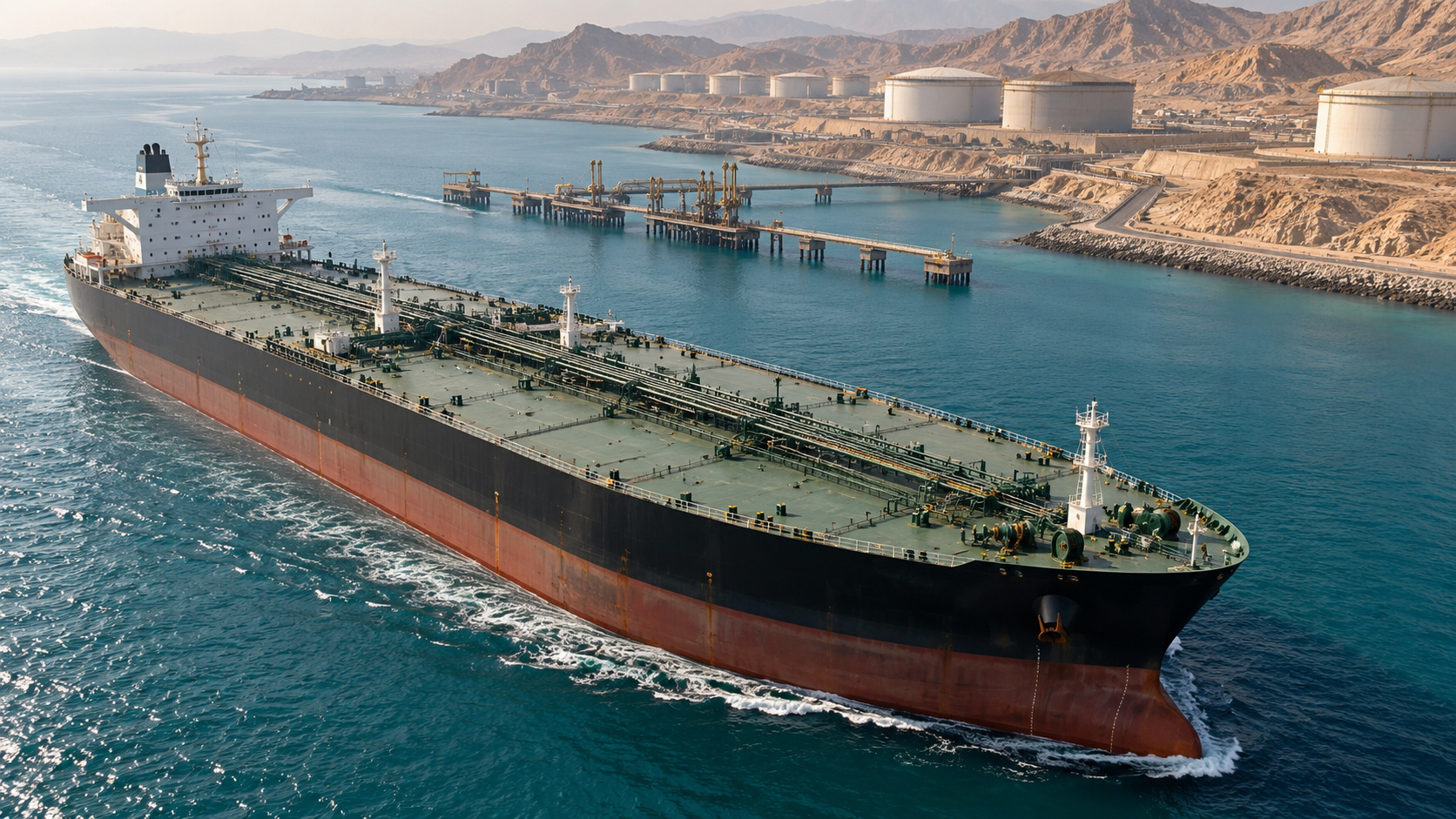
Brent slipped below $100 as tanker traffic through Hormuz recovers, but Saudi Aramco's chief executive says rebuilding drained global inventories could take two years, and refined fuel flows remain far from normal.
Crude prices slid on Monday and into Tuesday while tanker traffic improved. Saudi Aramco's chief executive used the same day to argue that the shortage has simply moved from the sea lanes into the storage tanks.
Brent crude settled at $100.32 a barrel on Monday, down about 1.9%, and extended the decline overnight to $98.99, back below the $100 line. U.S. benchmark West Texas Intermediate settled at $89.43 and fell to $88.01 early Tuesday. Heating oil, the U.S. proxy for diesel, dropped 2.4% overnight, faster than crude.
The decline coincides with a visible improvement at sea. Ship-tracking data show roughly 10.3 million barrels a day of crude moved through the Strait of Hormuz in the seven days to Saturday, about 76% of pre-war volumes.
Amin Nasser, speaking at an industry forum on Monday, argued that flows are the wrong yardstick. "Until Hormuz fully re-opens and confidence returns, the crude reality is that pressure at both ends of the barrel will intensify," he said. "Even then, replenishing inventories while meeting demand could take up to two years."
His numbers frame the problem. Almost three billion barrels of supply have been lost since the disruption began, he said, and about one billion barrels were released from stocks to cover the gap. Refilling those stocks would add roughly two million barrels a day of extra demand for 18 months. Much of the roughly six billion barrels still held around the world, he said, is not practically available, describing buffers as "scarily thin." Without Saudi Arabia's East-West pipeline, which lets crude bypass the strait, Brent would have hit $200, he added.
The arithmetic holds together. Two million barrels a day over 18 months comes to about 1.1 billion barrels, almost exactly the volume drawn from storage. In other words, Aramco is describing a second wave of demand that arrives just as the first wave of supply returns.
The product market already shows the strain. Refined fuels made up only about 11% of cargoes through Hormuz in the latest week, roughly 1.3 million barrels a day, against more than 20% before the war. Crude is coming back faster than diesel and jet fuel, and on Monday the White House moved to allow tax-exempt red-dyed diesel on public roads, a step most drivers are unlikely to notice at the pump.
Security risks have not cleared either. Five incidents involving shipping in the strait were reported on Monday, and the U.S. Treasury's sanctions office warned foreign banks that institutions still dealing with sanctioned Iranian lenders "could be targeted at any time without advance notification."
One market looks less convinced by the crude slide. The energy sector ETF rose 1% on Monday even as crude fell, a divergence that suggests investors expect producers to earn elevated margins for longer than the spot price implies.
The test arrives quickly. The Energy Department's monthly short-term outlook is due Tuesday, and its inventory projections will show whether official forecasters see the same two-year refill. If heating oil keeps falling faster than Brent, the market is betting that the product squeeze is easing. If the gap reopens, Nasser's warning will look like the better forecast.