
TQ Morning Briefing
Lula won after markets and bettors leaned the other way, and the main Brazil ETF and its biggest ADRs fell by about a quarter early Monday. Brent slipped as regional envoys headed to Tehran. Fed week opens with a 2-year sale.
The Indexes Barely Moved. Most Stocks Didn't Hold Up.
Friday's scoreboard depended on the index. The Dow fell 1.2% and still logged a third straight weekly gain. The S&P 500 fell 0.5% on the day and for the week. The Nasdaq slipped 0.2% to its lowest close since Aug. 3.
Underneath, the damage was wider. Decliners beat advancers almost two to one. New 52-week lows outnumbered new highs 1,141 to 379.
Energy was the exception. The Energy Select Sector SPDR Fund rose 2.6% to a 52-week high. Consumer staples fell nearly 2% and financials about 1.3%. The VIX ended the week at 19.45.
Monday started calmer on the surface. Brent eased to about $115, roughly 1.5% below Friday's $116.72 settle. The 10-year yield sat near 4.99%. Bitcoin slipped below $80,000 in Asian trading, then steadied near $80,200.
Market Implication
The index moves are understating what the average stock is doing. A 0.5% loss in the S&P 500 sat on top of roughly three new lows for every new high, with energy carrying most of what held up. That makes a calm open a weak signal this week, because the participation problem shows up in breadth before it shows up in the index. A small loss with three lows per high is a warning, not a rest.
Free Ticker: Company 400x Smaller Than NVIDIA Poised to Soar after Anthropic IPO
Everyone's talking about the Anthropic IPO. Even NVIDIA wants in, Reuters reports. But a company 1/400th NVIDIA's size beat it to the punch. Tech visionary Matt McCall has uncovered this obscure company's early stake... and why he believes it could rocket higher in the year or so ahead.
Brazil Priced a Change of Government. It Got Lula.
Lula won Brazil's runoff with 51.79% of valid votes to Flávio Bolsonaro's 48.21%. He is the first presidential candidate since direct elections returned in 1989 to win a runoff after losing the first round. Bolsonaro said he will seek to annul the result, citing a court order that extended voting by two hours. Both campaigns had asked for extensions.
Markets had positioned for the other outcome. Brazilian stocks closed Friday almost 7% above their level before the first round. The real was nearly 5% stronger. Compounded in dollars, those gains come to about 12%.
The reversal came overnight. Real futures fell about 10% in Asian trading. The iShares MSCI Brazil ETF was indicated about 26% below Friday's $42.59 close in thin early trading.
The ADRs sorted by home exposure. Itaú Unibanco (ITUB) was about 28% lower and Petrobras (PBR) about 23%. Nu Holdings (NU) was down about 22%. MercadoLibre (MELI) was off about 9%.
Alejo Czerwonko, chief investment officer for emerging markets at UBS Global Wealth Management, expects the rally that followed the first round to be "largely priced out." Brazil's public debt is above 82% of GDP, and Lula's team targets a primary surplus of about 1.3% of GDP by 2030.
Structural Setup
The first-round rally was a bet on a result, not on Brazil's fiscal math. A dollar-priced fund carries the stock and currency moves at once, so the 7% and 5% gains compound to about 12%, and the fund's indicated drop is about twice that. The gap is the fiscal premium the rally pushed aside, with debt above 82% of GDP. If the real's 10% futures drop holds once local trading opens, this is a repricing of risk, not just the exit from a trade.
SpaceX Says It Lined Up $40 Billion. The Neoclouds Traded Lower.
Elon Musk said on X that SpaceX (SPCX) closed $40 billion of debt for GPU purchases. He called it primarily callable debt for chips arriving in the first half of 2027. No terms, lenders or filing have been disclosed, and people familiar with the discussions said talks over pricing were still under way. Musk also said many neoclouds face "guppy-level death" and that SpaceX is not buying any.
CoreWeave (CRWV) was indicated about 5% lower premarket, below its 52-week low of $53.50, after closing Friday at $54.24. Nebius (NBIS) was down about 4%. CoreWeave's bonds sold in June with a 9.625% coupon were priced to yield about 15% earlier this month.
Private capital is pricing patience too. Bon Secours Mercy Health is in late-stage talks to buy a majority of Surgery Partners (SGRY) at about $20 a share, according to a published report. Bain Capital would keep its roughly 40% stake. That price is about 22% below the $25.75 a share Bain proposed in January 2025. The stock closed Friday at $15.75 and was quoted near $19 premarket.
Sector Read
Capital is sorting borrowers by balance sheet, not by the AI story. A company that says it has lined up $40 billion of callable debt keeps buying GPUs, while lessors whose bonds yielded about 15% earlier this month trade on the cost of their next dollar. Bain's reported plan to stay in at about 22% below its own bid shows the same behavior on the private side: holders roll rather than sell into a market that won't pay the old price. The price of money is now the product.
Trump to build "biggest data center on the planet"

America's about to get its first national data center… Completely funded by taxpayer dollars. When it comes online just days from now… This device could change the history of Artificial Intelligence… And even human civilization. (It could also make early investors in this company very happy.) Louis Navellier believes it will secure America's dominance over China in the AI arms race… While completely sidestepping the dangers of Artificial Superintelligence. Donald Trump committed $1 billion to support the stock behind the coming breakthrough right now… Ahead of a potential announcement from the company that could hit soon. Get all the details – down to the company name and ticker – here, in Louis' brand-new presentation.
This ad is sent on behalf of InvestorPlace Media at 1125 N. Charles Street, Baltimore, Maryland 21201. If you're not interested in this opportunity, pleaseclick here.
Envoys Headed to Tehran. Tehran Said Hormuz Won't Go Back.
Brent fell about 1.5% early Monday. Qatari mediators visited Tehran on Sunday, and senior officials from Saudi Arabia, Pakistan and Turkey were set to meet Iranian leaders there on Monday.
The other signals didn't ease. Houthi forces claimed a missile attack on Riyadh's main airport, and the Saudi-led coalition said it intercepted a missile headed for the city. Iran's foreign minister, Abbas Araghchi, said the Strait of Hormuz will not "be managed as it was in the past."
Prices split by grade and region. Murban, the UAE's benchmark crude, climbed about 3% to above $118 while Brent fell. European natural gas topped €97 a megawatt-hour for the first time since 2022.
Polymarket's contract on the U.S.-Iran ceasefire holding through Oct. 31 slid from 84.5 cents to as low as 69 cents on Sunday evening. It was back at 85.5 cents by morning. No cause for the drop has been established. A claimed strike in southern Iran surfaced only after the contract had begun to recover, and no U.S. official confirmed it.
Watch Signal
Diplomacy is taking strike risk out of the price faster than it can put the strait back together. Brent fell while Murban and European gas rose, so the benchmark and the regional prices are no longer telling the same story. The ceasefire contract lost more than 15 points and recovered all of it by morning, with no confirmed strike behind either move. What matters now is not whether a strike comes, but whether ships move through Hormuz the old way.
The Betting Market Was Not a Second Opinion
Polymarket priced a Flávio Bolsonaro win at 81.4 cents early Sunday afternoon. Kalshi had him near 82 cents. The final Datafolha poll, released Saturday, had Flávio at 51% to 49% of valid votes, inside its margin of error. Three days before the vote, it had the race tied.
Traders appeared to lean on the first round, which Flávio led 47.03% to 45.16%. Brazil's stock and currency rally did the same.
The contract slid through the afternoon as voting was extended, then collapsed as the count came in.
Bolsonaro's annulment bid came after the bets had settled. Kalshi's contract settled at No on Sunday night, before his statement, and Polymarket's resolved No later that night.
The Read
An 82-cent price looked like confirmation for anyone long Brazil. It looks like the same input, the first-round lead, counted twice: once in the contract and once in the real and the stocks. When the bet and the position lean on one fact, the prediction market stops checking the trade and starts echoing it. A price that agrees with your book is correlation, not corroboration.
He predicted the 2008 financial crisis…
He predicted Trump’s election in 2016….
He even predicted the rise of COVID-19 writing:
“The chance we don’t have something on the scale of a national pandemic in the next few years is near zero”
That was three months before the first reported case.
If he’s right again, God Bless America…
Because this crisis will be tectonic in scale…and it's going to begin with the bubble popping in AI.
Economic Data: Treasury sells $69 billion of 2-year notes today, $70 billion of 5-year notes Tuesday and $44 billion of 7-year notes Thursday. Third-quarter GDP and September PCE arrive Thursday. The employment cost index follows Friday.
Earnings: Verizon (VZ) before the open today and Cadence Design Systems (CDNS) after the close. Microsoft (MSFT) and Alphabet (GOOGL) Wednesday after the close. Amazon (AMZN) and Coinbase (COIN) Thursday. Exxon Mobil (XOM) and Chevron (CVX) Friday before the open.
Overnight: Kospi -1.46% | Nikkei -0.80% | Shanghai +0.19% | FTSE +0.45% | DAX +0.78%
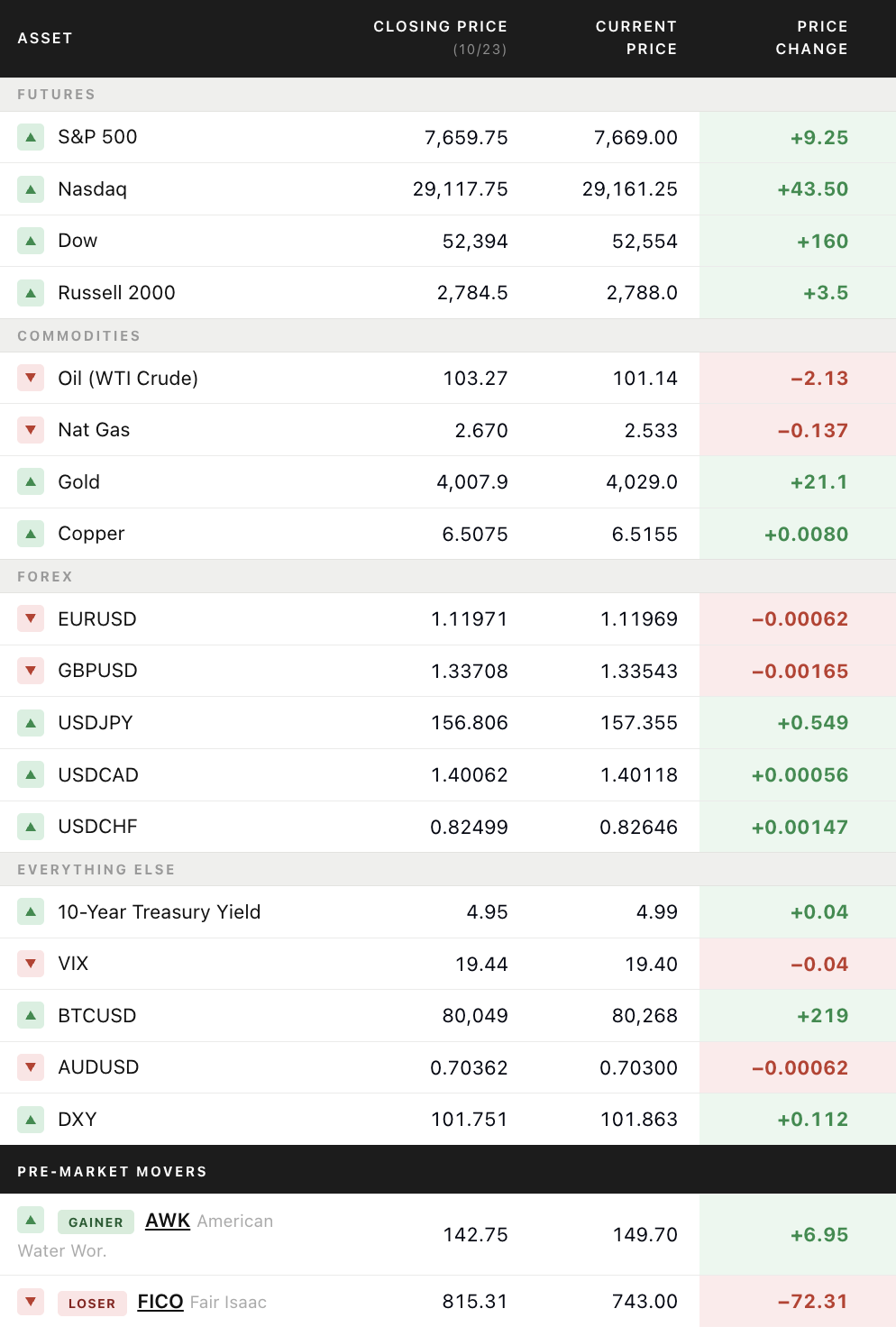
Monday's biggest move wasn't made in New York.
It came from a crowded call in Brazil, where stocks, the currency and the betting market all leaned toward one result and got the other.
The cleanest test is today's first local session. If the real holds most of its 10% futures loss once onshore trading opens, investors are repricing Brazil's fiscal risk, not just closing a bet. If it claws much of that back, the overnight print was a crowded position leaving through a narrow door.
Rates Just Reset. Who Feels It First?
On January 2, the 10-year Treasury yielded 4.19%. By September 30, it was 5.29%. Most of that move landed in a single quarter.
The bond market repriced and companies are starting to report it.
Some companies earn from higher rates. Some pay for them. And each one runs on a different clock.
We traced three of them, IBKR, WRB and FIS, in a new FREE Special Report:
Rates Just Reset. Who Feels It First?
Who earns it fast. Who earns it slowly. Who pays. One has already reported. The other two report next, and the report tells you the exact line to check.
We'll text the report straight to your phone.