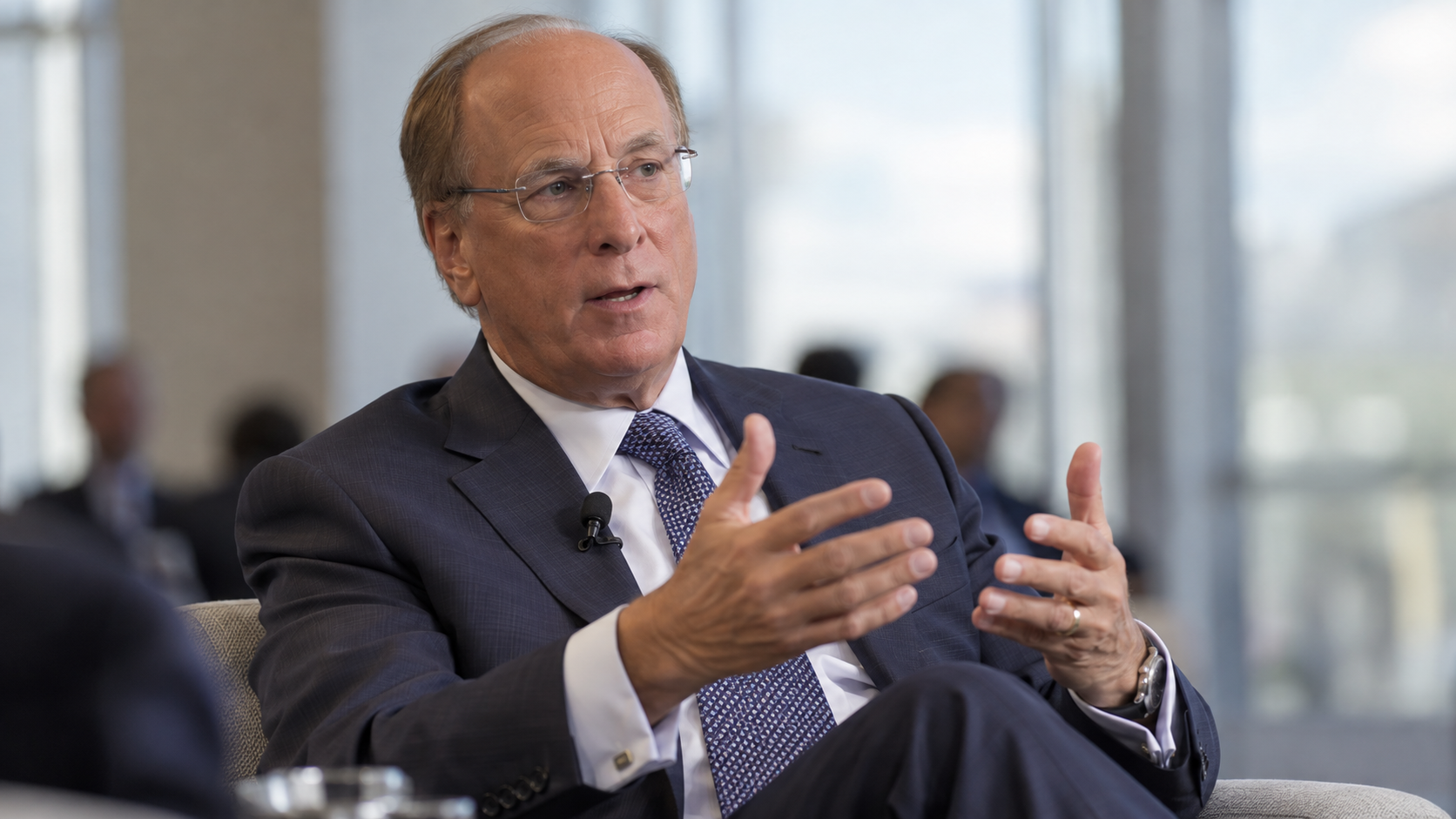
Revenue rose 19%, in step with average assets under management, and a 2.3% opening jump faded by early afternoon. On the call, Larry Fink argued that competition for capital will keep interest rates high for years, a view with consequences for a business whose fees move with asset values.
BlackRock reported a record quarter. The number that best explains how its stock trades is a ratio: how closely revenue follows the assets it manages.
The beat
Adjusted earnings came to $15.93 a share, about 11% above FMP's consensus of $14.32. Revenue rose 19% to $7.75 billion, ahead of the $7.42 billion forecast. Net income rose to $1.66 billion, or $10.57 a share under generally accepted accounting principles, from $1.32 billion, or $8.43. Clients added a net $205 billion, and assets under management reached $15.49 trillion at the end of September, up from $13.46 trillion a year earlier. The company reiterated a goal of more than $35 billion in revenue by the end of 2030.
The fee math
Measured against quarter-end assets, BlackRock's annualized revenue works out to roughly 20 basis points, or 20 cents on every $100, against about 19.3 a year earlier. That comparison flatters the trend. On the average assets BlackRock reports for the quarter, which rose about 19%, the same as revenue, the yield was roughly unchanged, and advisory and administration fees grew at about the same pace.
That one-for-one relationship is the point. BlackRock's revenue is, to a close approximation, a percentage of the value of what it manages. When markets lift those assets, revenue follows, and when they fall, it falls with them.
The reception
None of the beat held the stock up. Shares opened at $1,090.90, about 2.3% above Tuesday's close, and reached $1,106 before sliding back. By about 1:45 p.m. Eastern they were near $1,065, essentially unchanged.
Fink's argument
The chief executive used the analyst call to make a case about the supply of capital rather than inflation. Washington is running record deficits and companies are spending heavily on AI infrastructure, he said, and both are selling debt to finance it. In his view, that contest for investors' money will keep borrowing costs elevated over the long run even if inflation cools.
For BlackRock the view is double-edged. Persistently higher yields can steer money into bond and cash products, areas where the firm is large. They also lower what investors will pay for stocks and long-dated bonds, and because BlackRock's fees track the value of those holdings so closely, that pressure reaches its revenue directly. By early afternoon on the day Fink spoke, the S&P 500 was down more than 1%.
Market implications
The bullish reading is that $205 billion of inflows in a quarter shows a franchise still gathering assets faster than its rivals, which can offset softer markets. The bearish reading is that a manager whose revenue moves almost one-for-one with asset values is now led by a chief executive who expects the main driver of those values, interest rates, to stay a headwind.
What to watch
Whether fourth-quarter revenue keeps pace with average assets or starts to lag, which would signal fee pressure, and the split between bond and equity inflows, which will show whether Fink's rate view is already steering client money.