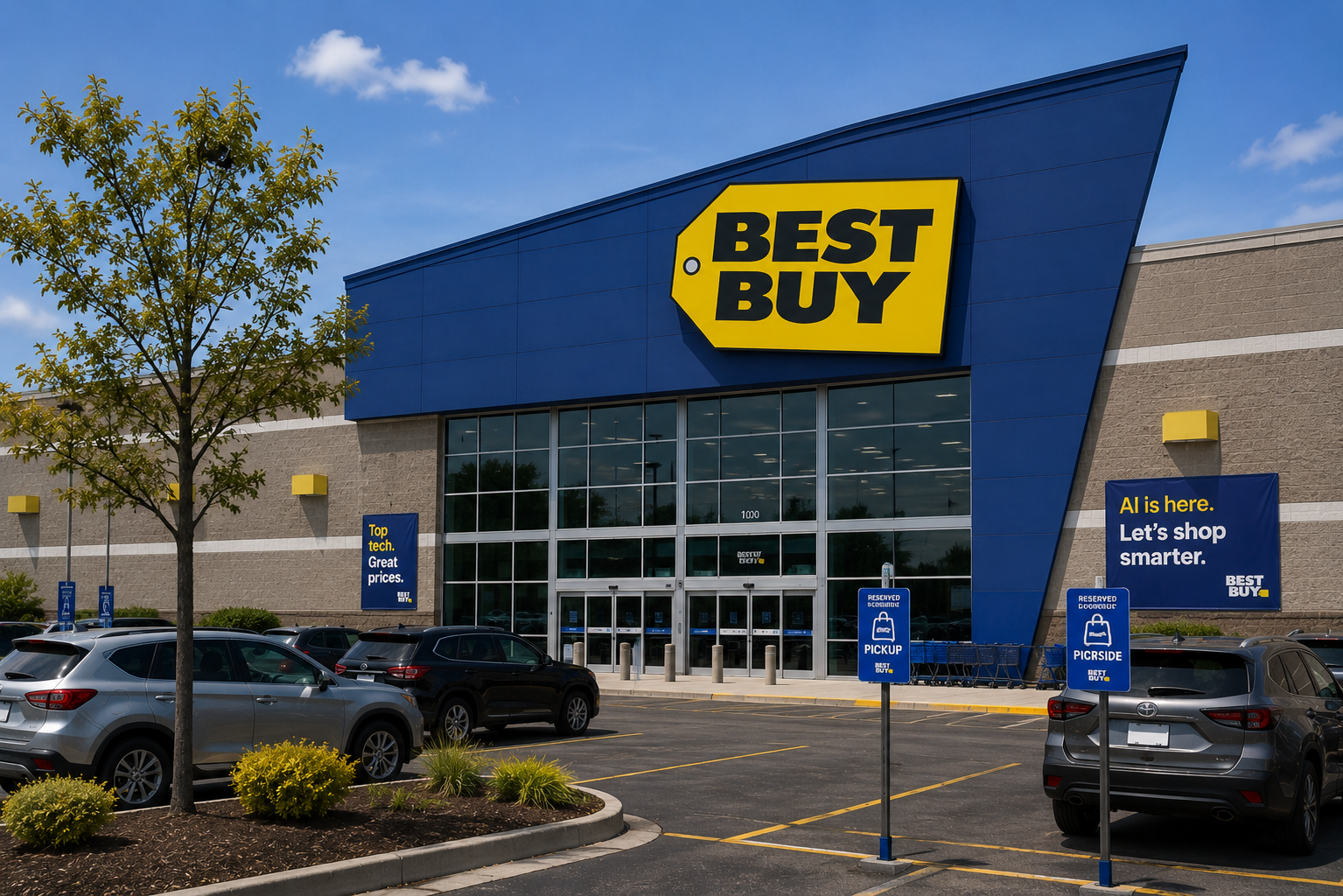
Comparable sales accelerated and the outlook moved higher across the board, but a 4.3% adjusted operating income rate is where investors appear to be focused instead.
Best Buy reported adjusted, non-GAAP earnings per share of $1.47, ahead of a $1.39 consensus estimate. Revenue came in at $9.779 billion, above a $9.594 billion consensus estimate, with comparable sales up 4.1%. By any conventional read, this was a beat, and the company followed it with a guidance raise. Full-year adjusted EPS guidance moved to $6.70 to $6.90 from $6.30 to $6.60. Revenue guidance rose to $42.3 billion to $42.8 billion from $41.2 billion to $42.1 billion, and comparable-sales guidance jumped from a prior range of negative 1.0% to positive 1.0% up to a new range of 1.9% to 3.0%. That is a meaningfully more constructive outlook than the company was offering last quarter.
Chief executive Corie Barry pointed to growth in Marketplace and Best Buy Ads, along with strength in AI-enabled glasses and the broader computing category, as drivers of the quarter. The company also rolled out an "Ask Blue" AI shopping assistant built with OpenAI integration. Computing posted its tenth consecutive quarter of positive comparable sales, a run that predates this quarter's acceleration. Domestic gross margin expanded 60 basis points to 24.0%, evidence that the company is not simply discounting its way to higher volume.
None of that prevented the stock from falling 4.38% to $83.61, in a session that ranged from $76.70 to $84.51, against a prior close of $87.44. A decline of that size on a beat-and-raise quarter demands an explanation beyond the headline numbers. The evidence points toward one in particular: an adjusted operating income rate of just 4.3%, pressured by compensation costs and continued investment in Marketplace and advertising.
Two additional pressures sit underneath that margin figure. The first is "memory inflation," a rise in memory-chip costs that is pushing computing-category prices higher. Higher prices introduce demand-elasticity risk if they eventually cool the volume growth the computing segment has been posting. The second is the tariff-refund benefit embedded in this quarter's results. It is temporary rather than structural and will not repeat as a source of earnings support in future quarters. Intra-quarter July comparable sales were stagnant, and comparisons grow tougher in the back half of the fiscal year.
The gross-margin expansion and the thin operating margin rate are both accurate descriptions of the same quarter, sitting at different points on the income statement. Gross margin improved because the company is managing pricing and mix well enough to expand it even as memory costs rise. The operating margin rate did not improve to the same degree because the costs sitting below gross margin, compensation and platform investment among them, absorbed a large share of that gain. The stock's decline reflects that gap: compensation costs, platform investment, a fading tariff benefit, and rising memory prices are the pressures investors are weighing against an accelerating top line and a maturing AI product lineup.