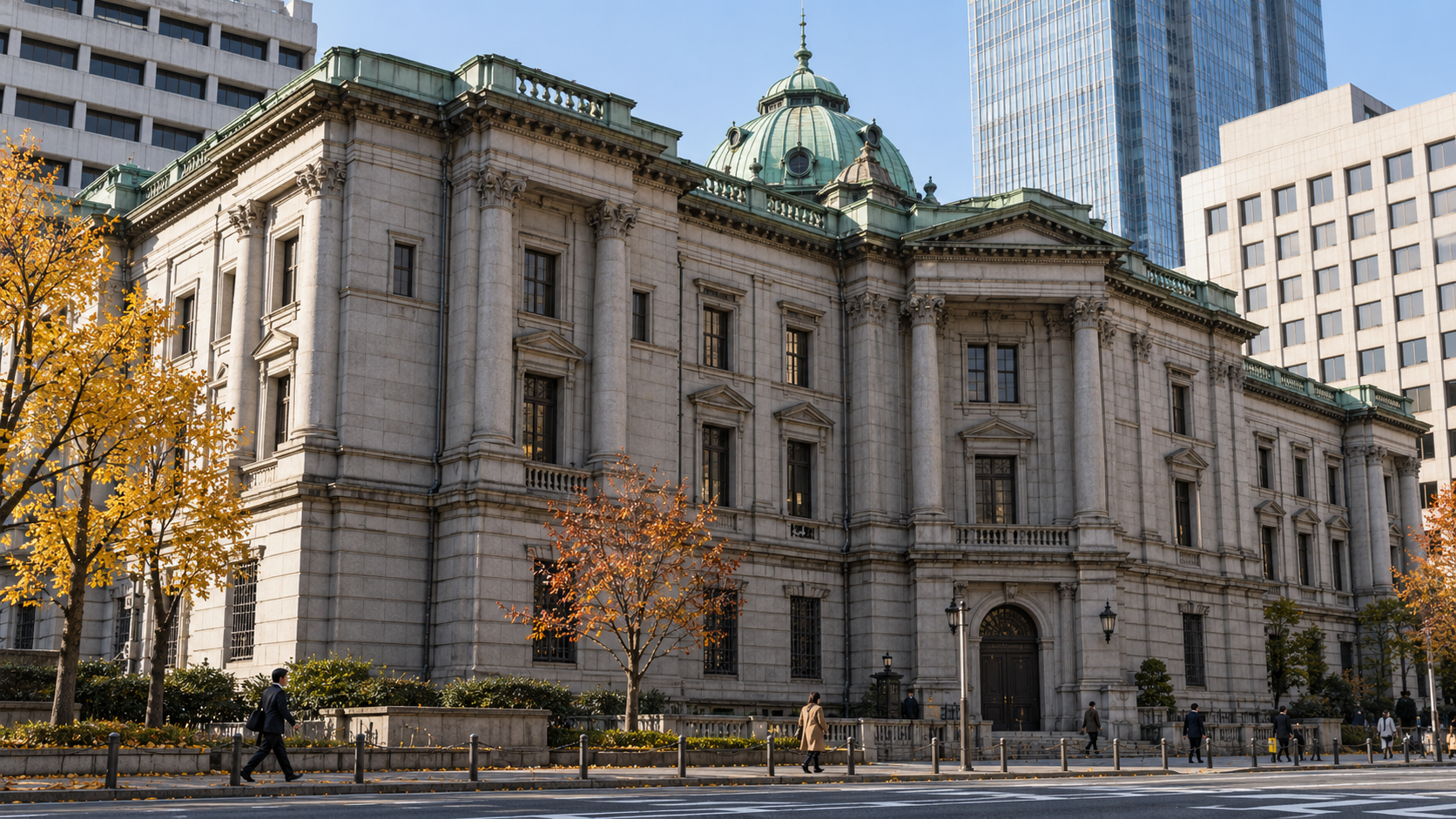
A summary of views from the September meeting shows policymakers focused on keeping inflation from running hot, as 10-year JGB yields climb past 3%.
For most of three decades, the Bank of Japan's problem was prices that would not rise. Its latest record of deliberations suggests the problem has flipped.
The bank's Summary of Opinions from its to meeting shows board members shifting their focus toward preventing an inflation overshoot. That meeting raised the policy rate to 1.25%.
Markets have taken the hint. Overnight index swaps now price a 22% chance of another increase at the to meeting and an 82% chance by December. Japan's 10-year government bond yield rose 4 basis points to 3.11% on Thursday.
A steep curve for a hiking central bank
The gap between those two numbers is notable. With the policy rate at 1.25% and the 10-year at 3.11%, the curve carries a term spread of 186 basis points. That is unusually steep for an economy whose central bank is actively tightening. It suggests investors expect either several more hikes or a lasting premium for holding long-dated Japanese debt, or both.
Japan's prime minister said Thursday that government steps would strengthen market confidence in the yen, a signal that Tokyo is watching the currency as global yields rise.
The Tankan split
The bank's own quarterly business survey, released the same morning, shows why the debate is complicated. Large manufacturers' sentiment rose to 24, an eight-year high, buoyed by global demand for chips and capital goods. Large non-manufacturers fell to 35 from 37, the first decline in five quarters, as oil costs squeezed service companies.
The gap between the two groups narrowed from 15 points to 11 in a single quarter. For a central bank weighing how fast to tighten, that convergence cuts both ways: exporters can absorb higher rates, but the domestic service economy, where most Japanese work, is starting to feel the energy shock.
Two readings for the October meeting
The hawkish reading is that an overshoot-focused board will not wait for clear weakness before moving again, and December pricing near certainty reflects that. The cautious reading is that a falling non-manufacturing index gives the board reason to pause in October, which is why the market assigns less than a one-in-four chance to a move that soon.
What to watch
The yen is the hinge. A weaker currency would import more inflation and strengthen the case for an earlier hike. A stable yen, helped by government reassurance, would let the bank take its time until the December meeting the market has largely penciled in.