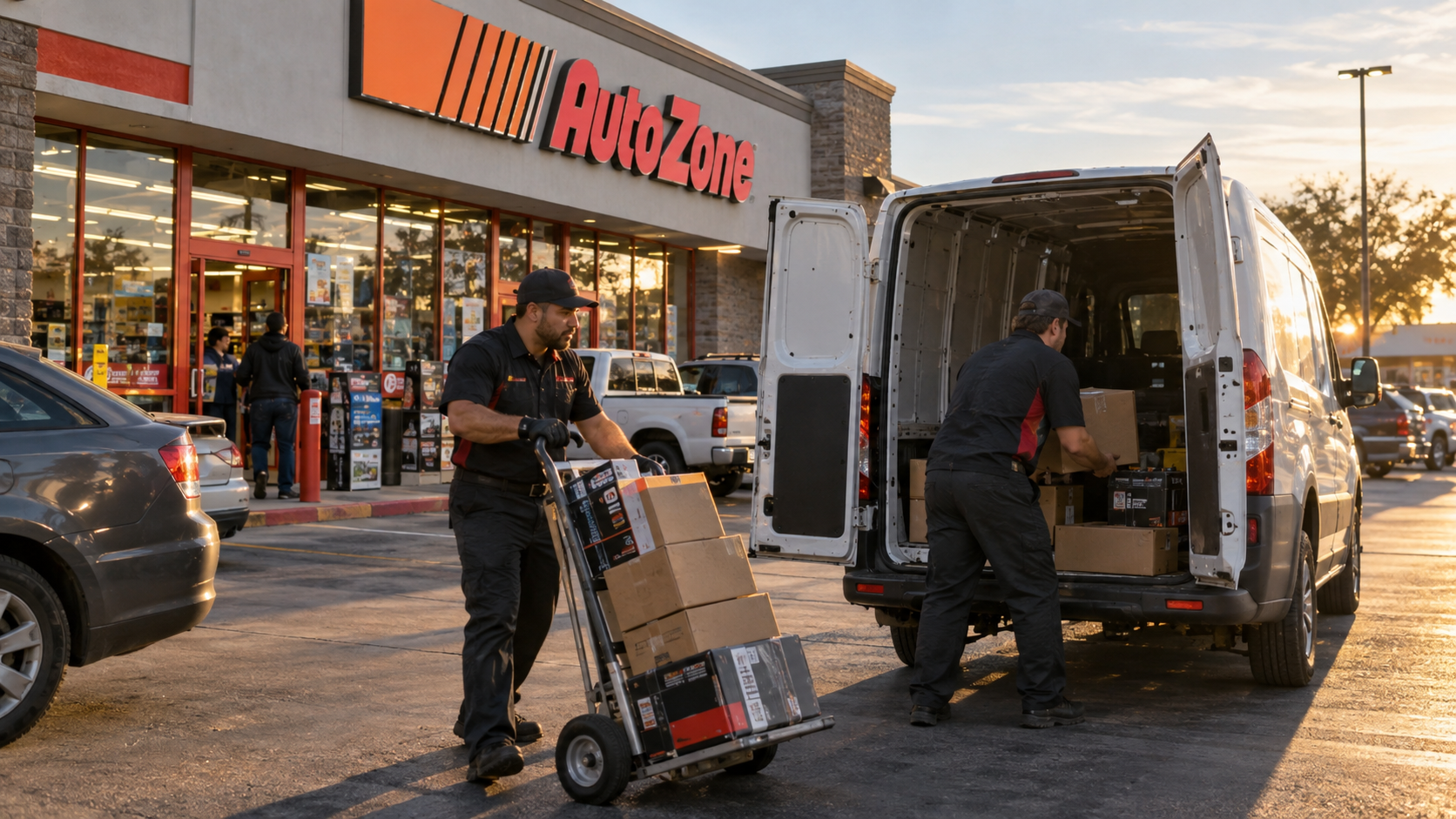
AutoZone beat on profit and topped Wall Street's per-share estimate, even as revenue came in just short of expectations and a chunk of the margin gain came from a source that won't repeat every quarter.
AutoZone closed out its 2026 fiscal year with a fourth quarter that improved as it went. The auto-parts retailer reported net sales of $6.6 billion for the 16 weeks ended August 29, up 5.6% from a year earlier, alongside diluted earnings per share of $56.05, comfortably ahead of the roughly $54 per share Wall Street had penciled in, though revenue landed just under the roughly $6.7 billion analysts were modeling. Net income rose to $931.6 million from $837.0 million a year earlier.
Same-store sales rose 2.7% companywide, with domestic stores up 1.6% and international locations, still a small but fast-growing part of the business, up 10.7%. Domestic commercial sales, the segment serving repair shops rather than do-it-yourself customers, grew 8.6% to $1.9 billion.
Gross margin expanded 182 basis points to 53.3%, but a meaningful share of that gain came from two sources that won't recur indefinitely: tariff refunds added 145 basis points, and a non-cash inventory accounting benefit added another 105 basis points, partially offset by a sales mix increasingly weighted toward lower-margin commercial business. For the full fiscal year, sales reached $20.3 billion, up 7.4%, while diluted earnings per share rose 5.3% to $152.55.
Chief Executive Phil Daniele pointed to a specific inflection inside the quarter rather than a smooth trend, saying that "over the last eight weeks of the quarter our sales results strengthened, and we feel we are well positioned for sales growth in fiscal 2027." The company did not attach a specific figure to that expectation, and its release did not detail what caused the earlier softness the eight-week acceleration was recovering from.
AutoZone kept up its aggressive buyback pace through the release, repurchasing $2.0 billion of stock over the full fiscal year at an average price of $3,496 a share, and closed the year with 8,031 stores across the U.S., Mexico and Brazil after adding 374 net new locations. Shares rose more than 2% in premarket trading following the release, rebounding off a recent 52-week low.