

Wednesday delivered a hotter-than-expected inflation print, and the 10-year Treasury still closed lower. That tells you what the market was actually afraid of. Not prices. Funding. In the same 24 hours, ASML said it can't build enough machines to meet 2027 and 2028 demand, TSMC posted a sixth straight record profit, and the cost of insuring Oracle's debt hit a record. Demand for AI hardware has rarely looked stronger. The open question is who pays for the buildout, and at what rate. That's today's Sip.
But before we get to that, let's take a quick look at the markets and the three moves that set up the day.
3 MOVERS IN 3 MINUTES
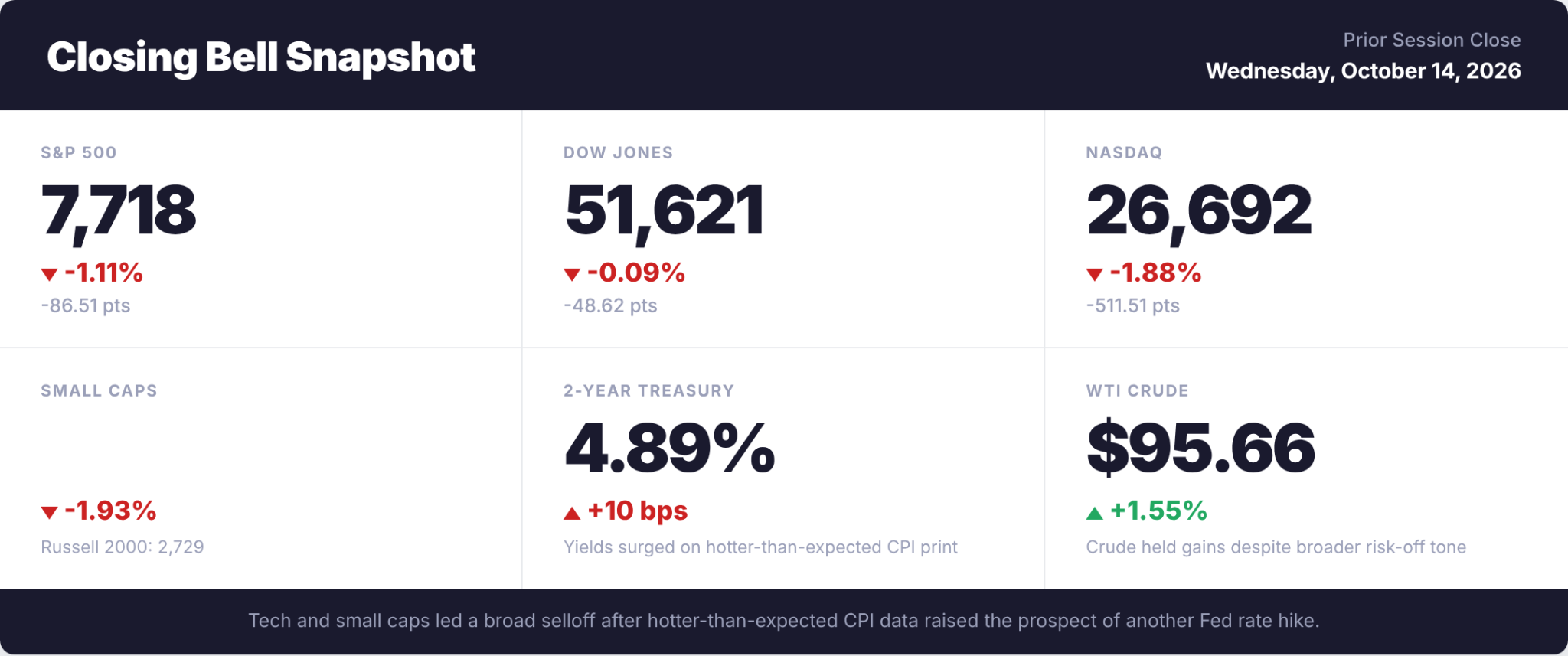
1. Core prices ran hot. Bonds rallied anyway. September core CPI rose 0.3%, a tenth above forecasts, and headline inflation reached 3.7% from a year earlier. The 10-year yield jumped to about 5.3% after the release, then closed near 5.19%, lower on the day. Kalshi's October rate-hike contract ran from 18 cents to 55 cents on Wednesday morning and was back near 27 cents early Thursday. The Fed's Beige Book found higher oil prices in every District's report and said spending in more than half of them is being carried by high-income households. When an inflation surprise ends with lower long yields, a softer dollar and gold futures up 1.7% overnight, the market is trading growth risk, not inflation risk. This morning's producer prices will show which one the Fed has to answer. Read more
2. Berkshire paid $33. The market paid $53. Bending Spoons (BSP) agreed to sell Berkshire Hathaway 10 million new shares at $33, a 12.8% discount to Tuesday's close, raising $330 million and lifting Berkshire's stake to 4%. The stock closed up 41.2% at $53.46, about 62% above the price Berkshire is paying. The money is modest for a company of this size. The endorsement was priced as anything but. Bending Spoons grows by buying software businesses and says the cash adds flexibility for more deals. Investors paid up for a Berkshire seal on a serial acquirer. Berkshire still got the better entry.
3. Japan pays for the fabs. Washington takes 4%. GlobalFoundries (GFS) will run two new chip plants in New York funded by up to $21 billion from Japan under a U.S.-Japan initiative. GF earns construction, operating and technology fees plus a share of the plants' EBITDA, without paying to build them. Separately, the Commerce Department will receive about 4% of GF, which CEO Tim Breen says brings total U.S. ownership to about 7%. Terms aren't disclosed yet. GF guides to $0.10 to $0.15 of added earnings per share by 2027. The stock rose 4.8% while the iShares Semiconductor ETF fell 4.5%.
3 SIGNALS FOR TODAY
1. Producer prices and retail sales, 8:30 a.m. ET. Forecasts call for September PPI up about 0.5% on the month, 0.3% at the core, and retail sales up 0.3%. A hot PPI would push October hike odds back toward Wednesday's peak. Soft retail sales would confirm the Beige Book's picture of a consumer split by income and strengthen the bond market's growth read. Cleveland Fed President Beth Hammack speaks at 4:30 p.m., and Chairman Kevin Warsh speaks at the IMF meetings in Bangkok late Thursday, New York time.
2. Bitcoin is sitting on its 50-day average. Bitcoin traded near $81,100 early Thursday, right at its 50-day average, after dipping to just above $80,000 late Wednesday as Asian chip stocks slid. Spot bitcoin ETFs lost $261.4 million on Wednesday, and ether fell about 5% to a two-month low, while gold rallied. If bitcoin keeps falling on days when yields ease, the case that it trades on liquidity weakens, and the case that it trades as part of the AI risk complex gets stronger.
3. Brazil's Datafolha poll lands tonight. Quaest put Flávio Bolsonaro at 46% and President Lula at 44% on Wednesday, inside its two-point margin. Polymarket's Flávio contract slipped from 85.05 cents to about 82.6 cents overnight, though the timing doesn't line up neatly with the poll. Datafolha publishes around 5:30 p.m. ET, ahead of Sunday's debate and the Oct. 25 runoff. An 83-cent favorite in a race the polls call close has room to reprice either way: another tie tests the market's confidence, while a clear Flávio lead would vindicate it.
7 Stocks That Could Become the Market’s Next Giants
Apple, Google, Tesla…
Sure, they’re household names now, but these companies and the other members of the original Magnificent 7 didn’t start out obvious.
They earned their place over time.
Our analysts believe the next generation of market leaders is forming now…
And we’ve identified the 7 companies that fit the “Magnificent” pattern.
You can see the full list for free today
Don’t wait until everyone’s talking about them.
The Sip
The demand side has never looked better
Start with the suppliers, because their message was unambiguous.
ASML (ASML) said its planned capacity for 2027 and 2028 "will not fully meet the demand of our customers," even after a planned 30% increase for 2027. Some customers already want to order for 2029 and 2030.
Overnight, TSMC (TSM) beat its own revenue forecast, lifted net income 68.7% to a record, guided fourth-quarter sales about 14% higher at the midpoint and called AI demand "extremely robust." Read more
If the bear case were collapsing orders, this was the week it should have died.
It didn't. Nasdaq futures were down more than 1% early Thursday, after the Nasdaq and S&P 500 posted their biggest one-day drops since July.
The price of money moved first
The selling wasn't really about orders. It was about credit.
Oracle's (ORCL) five-year credit default swaps jumped 26 basis points on Wednesday to a record 288, according to S&P Global Market Intelligence. CoreWeave's (CRWV) swaps pushed past 1,000 basis points, LSEG data show. The company owes nearly $50 billion, and its 2032 bonds traded at 77 cents on the dollar. Its shares fell 15% on Wednesday. Even Amazon, Alphabet, Meta and Nvidia saw default insurance hit record wides, though at far lower levels.
Then Asia opened. Korea's Kospi fell about 7.6% and tripped circuit breakers. SK Hynix dropped about 11%, and Samsung more than 9%.
The headline says AI stocks sold off. The tape says something narrower: the market started charging more for AI exposure that runs on borrowed money.
The funding window has been closing for weeks
Wednesday didn't come out of nowhere. It was the loudest day in a pattern that has been building.
Broadcom CEO Hock Tan said on Monday that capital "might be the biggest constraint" on AI. A $5 billion loan for Volta Infrastructure, an AI cloud startup with no operating history, was relaunched at about 11%, wider than an earlier attempt. JPMorgan and Goldman Sachs underwrote only $1.3 billion of it. Several big banks are reportedly exploring risk transfers on data-center loans as they near internal AI exposure limits.
The exits are narrowing too. Blackstone (BX) and CPP Investments' AirTrunk shelved a roughly $1.5 billion Singapore trust listing until next year, and last week Nvidia-backed Firmus dropped a planned $5 billion Australian IPO.
What is Elon Building in Texas?

Elon's mysterious Texas project will be 3X the size of Central Park… Cost $122 billion to build… And singlehandedly DOUBLE American chip production. One investment (not Tesla/SpaceX) is at the center of it all.
Click here to get its name and free ticker.
This ad is sent on behalf of InvestorPlace Media at 1125 N. Charles Street, Baltimore, Maryland 21201. If you're not interested in this opportunity, pleaseclick here.
None of these is a crisis. Together they describe a buildout whose cost of capital is rising faster than its revenue can be proven.
Venture is still paying peak prices
Here is the contradiction worth sitting with.
On the same day CoreWeave's bonds traded at 77, AI cloud startup Modal raised $750 million at a $15.75 billion post-money valuation, led by Accel. That is more than triple the $4.65 billion it was reportedly valued at in May. Modal says it recently crossed $1 billion in annualized run rate, which would put the round at roughly 16 times that figure.
The two businesses aren't identical, so the comparison isn't clean. But they sit on the same demand curve. Venture equity is pricing the upside of AI compute. Public credit is pricing the cost of failing to pay for it. Private marks are usually the last to move, which is why the gap matters.
Why the bond market cared more than the CPI
This is the chain that connects Mover 1 to The Sip.
Higher rates raise the hurdle for debt-funded data centers. Wider spreads slow the projects that depend on them. Slower projects mean fewer orders for the suppliers that just said they are sold out. Reuters framed Wednesday's selloff the same way, as rate-hike fears colliding with debt-funded AI buildouts. And because AI spending has been a pillar of U.S. investment, a funding squeeze becomes a growth problem. Jefferies economist Mohit Kumar put it directly: "A slowdown in the AI infrastructure build-out would imply a sharp slowdown in US growth expectations."
That's the read the bond market made on Wednesday. A Fed that hikes into a credit squeeze in the economy's main capital-spending engine is tightening twice.
What would settle it
ASML's shortage describes orders today. Financing decides how many of those orders get built. TSMC's own language points the same way: record results now, "prudent" planning for 2027. Its 2027 capital spending plan, usually given in January, is the cleanest test of whether caution reaches the order book.
Until then, the scoreboard is in credit. If spreads stabilize while orders hold, this was a repricing. If deals like Volta's keep clearing only partially and listings keep slipping, the constraint is real, and the companies that fund AI from cash flow will pull further away from those that fund it with debt.
For years I ignored gold. Until I found this income play. My #1 rule has always been: if it doesn't pay income, it's not worth owning. That's why for years I ignored gold. But I just found a $15 fund that pays income investors every single Friday. It could deliver $1,127 in a single month. See here how Friday Golden Payments work.
The MarketSips Takeaway
The AI trade is splitting by how it gets paid for, not by who has demand.
Watch: Oracle's five-year default swaps near 288 basis points and CoreWeave's 2032 bonds near 77 cents. They matter more this week than either stock's opening print.
What confirms the funding thesis: more partially underwritten AI loans, wider pricing, delayed data-center listings, and suppliers that start guiding cautiously on 2027.
What breaks it: spreads tightening without help from lower rates, big AI financings clearing at full size, and a soft PPI that lets yields fall and gives leveraged builders room to breathe.
Second-order names to track: cash-rich hyperscalers versus debt-funded builders, companies like GlobalFoundries that get partners to fund their capacity, Korean memory makers, bitcoin's link to the AI risk complex, and private AI valuations that haven't repriced yet.
None of this says AI demand is fading. It says demand is no longer the only number that matters.
Until then, sip slowly!
The Market Sip Desk
Today’s reply prompt: Is the market right to price AI's funding risk before its demand risk? Hit reply and tell us.
3 STOCKS OUR SIGNAL ENGINE SAYS TO WATCH CAREFULLY
Three stocks. Three signals. Two weeks later, the story changed.
On September 2, we published three market questions around KLAC, HPE and PG&E.
Two weeks later, every one of them produced new evidence.
One company delivered record revenue and raised its outlook.
Another saw weakness spread across its entire peer group.
And in the third, a market risk that had only been showing up beneath the surface suddenly became explicit.
Yet none of these stories is finished.
That’s why we built Market Tell.
To track the signals that keep moving after the headline is gone — and show you what investors should be watching next.
We’ve put the latest analysis into a new FREE Special Report:
3 Stocks at a Major Turning Point
See what changed… what still hasn’t been resolved… and the signals we’re watching now.
Tickers: ASML