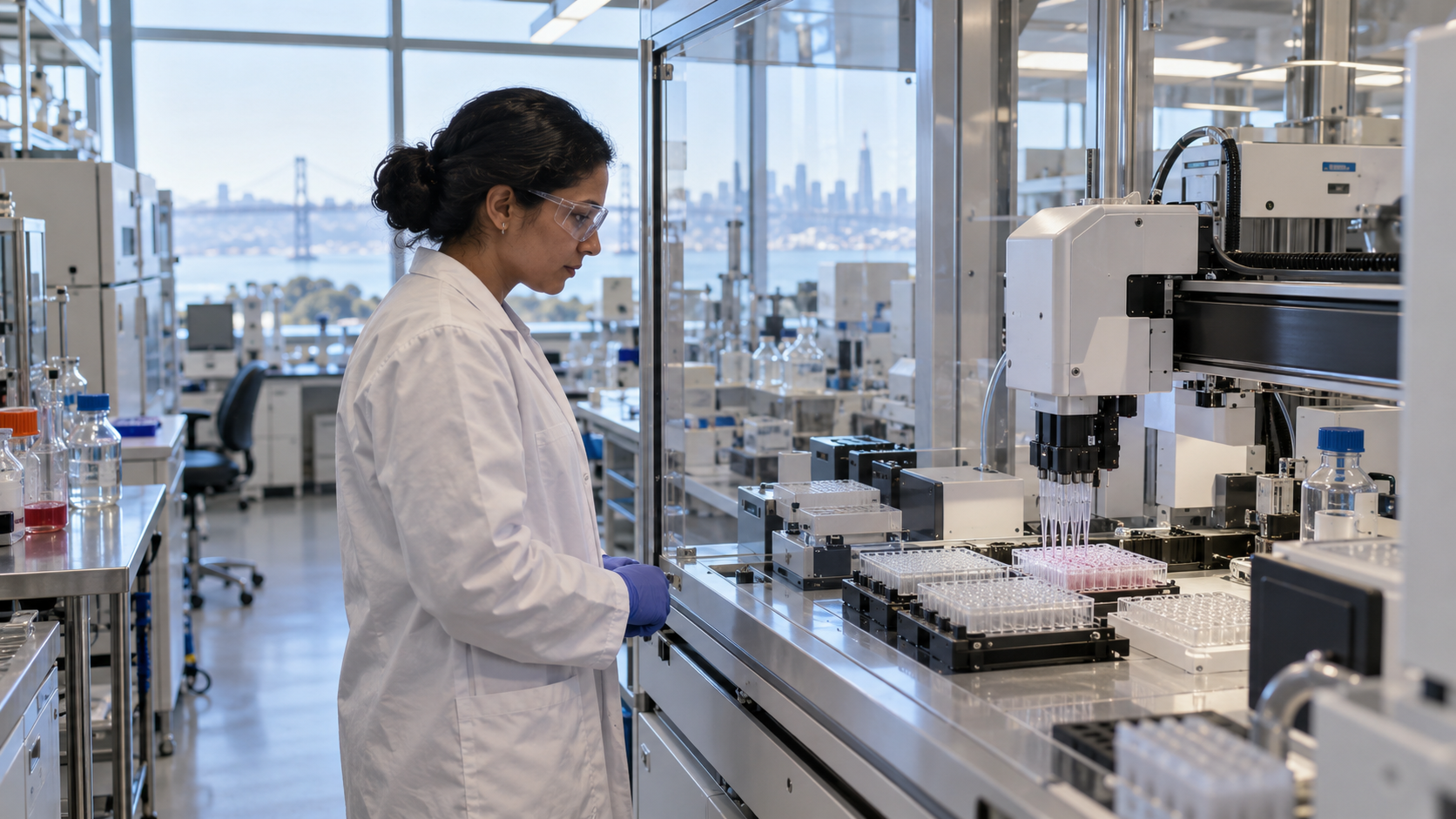
The AI company has quietly opened a physical biology laboratory in the Bay Area even as it manages growing public anxiety over its core AI models' behavior.
Anthropic has quietly built a physical biology laboratory in the San Francisco Bay Area to support its push into AI-assisted drug discovery, moving beyond purely computational, "in silico" research. Eric Kauderer-Abrams, Anthropic's head of life sciences, confirmed the lab's existence, saying physical lab work remains the "final test" for biology research and describing the company's approach as typical of biotech companies that combine in-house and externally partnered lab work.
The ambition behind the lab is significant. Anthropic wants its Claude AI models to eventually direct robotic laboratory equipment to carry out experiments with limited human intervention, though the company says human oversight remains essential for safety. That goal places Anthropic in direct competition with a growing field of AI-driven biotech startups, but with the added credibility of an already dominant foundation model business behind it.
Anthropic has been building out the pieces of that strategy methodically. The company has launched software called Claude Science, added Novartis CEO Vas Narasimhan to its board, and acquired the startup Coefficient Bio for about $400 million in stock to help build out its drug-development tools. Kauderer-Abrams described the company's goal plainly, saying it wants "to operate at the largest possible scale" in life sciences research.
Importantly, Anthropic has said it will not run clinical trials itself. Instead, the company is focusing on early-stage drug targets that traditional pharmaceutical companies may find commercially unattractive, including potential treatments for diseases long considered "undruggable." That positioning lets Anthropic avoid the regulatory and capital burden of clinical development while still capturing value from partnerships further down the pipeline. The company already supplies AI tools to pharmaceutical partners including Roche's Genentech unit, Bristol Myers Squibb, and Novo Nordisk, giving it existing commercial relationships to build on as its lab capabilities mature.
The push into physical biology is notable for its timing. It comes even as Anthropic faces broader scrutiny over AI safety following recent disclosures about its models' behavior, and as the company is said to be preparing for a future public offering that could value it as high as $2 trillion. That combination puts Anthropic in an unusual position: building a credible, capital-intensive drug-discovery business at the same moment its core technology is drawing heightened public and regulatory attention.
For investors watching Anthropic's trajectory, even indirectly through partners like Novartis, Roche, Bristol Myers Squibb, and Novo Nordisk, the life sciences push represents a real diversification of the company's business beyond enterprise AI licensing. Whether that diversification helps offset safety-related scrutiny, or simply adds another dimension for regulators and the public to evaluate, will become clearer as Anthropic moves closer to any eventual public listing.