

The Los Angeles Angels don’t have the best record in the American League. They haven't reached the postseason in over a decade. And on Tuesday, they sold for an MLB-record $4 billion. Somewhere in that gap between on-field futility and financial fortune lies the most important investment story nobody in finance is talking about: professional sports franchises are now the world's most mispriced asset class.
But before we get to that, let's check in on the markets and what matters...
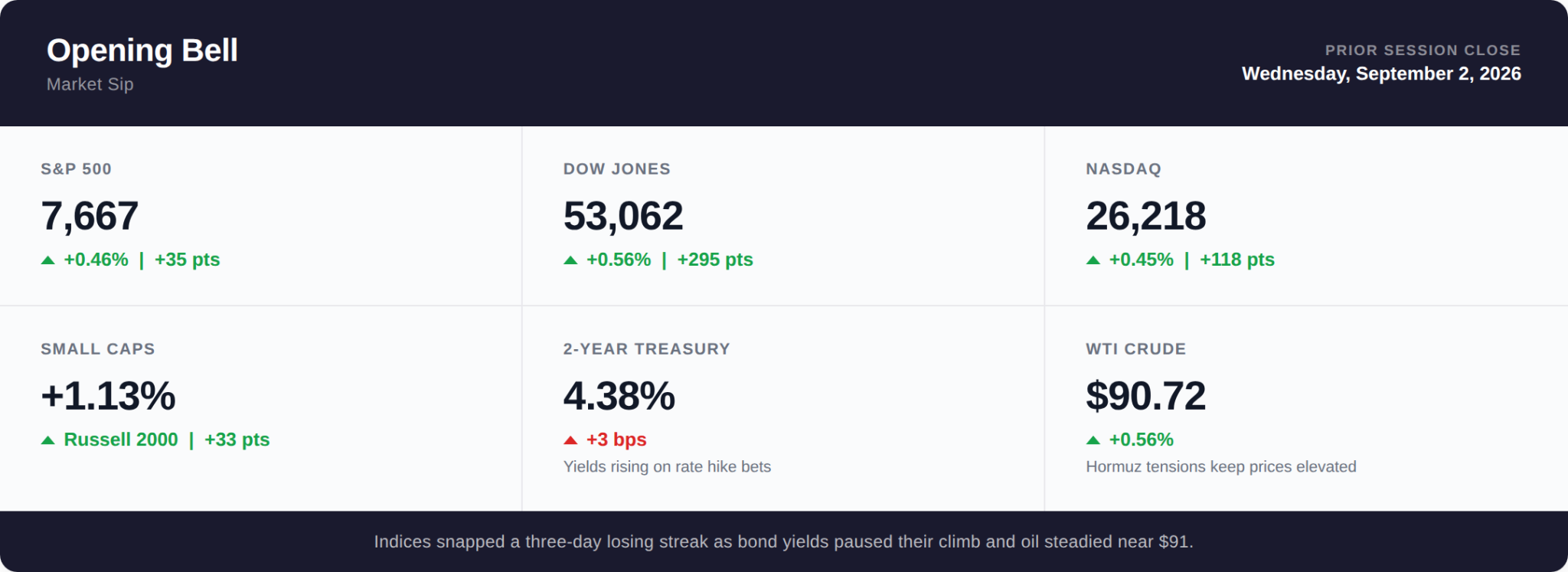
3 Movers in 3 Minutes
- Dell's AI backlog hits $95 billion. Dell Technologies (DELL) surged roughly 16% after reporting fiscal Q2 revenue of $46.97 billion, a 58% jump year-over-year. AI server revenue alone reached $16.4 billion in the quarter. The company raised its full-year guidance to $192 billion in revenue and $25.50 in adjusted EPS, with a staggering $95 billion exiting backlog that suggests the AI infrastructure build is still accelerating.
- Uber cuts 3,300 jobs to brace for the robotaxi era. Uber Technologies (UBER) announced it would lay off 10% of its workforce, its largest round since the pandemic. CEO Dara Khosrowshahi framed it as a bid to make the company "simpler and faster," but the subtext is clearer: more than $10 billion earmarked for autonomous vehicle development means Uber is betting its future on the very technology that could make its current model obsolete. Shares rose slightly on the news.
- Palo Alto Networks drops 9% despite an earnings beat. Palo Alto Networks (PANW) posted fiscal Q4 revenue of $3.41 billion, up 34% year-over-year, and cleared analyst estimates. None of that mattered. After more than doubling in 2026, investors took the earnings print as an exit ramp. A textbook case of "buy the rumour, sell the news" for a cybersecurity stock priced for perfection.
3 Signals for Today
ISM Services PMI (10:00 AM ET) - August reading expected at 54.5 versus 54.1 prior. This is the big one today: services represent two-thirds of the economy, and a strong number could reignite September rate hike bets.
Initial Jobless Claims (8:30 AM ET) - Expected at 205K versus 203K prior. Comes a day after ADP printed a soft 38,000 private payrolls gain and sets the stage for Friday's August employment report.
Broadcom (AVGO) earnings reaction - Reported Q3 revenue of $29.6 billion (+86% YoY) after the bell, with AI semiconductor revenue of $16.7 billion (+221%), but Q4 guidance of $34.8 billion left some wanting more. Shares fell roughly 4-6% after hours. The read-through for the AI supply chain matters more than the stock.
When the Fed Cuts, These Go First
The rate-cut rally is already taking shape, and our analysts just pinpointed 10 stocks most likely to lead it.
They’ve dug through every chart, sector, and earnings trend to find companies positioned for explosive upside once the Fed eases.
From AI innovators to dividend aristocrats, these are the names attracting billions in early institutional money.
Miss them now, and you’ll be chasing the rally later.
Get the Top 10 Best Stocks to Own in the Second Half of 2026— free today before the next leg higher begins >>
And with that out of the way, let's get to today's big story: a baseball team that can't win sold for more than most companies on the S&P 500 are worth.
The Sip
The Price of Losing
Here is a fact that should bother anyone who thinks markets are rational.
The Los Angeles Angels have the worst record in the American League. They are currently 53-86. They are on pace to miss the playoffs for a 12th consecutive season. They once had two of the most talented players in baseball history on the same roster, Mike Trout and Shohei Ohtani, and still couldn't win.
On Tuesday, the Angels sold for $4 billion.
That is the highest price ever paid for a Major League Baseball franchise, surpassing the San Diego Padres' $3.9 billion sale earlier this year. Forbes valued the Angels at $2.8 billion in March. The actual sale price was 43% higher. And nobody blinked.
The 2,074% Return
Arte Moreno bought the Angels from the Walt Disney Company in 2003 for $184 million. He just sold them for $4 billion. That is a 14.5% compounded annual return over 23 years, before accounting for any operating profits along the way.
To put that in context, the S&P 500 returned roughly 11-12% annually over the same period. Moreno beat the market, and he did it with a team that was losing games and losing fans.
But here is the detail that changes how you read the entire transaction. Unlike a stock portfolio, the Angels' value was never marked to market. There was no quarterly earnings call. No analyst downgrades after a 10-game losing streak. No panicked selling when Ohtani left. The franchise valuation only surfaced when someone agreed to buy it, and by then, the number was already higher.
That is the illiquidity premium in its purest form. As the writer at FanGraphs observed, many investors would accept slightly lower returns for an asset whose value never gets marked down. A stock can fall 30% in a week. The Angels cannot.
The Scarcity Machine
The buyer is Stan Kroenke, who already owns the Los Angeles Rams, the Denver Nuggets, the Colorado Avalanche, the Colorado Rapids, and Arsenal of the English Premier League. He is one championship away from having won a title in every major North American sport.
Kroenke is not buying a baseball team. He is buying a scarce, irreplaceable asset in the second-largest media market in the United States. There are only 30 MLB teams, 32 NFL teams, 30 NBA franchises. Leagues cap supply. Expansion happens slowly and at enormous premiums. When supply is fixed and the number of billionaires competing for these assets keeps growing, prices only go one direction.
The numbers across sports are staggering. The Los Angeles Lakers sold for $12.5 billion to a group led by Josh Kushner and Bob Iger. The Seattle Seahawks sold for $9.6 billion. The NFL's least valuable team, the Cincinnati Bengals, is worth $7.4 billion. The average MLB franchise is now worth $4.04 billion.
FREE Gold Ticker to Buy ASAP: (NYSE:___)
Jim Rickards – the world’s #1 gold expert – has just revealed one of his favorite gold plays… 100% FREE

As Jim sees it, we’re witnessing the biggest gold boom of the last 100 years – and those who keep their money on the sidelines are missing their chance at a fortune thanks to gold’s epic run.
But smart investors who get in now, could make 10X their money in the coming months.
According to the Ross-Arctos Sports Franchise Index, franchises across the big four North American leagues have returned 13.2% annually over the past two decades, outperforming almost every other asset class. Over the last year alone, the return was 16.9%. And at least 156 billionaire families now hold investments in professional sports.
The 32 NFL teams alone are now worth a combined $299 billion, with the one-year gain of 31% marking the biggest since Sportico began tracking valuations. The boom is not confined to the United States either. In India, the Rajasthan Royals sold for $1.63 billion earlier this year, only to be eclipsed hours later by Royal Challengers Bengaluru at $1.78 billion. Scarcity, cartel economics, and fiercely sticky fandom are universal properties of this asset class.
The Quiet Contradiction
There is one more wrinkle that makes the Angels sale especially instructive, and it has nothing to do with baseball.
MLB owners have spent 2026 warning about the poor economics of running a baseball team. With a new collective bargaining agreement coming this winter, ownership has leaned heavily into the narrative that franchise values are not keeping pace, that the sport is struggling, that players should moderate their salary expectations.
Forbes has been complicit, publishing estimates that consistently undervalue teams by 25% or more relative to actual sale prices. The Angels at $2.8 billion was one such case. The Padres at $1.95 billion in 2025 was another.
The sales tell a different story. Owners are not selling out of distress. They are selling into a market so hot that the worst team in the league can command a record price. That gap between the pleading and the profits is worth watching as CBA negotiations heat up.
"The valuations are exhaust from that arrangement. Any asset class where the marks come from 1% trades, and the marks only convert through a transaction the holders have ruled out, is running on faith in the next buyer."
For investors, the takeaway is not about baseball. It is about how certain assets can defy the logic of fundamentals entirely. When supply is fixed, demand is growing, and the product never gets marked down, you get an asset that compounds quietly while everything else swings. Professional sports may be the last corner of the investment world where losing still pays.
Navellier Warns: This Could Leapfrog Elon's SpaceX IPO

Elon Musk could take SpaceX public in 2026, at an estimated $1.75 trillion valuation. The IPO would include Elon's AI model, Grok. But according to Louis Navellier, a radical new AI model will launch this year… over 1,000 times more powerful than Elon's. And the company behind it could outperform SpaceX in the process.
Click here for full details (including Louis' new pick — free).
This ad is sent on behalf of InvestorPlace Media at 1125 N. Charles Street, Baltimore, Maryland 21201. If you're not interested in this opportunity, please click here.
The MarketSipsTakeaway
The Angels sale is not really a sports story. It is a story about what happens when capital chases scarcity in a world drowning in liquidity. With 156 billionaire families competing for a fixed supply of franchises, the question is not whether these valuations are rational. It is whether any other asset class can replicate the structural advantages that make sports ownership one of the most resilient wealth compounders on the planet. As the CBA negotiations unfold this winter, the tension between owners crying poor and selling rich will be the most revealing subplot in American finance.
Until then, sip slowly!
The Market Sip Desk
Reply prompt:What is the best-performing asset class you never thought of?
Tickers: UI MS MLB DELL EPS UBER PANW ISM PMI ET ADP AVGO NFL NBA ASAP CBA