Amazon has proved that AI demand is real. It has not proved what the buildout returns.
AWS grew 36.7% last quarter, its fastest pace in 18 quarters. Operating profit rose 43%. Trailing free cash flow swung to an outflow of $7.6 billion. The stock rose anyway. Investors decided that demand visibility matters more than cash conversion. That trade holds only while AWS keeps accelerating.
The headline profit is not the profit
Net income reached $62.6 billion, or $5.75 a share. Analysts had modeled about $1.82. Those two numbers do not belong in the same sentence.
Amazon booked $53.4 billion of non-operating pre-tax income, primarily from its stake in Anthropic. That is a mark to market on an investment. It says nothing about how well Amazon sells cloud or retail. The tax line moved with it, jumping to $18.2 billion from $2.7 billion.
Operating income is the number that counts. It rose 43% to $27.5 billion.
Even that needs two adjustments. Management flagged roughly $600 million of tariff refunds in North America and about $600 million from remeasuring energy contracts, mostly inside AWS. Strip both and operating income lands near $26.3 billion, still up about 37%. Both figures came from the call rather than the release.
So the operating strength was real. The headline profit was not a measure of it.
AWS answered the bear case, but not the share question
AWS revenue rose to $42.2 billion, an annual run rate of $169 billion. Growth has accelerated five quarters running: 17%, then 20%, 24%, 28% and 37%. The unit added $4.6 billion of revenue in a single quarter.
Margins widened at the same time. AWS operating margin hit 39.4%, up from 32.9% a year earlier. Remove the energy benefit and the underlying figure sits near 37.9%. That is still real expansion. AWS now supplies about 61% of Amazon's operating profit. This is a cloud company with a retail business attached.
The beats were wide. Analysts had penciled in roughly 31% AWS growth. Segment operating income of $16.6 billion cleared a consensus near $13.6 billion.
Here is the part bulls should not skip. Microsoft reported Azure up 43%. Alphabet reported Google Cloud up 82%. AWS is the largest cloud business and it is still growing slower than both. Accelerating and gaining share are not the same thing. Evercore's Mark Mahaney and Greg Melich flagged that risk before the print, noting Alphabet's sequential dollar gains raised the odds of share shifts.
Capacity is sold before it exists
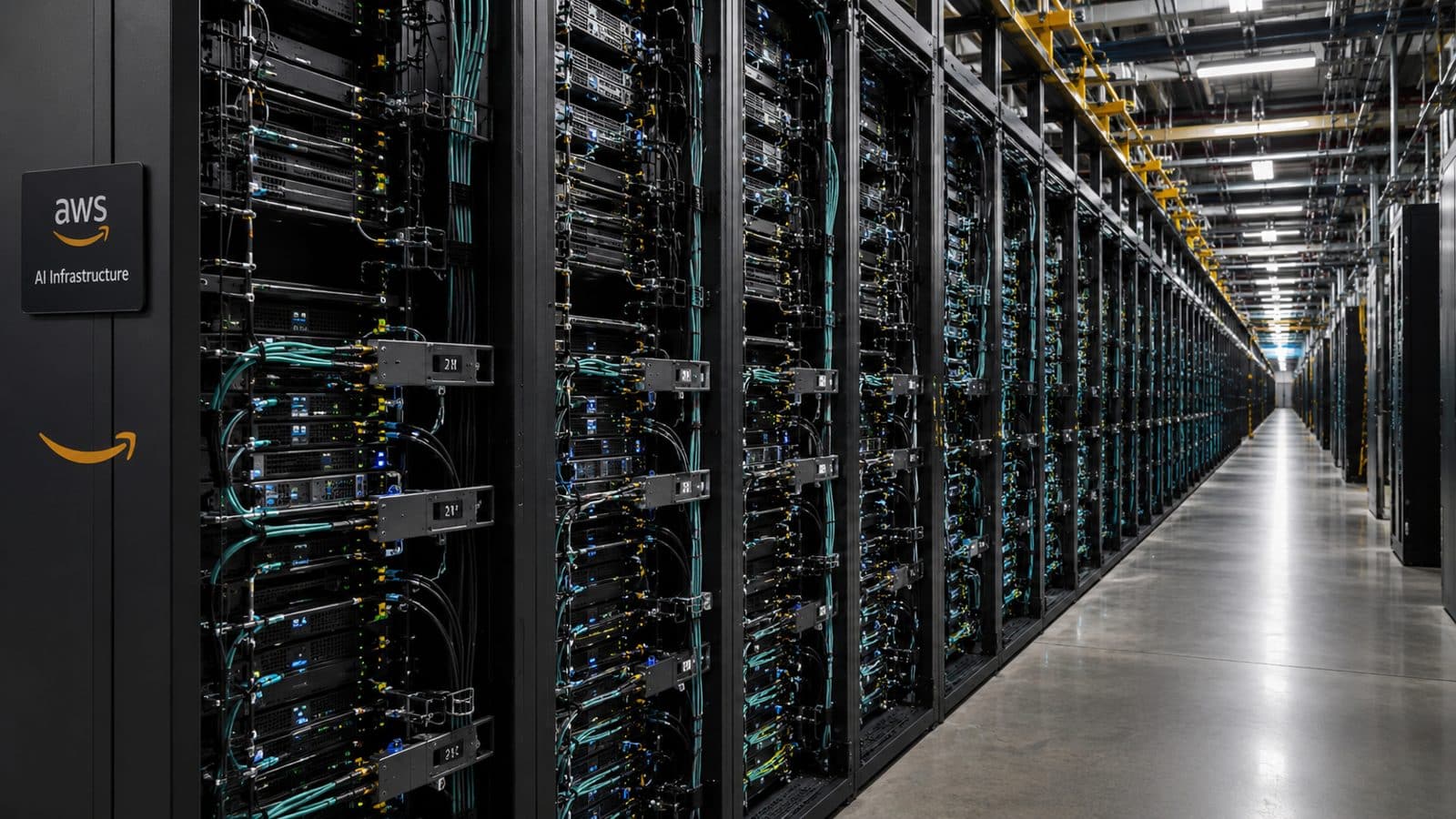
Amazon lifted 2026 capital spending to about $220 billion, up roughly $20 billion. Management still expects to leave demand unserved this year and into 2027. Higher memory prices explain part of the increase.
The bull reading is clean. Amazon is not building empty data centers. Management put the AWS backlog near $496 billion, up from about $364 billion, and said most 2027 capacity is already reserved. That lowers utilization risk. The backlog came from the call and is not a filed obligation figure.
The bear reading is that the cycle is open-ended. Spending has to keep climbing just to stop revenue slipping into later years. Constraints also hand rivals the workloads Amazon cannot host.
One dynamic deserves attention. The investment gain came from Anthropic. Anthropic and OpenAI each committed to multi-year, multi-gigawatt Trainium capacity in the same quarter. So Amazon's largest asset writeup and a slice of its future cloud demand trace to overlapping counterparties. Nothing about that is improper. It does mean one bet is showing up in two places on the financials.
Context explains the reaction. Alphabet raised capex last week and fell more than 6%. Amazon raised capex and rallied. AWS acceleration was the difference.
Cash conversion broke, and debt filled the gap
This is the clearest problem in the quarter. Trailing free cash flow swung to an outflow of $7.6 billion from an inflow of $18.2 billion a year earlier. Trailing purchases of property and equipment reached $169 billion, up 64%. The year-over-year increase alone was $66.1 billion.
That is the symmetry worth sitting with. AWS produces about $169 billion of annualized revenue. Amazon is spending about the same figure on property and equipment every twelve months.
Depreciation is following the assets. It rose 31% to $20 billion in the quarter. Servers and accelerators wear out far faster than buildings do, and that charge lands on AWS margins later.
Funding has changed too. Long-term debt nearly doubled since December, to $128.9 billion. Interest expense more than doubled to $1.3 billion. Cash fell while property and equipment climbed to $446 billion. Total assets passed $1 trillion.
None of this signals stress. Amazon still generated $161 billion of trailing operating cash flow. It does mark a shift. Amazon used to fund growth mostly from operations.
Commerce is helping carry the load. North America revenue rose 16% at a 7.9% margin, though about $600 million of that profit was tariff refunds. Advertising grew 26% to $19.8 billion and needs almost no capital behind it. International grew 15%, but its margin held flat at 4.1%. Shipping costs rose 19%, faster than the 17% gain in paid units.
What Amazon has to prove now
Third-quarter guidance looks soft and mostly is not. Amazon guided revenue to between $197 billion and $202 billion, or 9% to 12% growth. Prime Day fell in the second quarter this year and the third quarter last year. Excluding it, growth would be nearly 400 basis points higher. Currency costs another 80 basis points. Underlying growth sits closer to the mid teens.
The demand question is settled. AWS accelerated for a fifth straight quarter. The AI and chips businesses each passed a $25 billion run rate. Capacity is committed years out.
The return question is not. Amazon plans to spend about $220 billion this year, expects to turn away demand anyway, and is funding the gap with debt while free cash flow runs negative. Management's framework on asset lives is reasonable in concept. It is not quantified enough to test.
So the burden of proof has moved. Amazon no longer has to show that AI demand exists. It has to show three other things. That the gap between spending and revenue is timing rather than structure. That AWS margins hold as depreciation builds. And that free cash flow recovers while short-lived compute keeps getting replaced.
Amazon has proved the opportunity is larger than investors expected. It has not proved the opportunity preserves the economics investors used to associate with AWS.