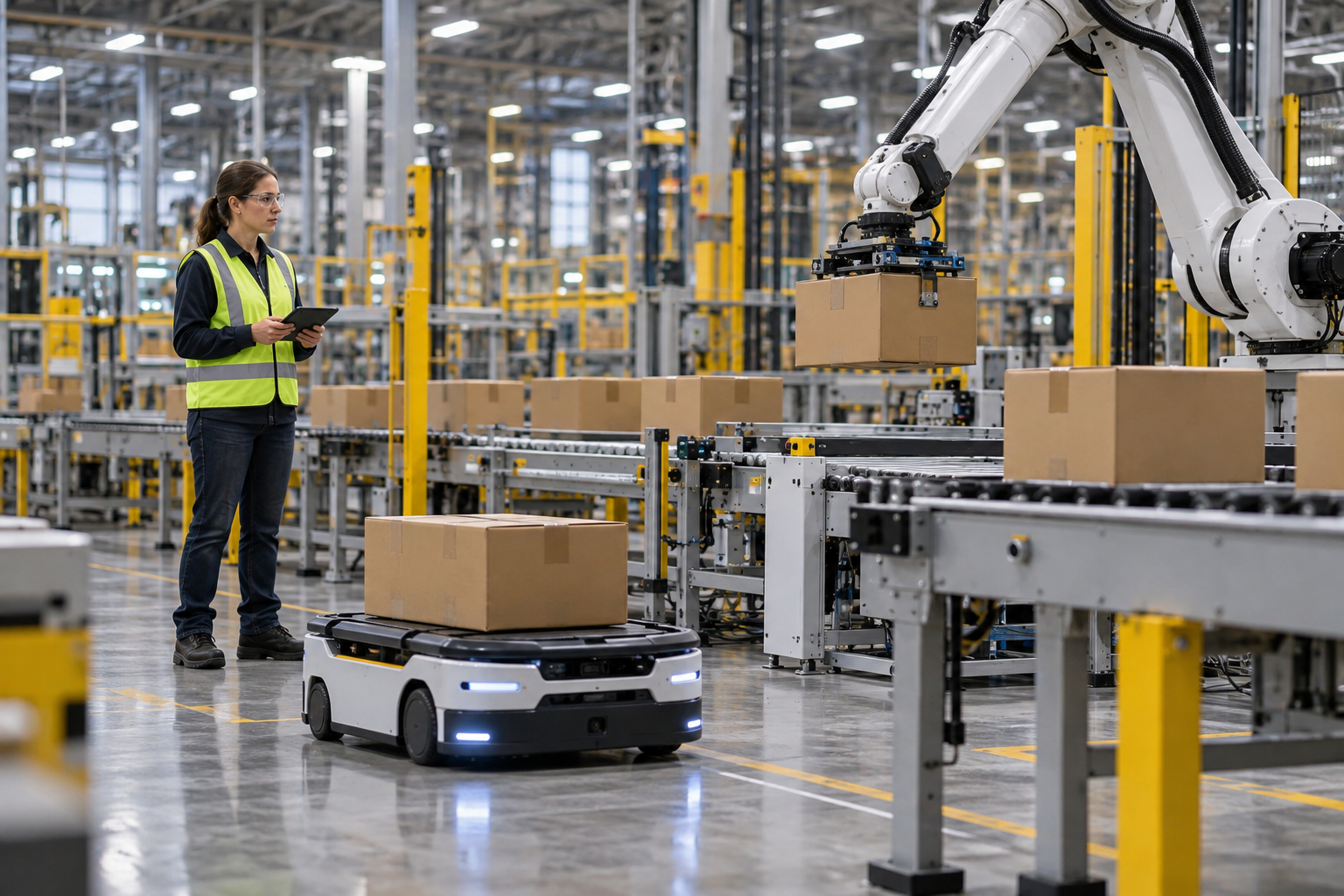
A Greenwood, Ind., plant costing more than $100 million is due by 2028. Robots already help fill three of every four Amazon orders, and the company is its own only customer for them.
Three of every four orders Amazon ships now get help from a robot somewhere along the way. The company intends to make a lot more of them.
Amazon plans to put more than $100 million into a robot factory in Greenwood, Ind., with a target opening of 2028. Together with an Austin hub disclosed last month, it will take the company from two robot plants to four. Both existing plants sit in Massachusetts, a legacy of the $775 million purchase of warehouse-robot maker Kiva Systems in 2012.
Holly Sullivan, who runs Amazon's worldwide economic development, put the fleet at more than a million robots deployed over 10 years. "In that time, we've hired hundreds of thousands of employees that work alongside those robots," she said. Amazon employs more than 1.5 million people.
Public opinion is moving the other way. Roughly 70% of American adults now expect AI to eliminate jobs over the next two decades, seven points more than two years ago, Pew Research Center found. Rosenblatt Securities analyst Scott Devitt expects AI and robotics to "shift the labor force around," adding skilled roles while possibly displacing some warehouse work.
The Indiana site is expected to bring 300 manufacturing and engineering jobs paying close to $100,000 a year on average. At that headcount, Amazon is spending more than $330,000 per job. Sullivan cited Indiana's manufacturing base and Amazon's existing presence there, as well as a tax abatement the site's previous developer had already negotiated.
Amazon does not sell the machines. Everything the plants turn out goes into its own network, which now spans more than 300 facilities with robots on the floor. The product line ranges from Sparrow, an arm that sorts and consolidates inventory ahead of packing, to Proteus, a round, self-driving robot that hauls carts of packages weighing about 900 pounds.
The company's case for automation rests on safety and job quality. It says robots have helped reduce its rate of recordable injuries by more than 40%, and it recently lifted starting pay for full-time U.S. operations staff to $20 an hour. Joseph Quinlivan, who leads fulfillment technology and robotics, said workers who were wary of Proteus came around fast "because very quickly they saw how they behaved and they saw there was no incidents."
For investors, owning robot production suggests Amazon expects to deploy machines at a pace that justifies building its own supply chain for them. The 75% figure is the one to follow as Greenwood and Austin come online: how much higher it goes, and how fast, will show how far the company intends to take automation inside its warehouses.