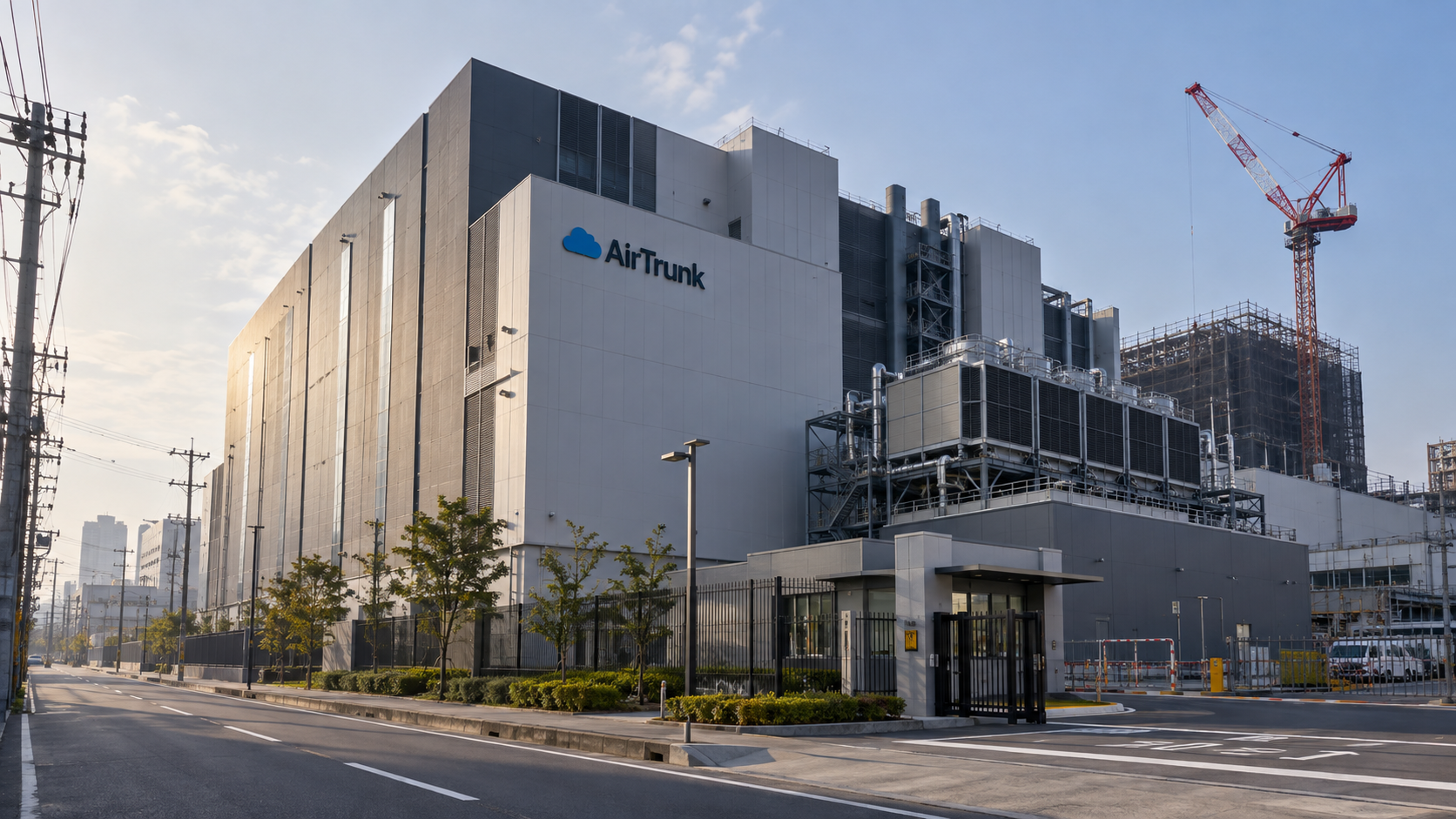
AirTrunk funded its Tokyo campus expansion with a $1 billion green loan from three Asian banks. Samsung's investment in Helix sits alongside KKR, Nvidia and Vistra.
| BX, KKR, NVDA, VST, 005930.KS
Two deals in Asia this week show how private capital is financing AI infrastructure outside the U.S., and how much of it is being matched with debt and corporate money.
AirTrunk, the data-center operator owned by Blackstone, said it will invest an additional $1 billion in its TOK1 campus in Tokyo, funded with a $1 billion green loan from Sumitomo Mitsui Banking Corp., MUFG and United Overseas Bank.
Separately, Samsung group companies will invest $1 billion in Helix, an AI-infrastructure platform launched by KKR, with Samsung Electronics contributing $500 million. KKR, Nvidia and Vistra are among the other investors.
The AirTrunk structure
The Tokyo expansion is financed dollar for dollar with debt, at least at headline level. A green loan carries terms tied to environmental criteria. The lenders are two Japanese banks and a Singapore bank, which suggests regional banks are willing to lend directly into AI capacity rather than leaving that role to private-credit funds.
The Helix structure
Helix brings together a private-equity sponsor, the leading AI chip supplier, a power producer and an electronics manufacturer that is also a major memory supplier. That mix covers capital, chips, electricity and components, the main inputs for an AI facility.
For Samsung, the investment places it as an owner in the infrastructure that buys its memory chips. That demand is visible in its own numbers: preliminary third-quarter operating profit of 107.4 trillion won, up 783%.
The contrast
The deals come as public investors in Australia push back on the price of the Firmus data-center IPO, where fund managers now expect about A$9 a share against the A$11 marketed. Private and strategic money is still committing to AI infrastructure at scale, while public-market buyers are asking for a lower entry price.
Broader Funding and Shared Exposure
One reading is that AI-infrastructure capital is broadening across Asia, with banks, large corporates and sponsors all participating, which reduces dependence on any single funding source.
Another reading is that the circularity is rising. Chip and memory suppliers are investing in the platforms that buy their products, and data centers are financed heavily with debt, so a slowdown in AI demand would reach lenders, suppliers and owners at the same time.
Next milestones
The timeline for TOK1's added capacity, the first assets Helix acquires or builds and any disclosure of the platform's total capital will show how quickly these commitments become operating capacity.