

Overnight, Schneider Electric said demand from data centers more than doubled in its third quarter. The day before, a $5 billion loan to build exactly that kind of capacity reportedly cleared only after banks cut the price to 95 cents on the dollar and handed lenders extra protections. Both things can be true. One tells you AI demand is still running hot. The other tells you what it now costs to borrow against it. Equities spent Thursday forgiving the AI credit scare. The loan market didn't. That gap is today's Sip.
But before we get to that, let's take a quick look at the markets and the three moves that set up the day.
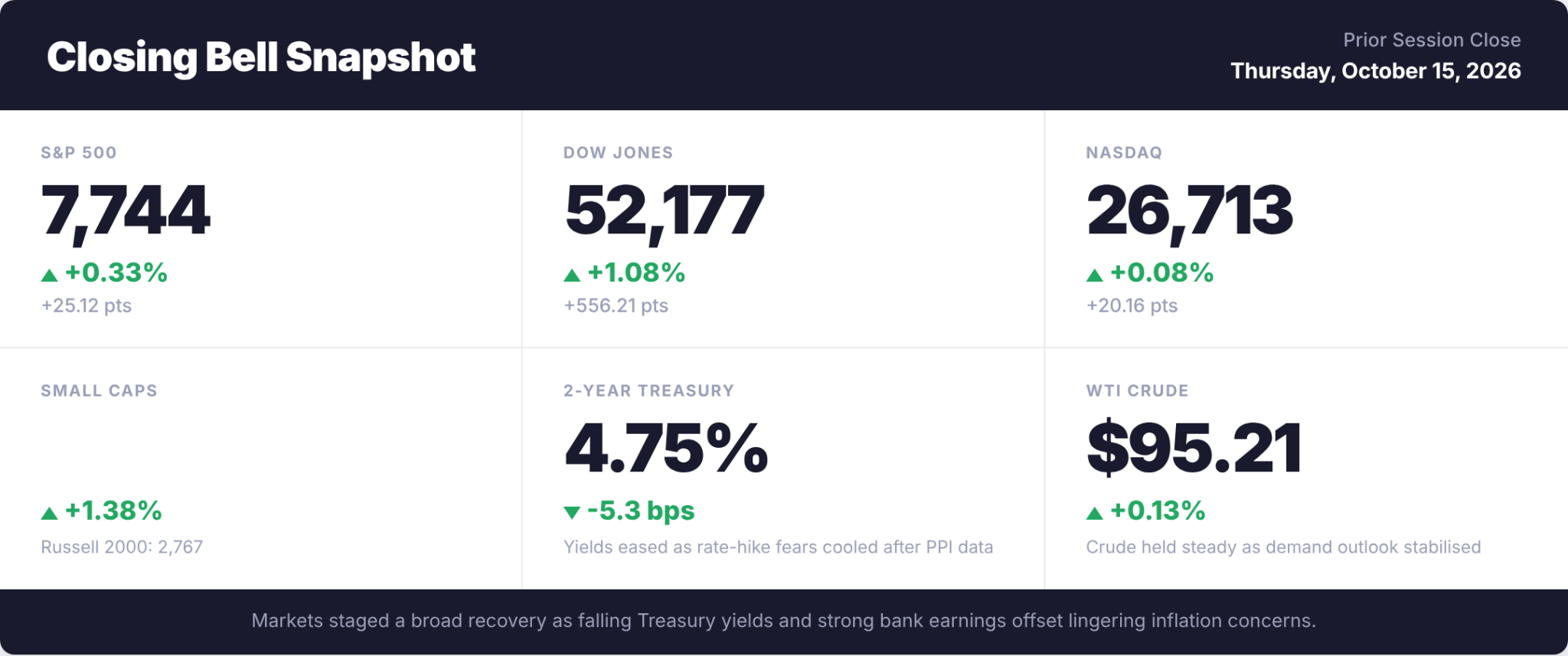
3 MOVERS IN 3 MINUTES
1. The October hike bet lost half its value while America slept. Kalshi's contract on a quarter-point Fed hike on Oct. 28 traded between 27 and 30 cents all Thursday afternoon and evening, after a week of hot inflation data that included a 1.3% jump in September producer prices. Then, around 11:30 p.m. ET, Fed Chair Kevin Warsh took the stage in Bangkok and declined to tip his hand: "I don't prejudge meetings." By 11:58 p.m. the contract was at 19 cents. It traded at 13 cents at 7 a.m. ET, and Bloomberg-cited fed funds futures pricing fell to roughly 15% to 17%. The data argued for a hike, and the 10-year yield fell 9 basis points anyway, to 5.10%. Warsh supplied no tiebreaker, and Fed speakers go quiet from Saturday.
2. KFC is swapping Pepsi for Coke, and PepsiCo shares slid within minutes. KFC U.S. said it will move its U.S. beverage business to Coca-Cola starting in January, with Coke in every U.S. restaurant by spring 2027. That covers 3,718 U.S. locations, according to Reuters. KFC has poured Pepsi since PepsiCo bought the chain in 1986. PEP shares fell within minutes of the Wall Street Journal's 3:16 p.m. report and closed down 0.69% on a day consumer staples rose 0.72%. By our arithmetic, that shed roughly $1.6 billion of market value between the report and the close. Nobody disclosed what the contract is worth. PepsiCo told Reuters it just renewed Taco Bell for 10 years and KFC outside the U.S. KO, the winner, closed up just 0.24%. The market reacted to the signal more than to any number anyone had seen.
3. Bitcoin-treasury stocks got a deadline and a price tag on the same night. After Thursday's close, MSCI adopted rules that bar "non-operating" companies from its global indexes, with a final list of affected stocks due Nov. 11 and changes effective at the Nov. 30 close. An earlier MSCI test run had flagged Strategy and Metaplanet. MSTR, which rallied 5.6% in the regular session before the announcement, slipped about 2% in thin after-hours trading, while Metaplanet rose 4.5% in Tokyo. Hours later, Strive (ASST) priced an upsized $630 million sale of 15% perpetual preferred stock at $90 against a $100 stated value. That works out to an effective yield of about 16.7% before fees, with bitcoin purchases among the stated uses. Index demand just got a deadline. The alternative funding channel costs almost 17%.
3 SIGNALS FOR TODAY
1. Varonis trades for the first time with a $49.75 bid on the table. After Thursday's close, Thoma Bravo's Proofpoint agreed to buy VRNS for $49.75 a share in cash, a deal valued at about $6.3 billion. The company is leading with a 52% premium to its June price. Thursday's $47.34 close puts the premium closer to 5%. A year ago the stock closed at $63, the day before it lost nearly half its value. Overnight indications sat near $48.50. Watch the spread in the first session. A tight one says investors see a done deal and no rival bidder. A wide one says they doubt the regulatory timeline, with closing not expected until the first half of 2027. The deal terms favor holders on one point: Proofpoint owes a $423.3 million fee if specified closing failures occur, twice what Varonis would owe to walk.
2. Regional banks show how much a 5% 10-year costs. Truist reported this morning and took a $1.4 billion pre-tax loss repositioning its available-for-sale securities. The loss cost 90 cents a share. GAAP earnings were 56 cents, against $1.16 adjusted. M&T, Citizens and Regions are also scheduled to report this morning. On Thursday, PNC said its unrealized losses grew by about $2.4 billion in a single quarter. Watch whether investors reward banks for taking bond losses now or punish the hit to capital. Truist's CET1 ratio slipped to 10.7% from 10.9%.
3. The last data before the Fed goes quiet. September import prices land at 8:30 a.m. ET, and industrial production follows at 9:15. This is the final economic read before the Fed's pre-meeting blackout begins Saturday. With the October contract at 13 cents, the asymmetry is clear. A hot import-price print revives a bet the market just abandoned, while a soft one lets Warsh's silence stand as the answer.
Investing In The Titans of AI

Carnegie didn't invent steel. He used new technology to produce it cheaper and faster than anyone on Earth.
Rockefeller didn't discover oil. He used industrial machinery to refine it more efficiently.
Vanderbilt didn't build the railroad. He understood that whoever controlled the infrastructure controlled the economy.
Their combined fortunes were between $700 billion and $1 trillion.
Best-selling financial author Alexander Green has identified three companies positioned to be the Titans of the AI age.
CLICK HERE TO FIND OUT WHO THEY ARE BEFORE THE WINDOW CLOSES
The Sip
Volta's $5 billion AI loan found its buyers. The buyers set the terms.
According to Bloomberg, citing people with knowledge of the matter, JPMorgan and Goldman Sachs sold the package Thursday at 6.5 percentage points over SOFR and a price of 95 cents on the dollar. That is the wide end of the 6.25-to-6.50-point range in price talk, and two to three points cheaper than the 97 to 98 cents first floated. Buyers also won added protections and a prepayment penalty, and the yield came in past the 11% the banks had floated. JPMorgan declined to comment. Goldman and Volta didn't respond.
The deal cleared. How it got there matters more.
Two loans in one wrapper
The package is really two different risks. About $1.3 billion is a first-lien term loan that the two banks underwrote. It backs lease payments to BTDR (Bitdeer) at a data-center campus in Norway. The other $3.7 billion buys roughly 36,000 Nvidia chips, and the banks did not underwrite it. The debt is unrated, which keeps out most CLOs, the biggest buyers of leveraged loans.
The banks committed their own balance sheet to the piece backed by a lease and left the piece backed by chips for the market. Then the market set the price. Pricing moved one way the whole time. The package was pitched at about 5 points over SOFR in September, widened to 6.25 to 6.50 this month, and then cleared at the widest level with a deeper discount.
Demand isn't the question
The easy explanation is that lenders are losing faith in AI demand. This week's evidence doesn't support that.
Schneider Electric, which sells the power and cooling gear inside data centers, reported record third-quarter revenue and raised its 2026 targets for the second time this year. Its CEO described "triple-digit demand growth" from data centers in the quarter. TSMC posted a record quarter on Thursday and guided higher again. And Bloomberg has reported, citing people familiar with the matter, that the Norway site's end customer, Anthropic, has a six-year compute agreement there.
So the demand looks strong and the tenant looks strong, and the loan still needed a discount to clear. Bloomberg reported that investors balked at an unrated loan of this size from a first-time borrower, in a volatile week. The structure adds a second clue. The banks committed their own balance sheets only to the lease-backed piece and left the chip-backed piece to the market.
Louis Navellier: My #1 AI stock for 2026 (name & ticker inside)

"I want to give you a free stock pick today. This company's sales are up 28% year over year. It holds over 30,000 patents in wireless and video technology. And it just earned an A-rating in my proprietary Stock Grader system. That's the same system that helped me flag Nvidia back in 2005 — before its 82,000% run. In fact, this system has identified the top-performing S&P 500 stock for 12 years running. Over the years, it has cost me $9 million to build and maintain. And right now, it's flashing its highest possible rating on this AI play." — Louis Navellier Click here to see which AI stock my $9 million system is flagging right now, free.
This ad is sent on behalf of InvestorPlace Media at 1125 N. Charles Street, Baltimore, Maryland 21201. If you're not interested in this opportunity, pleaseclick here.
Stocks forgave. Credit kept the receipt.
The pricing landed in a week when the market had two moods. CRWV stock bounced 5.9% Thursday off a 52-week low, and the Nasdaq erased a 1.4% intraday drop to close higher. CoreWeave's credit didn't bounce with it. Its five-year default swaps later stood near 1,038 basis points after topping 1,140 intraday Thursday, according to CNBC, and its bonds due 2032 had traded around 77 cents on the dollar.
Rates make it worse. A spread of 650 basis points over a base rate tied to a Fed that hiked in September, with a 10-year Treasury near 5.1%, is expensive money. Everything built on depreciating hardware has to earn that hurdle before the hardware ages out.
What this changes
Much of the AI-infrastructure trade has leaned on one assumption: that strong demand guarantees cheap capital. Volta suggests the two have come apart. Demand can stay strong while the cost of money rises, and the gap between them falls on the borrowers in the middle. These are the neoclouds and data-center developers that don't have hyperscaler balance sheets.
That doesn't mean the money is gone. Volta found buyers for $5 billion, after all. It means the next borrower walks in knowing the market's price. An unrated, first-time borrower pays in spread, discount and protections, and the banks will commit to the lease before they commit to the chips.
What would change the read
The cleanest test is where the loan trades once it's free to trade. If it holds near 95 or climbs, buyers got paid fairly and the repricing is a one-off for a debut borrower. If it slips, the discount was too thin. The next GPU-backed financing is the second test, because terms near Volta's would set a new baseline and tighter terms would make Volta look like a peak in fear. The third is CoreWeave's default swaps. If they narrow toward the stock's rebound, credit is catching up to equities. If they don't, credit is still warning about something stocks have stopped pricing.
Middle East Conflict Lights Fuse on US Debt Bomb
America was already drowning in $38 trillion of debt, but the recent conflict in the Middle East just accelerated the timeline.
As oil spikes, a 100-year-old stock market signal that accurately predicted the 2008 and 2020 crashes is flashing a massive "Sell" on dozens of popular U.S. equities.
If you hold the wrong stocks when this debt crisis hits, it could wipe out years of gains.
Click here to see the 10 popular stocks to dump immediately
11780 US Highway 1, Palm Beach Gardens, FL 33408-3080 Would you like to edit your e-mail notification preferences or unsubscribe from our mailing list? Copyright © 2026 Weiss Ratings. All rights reserved.
The MarketSips Takeaway
Don't read Volta as a verdict on AI demand. Read it as the price of financing AI capacity for an unrated, first-time borrower, in a 5% 10-year world, when the banks will only stand behind the lease.
What to watch: the loan's first secondary-market levels against 95, terms on the next GPU-backed deal, CoreWeave's default swaps against its stock, and the 10-year against 5%.
What would confirm it: wider terms on the next neocloud financing, or credit spreads that keep refusing to follow equities higher.
What would break it: secondary trading above issue, or a GPU-backed deal that clears tighter without lease support.
Second-order: the equipment makers selling into data-center demand, Schneider and its peers, sit on the demand side of this split. The borrowers buying chips with debt sit on the funding side. This week, those two sides moved apart.
Until then, sip slowly!
The Market Sip Desk
Today’s reply prompt: If you were lending into the AI buildout today, would you rather hold the lease or the chips? Hit reply and tell us why.
3 Market Signals Most Investors Aren't Watching
The headline is usually the last place the story shows up.
By the time everyone is talking about a stock… the signals underneath it may have been changing for weeks.
• Institutional money moves.
• Options activity changes.
• Management confidence shifts.
• Fundamentals improve, or quietly begin telling a different story.
That’s exactly what our analysts found in three stocks where the evidence stopped agreeing with itself.
And in all three cases, the story is still developing.