
A supplier gave its customer a claim on its own stock to lock in an $11.6 billion deal. The AI build's money now runs both ways.
5%
The most of Akamai that Anthropic could own under a warrant tied to their new cloud deal. About 2% rests on the signed contract. The rest needs more business.
Wall Street Is Positioning Before the Fed Cuts
Billions of dollars are quietly flowing into a small group of stocks ahead of the next rate-cut rally.
Our analysts tracked the institutional money and uncovered 10 companies positioned to surge when the Fed pivots.
Some are AI leaders.
Others are dividend powerhouses built for income and upside.
Miss them now and you may be chasing the rally later.
See the Top 10 Stocks to Own in the Second Half of 2026 — free today.
Akamai won a seven-year Anthropic contract and issued a warrant with it.
Mortgage rates jumped to 7.45% on a selloff with no clear trigger. Bird borrowed $450 million from banks to pay its owners. Blue Origin raised $10 billion at a $140 billion valuation.
PMD LENS
This week PMD tracked Nvidia buying into the build its chips depend on. Thursday brought the mirror image: a supplier giving its customer a stake. Around it, rates climbed, strong borrowers chose banks and space money bet on 2030.
- Anthropic seeks 50.1% of voting power for its seven co-founders, people familiar said. Shareholders must approve the plan before its IPO.
Akamai Gave Anthropic a Claim on Its Own Stock to Win an $11.6 Billion Deal
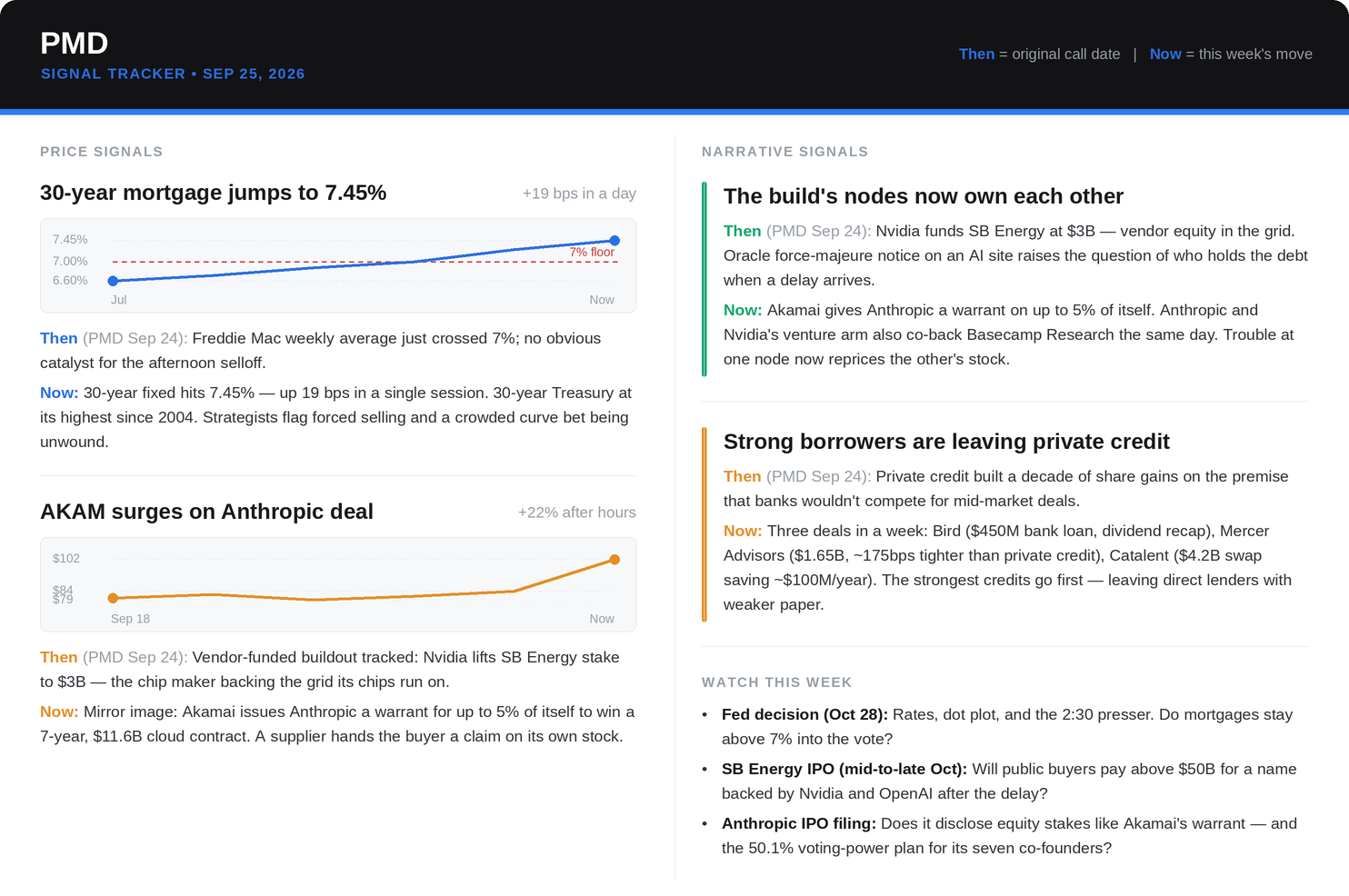
Akamai (AKAM) signed a seven-year, $11.6 billion cloud deal with Anthropic Thursday. It also issued Anthropic a warrant for up to 5% of the company. A warrant is the right to buy shares at a set price. Here the price is $111.33 a share. Those Series B shares convert into about 7.7 million common shares. Akamai rose 22% after hours.
About 2% of Akamai's stock is tied to the signed deal. The other 3% vests only if it grows by up to another $9 billion. Akamai puts capex for the first commitment at about $5.5 billion. Its 2026 capex rises about $1.7 billion for parts such as memory. It sees no change to its revenue forecast.
This week PMD tracked Nvidia lifting its SB Energy stake to $3 billion. That was the vendor funding a buildout its chips depend on. Akamai runs the other way: the supplier hands the buyer a claim on itself. The same day, Anthropic and Nvidia's venture arm backed Basecamp Research. Its models train on a gene dataset both helped develop.
The test comes when outside money has to buy in. SB Energy pushed its IPO to October. Investors had balked at a valuation above $50 billion. Nvidia and OpenAI are among its backers.
When the Customer Owns a Piece of the Supplier, the Risks Merge
Thursday's PMD tracked a force-majeure notice on an Oracle AI site. Oracle says the site remains on schedule. This morning the money under the build tangles further. Akamai's holders gave part of their upside to Anthropic to lock in the revenue. An allocator exposed to both now holds one bet twice. If one slips, the other can reprice with it.
Louis: The "Strawberry Problem" Is Stalling the AI Revolution

Billion-dollar tech investor Louis Navellier calls it "AI's darkest secret." Until AI models solve the "Strawberry Problem," they'll never create new breakthroughs in medicine, energy, or quantum computing. The good news? One company is about to solve the crisis… unleashing a new $100 trillion opportunity.
This ad is sent on behalf of InvestorPlace Media at 1125 N. Charles Street, Baltimore, Maryland 21201. If you're not interested in this opportunity, please click here.
SIGNAL 1: Mortgages Jumped to 7.45% on a Bond Selloff No One Could Explain
The average 30-year fixed mortgage rate hit 7.45% late Thursday, per Mortgage News Daily. That's up 19 basis points in a day. Freddie Mac's weekly average had just crossed 7%. The 30-year Treasury touched its highest since 2004.
Mortgage News Daily's Matthew Graham saw "no obvious catalyst" for the afternoon selloff. "Sellers decided to sell... a lot," he said. Strategists at Jefferies and MUFG point to a crowded curve bet being unwound. "The move has the hallmarks of a pain trade and forced selling," said MUFG's Derek Halpenny.
Oil explains part of the rise, maybe too much. An oil shock lifts inflation once, then fades. "It makes no sense that what happens to oil today should affect the 10-year," said Vítor Constâncio. He is a former ECB vice president.
Forced Sellers Are Setting the Price Homebuyers Pay
If forced selling drove the move, part of it could reverse once positions clear. Homebuyers can't wait for that. They lock at today's rate, and economists say more of them sit out above 7%. The AI build borrows in the same market. Fed Chair Kevin Warsh counts its borrowing among the forces lifting long rates.
SIGNAL 2: Bird Borrowed $450 Million From Banks to Pay Its Owners. That's Three Strong Borrowers Picking Banks in About a Week.
Bird, a messaging-software company, took $450 million of bank debt. JPMorgan leads, with Capital One and Citi. It's a dividend recap, so the money goes to existing owners, not growth. The term loan is $400 million. That's about 2.4 times Bird's 2025 EBITDA of $165 million.
A cash-rich private software firm is just the kind of borrower private credit courts. Bird went to banks. Last week Mercer Advisors replaced private-credit debt with a $1.65 billion bank loan. It priced about 1.75 points tighter. Catalent is swapping a $4.2 billion direct-lender loan for bank debt. It expects to save about $100 million a year.
The Best Borrowers Are the First to Leave
Three deals aren't a trend, and Bird hasn't said why it chose banks. But the direction cuts against a decade of private-credit share gains. The strongest credits have options, so they refinance first. That can leave direct lenders with weaker loans. It comes as three big funds face exit requests two to three times their payout caps.
SIGNAL 3: Blue Origin Raised $10 Billion at a $140 Billion Valuation. Its Plan Needs Revenue to Grow More Than 20-Fold by 2030.
Blue Origin has raised $10 billion in its first round open to outsiders, company documents show. The oversubscribed round values it at $140 billion. Jeff Bezos committed $2 billion to it. That lifts his total since 2000 to $30 billion.
Revenue was $800 million in 2025. The documents project about $1.4 billion this year. They see more than $30 billion in 2030. Much of that rests on launch demand. Part rests on a satellite business with no device yet in orbit. New Glenn hasn't flown since one exploded on a Florida launchpad in May.
The Price Is Set on 2030, Before the Hardware Is Proven
Blue Origin's valuation is near 100 times this year's projected revenue. The multiple only makes sense on the 2030 plan. Like AI, space money is paying now for capacity not yet built. If launches slip, the plan's 2030 slips with them.
The Closest Thing to a Virtual AI Monopoly Wall Street Is Ignoring

A little-known company is building what may be the closest thing to a virtual monopoly the AI era has ever seen.
Only 3...
Yet it beat Apple, Amazon, and the S&P 500 combined...
While paying out $146,000 in total dividends on a 1,000-share stake.
Kevin O'Leary calls what it controls a "unicorn."
Right now, it's trading at a rare discount.
>>>Whitney Tilson reveals the name, completely free.<<<
This ad is sent on behalf of Stansberry Research, 1125 N Charles St, Baltimore, MD 21201. If you would like to optout from receiving offers from Stansberry Research please click here.
- Mid-to-late October: SB Energy's delayed IPO. Will public buyers pay up for a name backed by Nvidia and OpenAI?
- Oct. 28: The Fed decides. Do mortgages stay above 7%?
- Anthropic's IPO filing: Does it disclose stakes like Akamai's warrant?
- Open: Do other suppliers offer equity to win AI contracts? Does another strong borrower leave private credit?
One build, four prices. A supplier gave up equity to win a contract. Forced sellers set mortgage rates. Strong borrowers left private credit. A space company is priced on 2030.
Thursday morning, PMD asked who can see the debt under the build. By afternoon, who holds it when a delay arrives. Akamai adds the third layer: when a customer owns a piece of its supplier, trouble at either one runs into the other's stock. The nodes of the build have stopped just lending to each other. They've started owning each other. The question was who holds the debt. Now it's who owns whom.
3 STOCKS OUR SIGNAL ENGINE SAYS TO WATCH CAREFULLY
Three stocks. Three signals. Two weeks later, the story changed.
On September 2, we published three market questions around KLAC, HPE and PG&E.
Two weeks later, every one of them produced new evidence.
One company delivered record revenue and raised its outlook.
Another saw weakness spread across its entire peer group.
And in the third, a market risk that had only been showing up beneath the surface suddenly became explicit.
Yet none of these stories is finished.
That’s why we built Market Tell.
To track the signals that keep moving after the headline is gone — and show you what investors should be watching next.
We’ve put the latest analysis into a new FREE Special Report:
3 Stocks at a Major Turning Point
See what changed… what still hasn’t been resolved… and the signals we’re watching now.